Why the Alcaraz-Sinner French Open final is among the most epic battles
The Hindu
Grand Slam finals with epic battles, historic moments, and emerging rivalries between Sinner and Alcaraz.
Grand Slam finals carry an unmistakable aura. When a Slam final stretches into a five-setter, it signifies an enthralling contest between evenly matched rivals. Add multiple tie-breakers into the mix, and the sense of parity intensifies, turning the match into an absorbing duel between superior equals. These epic battles become historic.
No fan can forget two such memorable men’s tennis finals from the recent past. The longest Grand Slam final ever in the Open Era — a gruelling 5-hour, 53-minute battle between Novak Djokovic and Rafael Nadal at the 2012 Australian Open — remains unmatched to this day. Djokers’ celebration, during which he tore off his shirt, remains etched in every tennis fan’s memory. Equally unforgettable is the memory of both the players, their legs trembling, at the trophy presentation, until someone brought them chairs.
The 2019 Wimbledon final between Djokovic and Roger Federer stood out for different reasons. Lasting 4 hours and 57 minutes, it became the first Slam final to feature three tie-breaks in the Open Era. The sight of Djokovic squatting on Centre Court and eating grass in triumph signalled not just victory, but also a poignant end to Federer’s legendary pursuit.
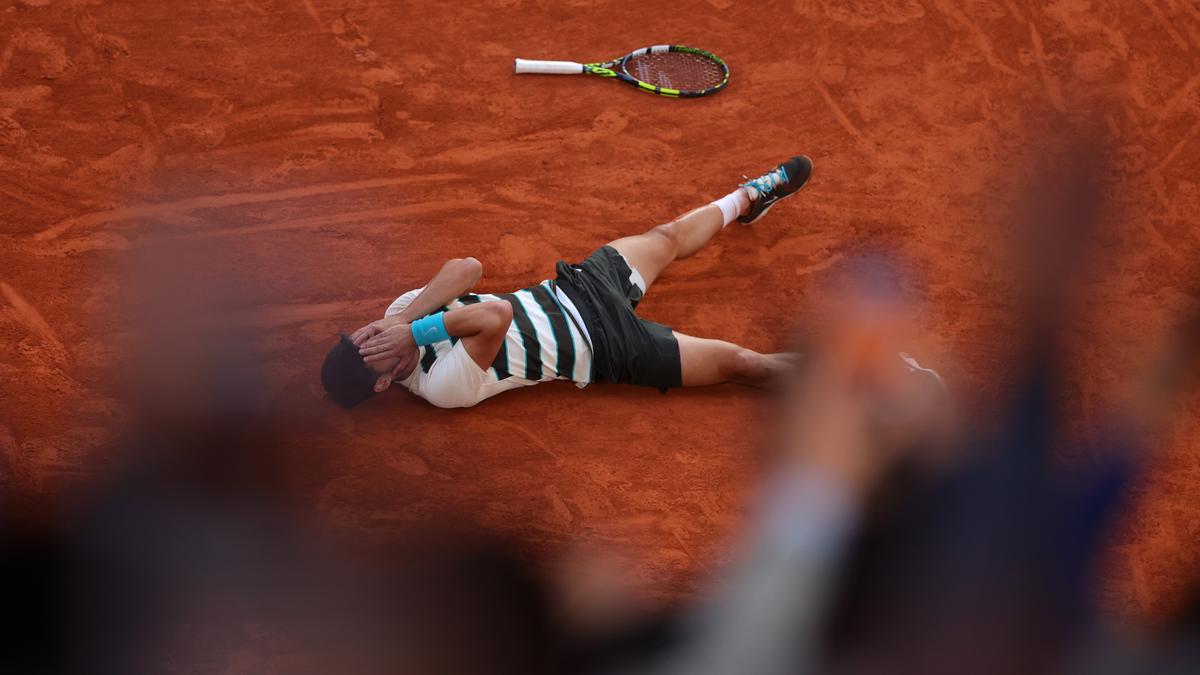
Sunday’s showdown at Roland Garros between World No. 1 Jannik Sinner and World No 2 Carlos Alcaraz has earned its place among the greatest Slam finals. Lasting 5 hours and 29 minutes, it is the second-longest Grand Slam final in the Open Era.
The chart shows the length in minutes for 122 Grand Slam Finals (data from 1991 to 2025). Each circle corresponds to a final. The higher the dots, the longer the finals. Interestingly, in recent years, matches have been relatively longer.
The gripping encounter also featured three tie-break sets — only the second time in Open Era Grand Slam finals. However, the number of tie-breaks should be viewed with caution, as rules have varied across years and Grand Slams.
The chart on the left shows the number of finals that featured three/two/ one/zero tie-break sets and the chart on the right shows the number of finals that featured five/four/three sets in the Open Era.


My target is to be in the top-30: Devika Sihag

CSK names James Foster as fielding coach

Mayank Chakraborty becomes Assam's first Grandmaster, ending a three-decade wait for the North-East in chess history.

M.S. Dhoni advises CSK rookie Prashant Veer to save money wisely as he navigates his first IPL experience.

Sanju Samson reflects on his T20 World Cup victory, sharing his excitement for the upcoming IPL with CSK.

North Zone clinches the J.K. Bose cricket title with an unbeaten run, defeating East Zone decisively at Roshanara Ground.

Jay Shah emphasizes long-term planning for India's sports future, urging collaboration for upcoming global events from 2030 to 2036.

Daniil Medvedev defeats Carlos Alcaraz, ending his unbeaten streak, and advances to the Indian Wells final against Jannik Sinner.

Shorts News:Watch: Iranian female footballers safe in Malaysia: Asian Football Confederation

Argentina vs. Spain's Finalissima in Qatar canceled due to escalating West Asian conflict, impacting pre-World Cup match plans.

Smriti Mandhana and Shubman Gill win BCCI's top awards for their exceptional performances in the 2024-2025 cricket season.

Rajnath Singh advocates for stronger public-private partnerships to enhance India's sports economy and global identity, especially in polo.

Kimi Antonelli's historic victory at the Chinese Grand Prix signals a thrilling future for Mercedes and intense internal competition.