Why is fiscal consolidation so important? | Explained Premium
The Hindu
Why was the fiscal deficit estimate announced in the recent Union Budget considered to be ambitious?
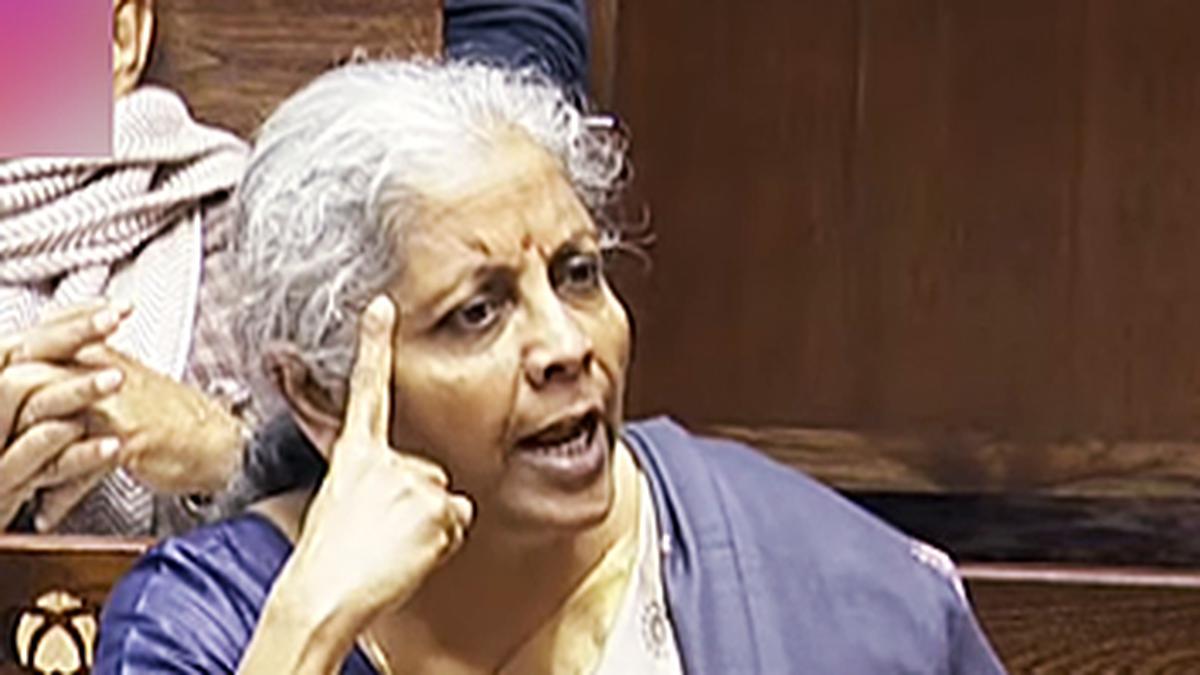
The story so far: Union Finance Minister Nirmala Sitharaman announced during her Budget speech that the Centre would reduce its fiscal deficit to 5.1% of gross domestic product (GDP) in 2024-25. She further added that the fiscal deficit would be pared to below 4.5% of GDP by 2025-26. The FM’s projections surprised most analysts who expected the government’s fiscal deficit target would be slightly higher, at about 5.3% or 5.4% of GDP. The government’s revised estimates also lowered the fiscal deficit projection for 2023-24 to 5.8% of GDP.
Fiscal deficit refers to the shortfall in a government’s revenue when compared to its expenditure. When a government’s expenditure exceeds its revenues, the government will have to borrow money or sell assets to fund the deficit. Taxes are the most important source of revenue for any government. In 2024-25, the government’s tax receipts are expected to be ₹26.02 lakh crore while its total revenue is estimated to be ₹30.8 lakh crore. The Union government’s total expenditure, on the other hand, is estimated to be ₹47.66 lakh crore.
When a government runs a fiscal surplus, on the other hand, its revenues exceed expenditure. It is, however, quite rare for governments to run a surplus. Most governments today focus on keeping the fiscal deficit under control rather than on generating a fiscal surplus or on balancing the budget.
Also read | India’s lower fiscal deficit target a ‘surprise’ – ICRA’s Nayar
The fiscal deficit should not be confused with the national debt. The national debt is the total amount of money that the government of a country owes its lenders at a particular point in time. The national debt is usually the amount of debt that a government has accumulated over many years of running fiscal deficits and borrowing to bridge the deficits. The fiscal deficit is generally expressed as a percentage of a country’s GDP since it is believed that the figure shows how easily the government will be able to pay its lenders. In other words, the higher a government’s fiscal deficit as a share of GDP, the less likely its lenders will be paid back without trouble. Countries with larger economies can run higher fiscal deficits (in terms of absolute numbers of money).
In order to fund its fiscal deficit, the government mainly borrows money from the bond market where lenders compete to lend to the government by purchasing bonds issued by the government. In 2024-25, the Centre is expected to borrow a gross amount of ₹14.13 lakh crore from the market, which is lower than its borrowing goal for 2023-24, as it expects to fund its spending in 2024-25 through higher GST collections. Economists were expecting that the Centre would set a borrowing target of about ₹15.6 lakh crore for 2024-25.
It should be remembered that central banks such as the Reserve Bank of India (RBI) are also major players in the credit market, although they may not always directly purchase government bonds. The RBI may still purchase government bonds in the secondary market, from private lenders who have already purchased bonds from the government. So, when a government borrows from the bond market, it not only borrows from private lenders but also indirectly from the central bank. The RBI purchases these bonds through what are called ‘open market operations’ by creating fresh money, which in turn can lead to higher money supply and also higher prices in the wider economy over time.


The rupee declines 20 paise to 93.73 against the dollar as global oil prices rise and investor uncertainty persists.

Siemens said on Monday that the Iran war has led to customers holding back on new investments as prices increase for raw materials and energy.

OpenAI said its close ties with Microsoft could be a potential risk to its business, telling investors that the software company is responsible for “a substantial portion of our financing and compute,” CNBC reported

LPG crisis: Alternative solutions are being considered, with ammonia cylinders being increasingly used for industrial applications amid delays in commercial LPG deliveries.

India monitors U.S. military pause on Iran as oil prices dip; External Affairs Minister engages with GCC nations for support.

India monitors U.S.-Iran tensions as Trump pauses attacks, leading to a significant drop in oil prices.

Union Minister Ashwini Vaishnaw launches three initiatives to enhance India's creative economy through AI training, citizen platforms, and advanced tech access.

Two Indian-flagged LPG tankers approach the Strait of Hormuz, navigating safely amidst regional tensions to reach Indian ports.

Gold and silver prices plummet over 7% due to West Asia tensions, inflation fears, and a stronger dollar.

Asian shares fall as rising oil prices and escalating Iran conflict diminish hopes for U.S. interest rate cuts.

Japan's SoftBank Group said Saturday it plans to build a huge new gas-fired power plant in the US state of Ohio

Silver prices plunge 9% to ₹2.06 lakh per kg in futures trade amid weak global cues and rising macroeconomic pressures.

OpenAI plans to nearly double its workforce to 8,000 from 4,500 by the end of 2026, the Financial Times reported on Saturday, citing two people with knowledge