Why is Chennai’s Karthic Rathinam building himself a cardboard house. And would you like one too?
The Hindu
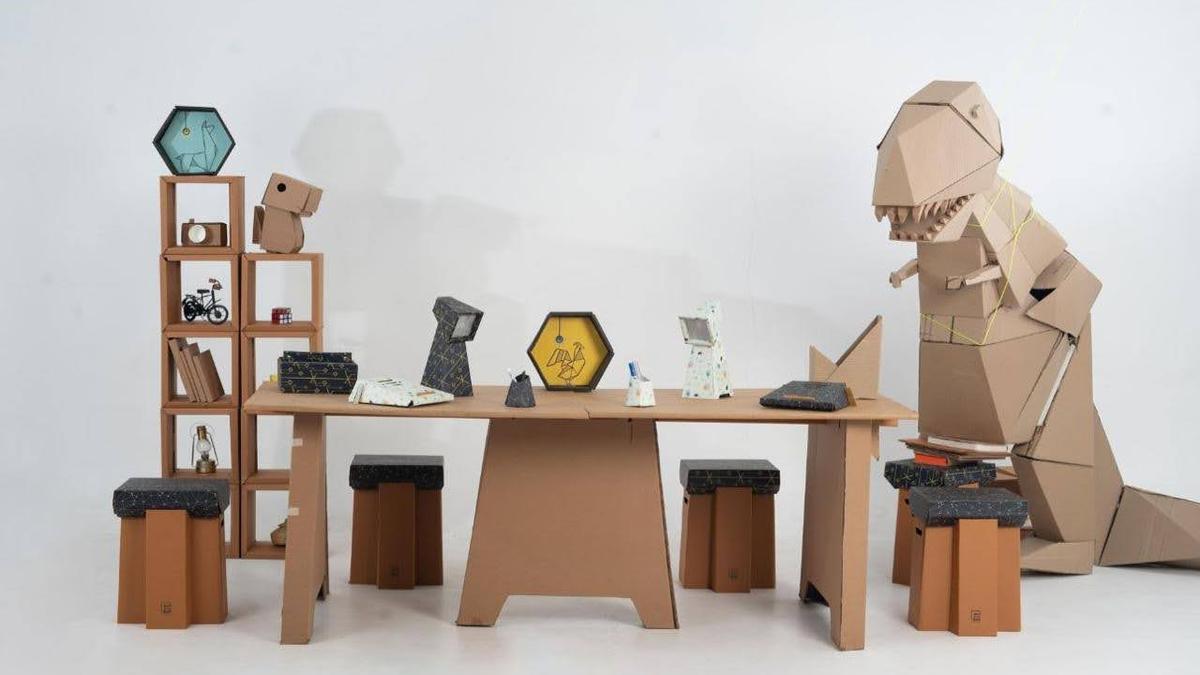
Karthic Rathinam and his team at Out of the Box craft DIY furniture, sculptures, and decor with cardboard, showcasing its potential for temporary housing, event installations, and more
When Karthic Rathinam — then a third-year product design student in Pune — moved out of his hostel into an unfurnished studio apartment, he decided to build his own furniture. “I experimented with wood, and steel, but with little money left after spending on basic living expenses, I couldn’t afford to build things with those materials,” he says, adding how cardboard boxes that held his belongings took his fancy. “That’s when it hit me. Why not try building with cardboard? I built a bed, table, chair, and shelves out of cardboard and ended up using them for six months.”
This got Karthic studying cardboard’s structure, limitations, and possibilities. In 2021, Karthic designed a cardboard-based sanitizer stand that went viral on WhatsApp. “I sold over 80,000 units initially that were deployed at Metro stations in Delhi,” says the designer, who went on to set up his firm, Out of the Box, the same year.
Now based in Chennai, Karthic began with eight products including a table, table lamp, stool, laptop stand, tabletop desk organiser, shelving options. Today, the 26-year-old and his team have branched into packaging and sculptures. They also conduct workshops in design colleges and schools.
He explains how they use high-strength corrugated cardboard sourced from specific partners. “It’s not the same cardboard that you will find in your regular parcel boxes,” he clarifies, “It’s triple-layered, very strong corrugated boards. Our furniture is designed to be lightweight yet structurally strong, and entirely adhesive-free. All pieces are DIY and use the interlocking technique. Imagine IKEA, but for cardboard,” says Karthic, adding how the material’s versatile nature makes it ideal for temporary installations such as movie sets, exhibition stalls, etc.
Their stool, for instance, can hold a weight of 300 kilograms. “How do we know this? We made six people stand atop it,” he shares. With in-depth research, the team has managed to eliminate odour, improve aesthetic with colour printing, and make the products water- and oil-resistant. “It’s not waterproof, but definitely water-resistant. Also, we are not claiming it will last you a lifetime, It will last you for a good two years, and maybe more if maintained better,” affirms Karthic. “The products are fully recyclable. You can give them to your paper mart vendors. Even if you decide to trash them, cardboard finds a way back to you in another format.”
Over the last three years, these cardboard offerings have taken the fancy of not just students and designers, but corporate clients as well. “We’ve had clients for the sanitiser stands from South Africa, Dubai and London. One of the biggest highlights was when a South African client licensed our design to distribute across 54 countries. Since cardboard has the capability to get branded or printed, we can custom products too,” says Karthic, whose Anna Nagar office has been using cardboard furniture for the last two years. “Even Startup TN [a State government initiative] has a small corner with cardboard furniture which people use on a day-to-day basis,” says the designer who has also designed life-size sculptures for events such as Madras Art Weekend and Echoes of the Earth.
Addressing challenges faced in maintaining sustainability while scaling up, Karthic says that the biggest was logistics. “At one point, shipping cost more than production. Also, while our material is sustainable, ensuring quality, strength, and water resistance at scale needs intense R&D. The lack of strong design protection laws in India has also made it difficult to prevent copycats, which hurts original creators,” he explains.


Discover Niraba, a collaboration merging Odisha's sabai grass weaving and dhokra craft into contemporary furniture and lighting design.

How do you create a Christmas tree with crochet? Take notes from crochet artist Sheena Pereira, who co-founded Goa-based Crochet Collective with crocheter Sharmila Majumdar in 2025. Their artwork takes centre stage at the Where We Gather exhibit, which is part of Festivals of Goa, an ongoing exhibition hosted by the Museum of Goa. The collective’s multi-hued, 18-foot crochet Christmas tree has been put together by 25 women from across the State. “I’ve always thought of doing an installation with crochet. So, we thought of doing something throughout the year that would culminate at the year end; something that would resonate with Christmas message — peace, hope, joy, love,” explains Sheena.

Max Born made many contributions to quantum theory. This said, he was awarded the Nobel Prize for physics in 1954 for establishing the statistical interpretation of the ____________. Fill in the blank with the name of an object central to quantum theory but whose exact nature is still not fully understood.

Join the Moms of Kochi for the Purple Carnival, a vibrant lifestyle exhibition featuring stalls, competitions, and entertainment on December 13-14.

Human-rating emerges as a crucial process ensuring that space systems like LVM-3 can safely carry humans by adding redundancy, robust abort capabilities, and rigorous testing

Discover how golden apple snails' eye regeneration offers insights into restoring human vision through genetic understanding and CRISPR technology.

Discover how microwave ovens can superheat water, leading to unexpected boiling when disturbed. Stay safe while heating.

INDN has launched in NYC’s NoMad. Indian food goes 21+ here, with savoury cocktails, nostalgic small plates and a bar that refuses desi clichés — much to one dad’s horror

EU scientists predict 2025 will be among the hottest years on record, highlighting urgent climate change concerns and inadequate global action.

Explore the complete review of the 2025 Tata Sierra, India’s reborn SUV icon. From its standout design and premium cabin to refined petrol and diesel engines, advanced tech and competitive pricing, this in-depth breakdown reveals why the new Sierra is poised to lead the midsize SUV segment.

Elon Musk’s SpaceX is moving ahead with plans for an initial public offering that would seek to raise significantly more than $30 billion and target a valuation of about $1.5 trillion, Bloomberg News reported

Aditya-L1 and U.S. satellites uncover why the May 2024 solar storm behaved unusually, revealing significant magnetic field dynamics.

Harley-Davidson X440T introduces updated rider aids, refined performance and refreshed styling, offering a modern, city-focused evolution of the successful X440.