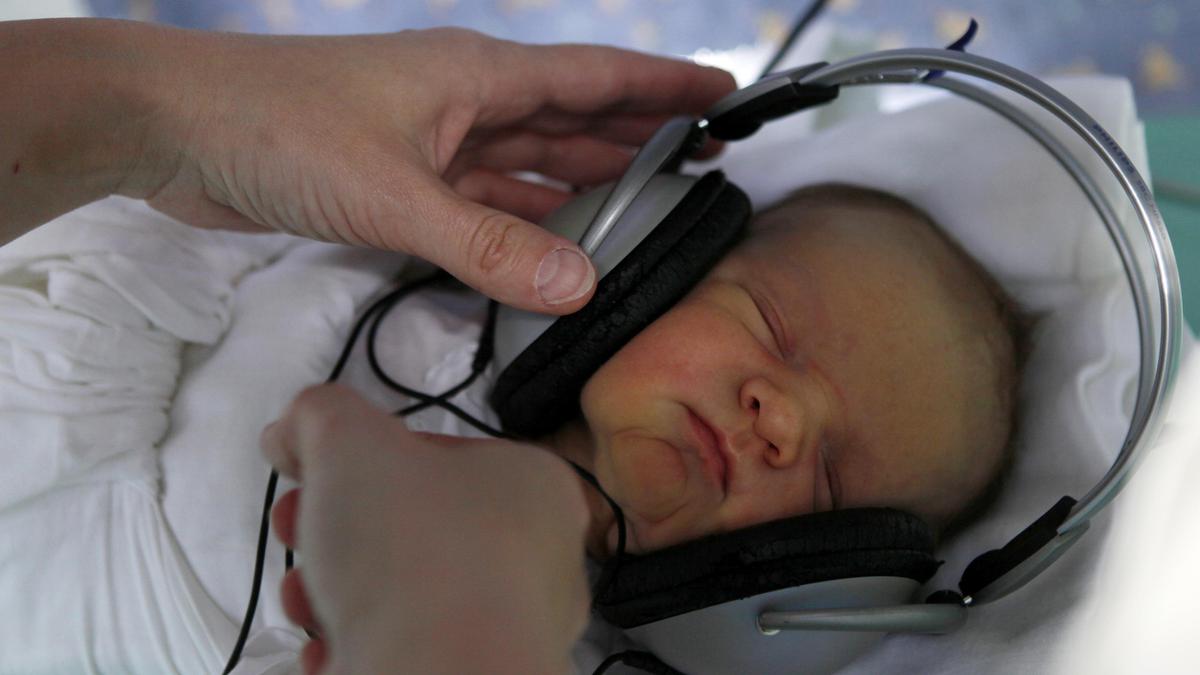
Why happy rather than sad music soothes newborns – new research
The Hindu
Newborns respond to aspects of music, such as its beat, structure as well as consonance and dissonance.
Music is the language of emotions, arousing and regulating our feelings. For example, research has shown that college students listen to music 37% of the time, and it fills them with happiness, elation or nostalgia during 64% of these sessions.
Children might have even greater exposure to music than adults do. Survey data shows that 54% of teachers in South Korea use background music in schools. We also know music is played as often as 6.5 times per hour to help children’s learning in US classrooms.
But how early do children develop a real appreciation for and understanding of music? Our recent study, published in Psychological Studies, suggests newborns may be rather musical, finding happy music soothing in particular.
This could be seen as surprising because, ultimately, culture plays a major role in when and how we understand music – it’s something we learn. Preschoolers, for example, are often unable to pair pictures of happy or sad faces with happy or sad music. Such ability usually develops later in childhood.
It has long been unclear whether newborns and young children feel emotions in music. But we know that newborns respond to aspects of music, such as its beat, structure as well as consonance and dissonance.
Young infants also love “motherese”, a very musical, melodic and slow type of speech that adults often adopt when talking to babies. Even those babies who can hear but were born to deaf parents (who don’t speak to them in this way) pay attention to such speech or maternal-style singing.
Some research suggests even foetuses seem to respond to music. One study has shown that when pregnant women at the 28th week of gestation listen to their favourite songs, their foetuses' heartbeats increase, even though the mothers show no change in their heart rates.


CERN's Large Hadron Collider discovers the Xi-cc-plus particle, enhancing understanding of quantum mechanics and baryon behavior.

Vibha Batra’s latest book, Spotless (Hachette India) is a novel in verse for young adults

In its first edition, the Madras Art Salon spotlights the works of journalist and artist Narayan Lakshman at The Botanical Club, a social space in the British Deputy High Commission, Chennai

Cholesterol enhances melanoma cell invasion by making nuclei squishier, revealing a potential treatment target in cancer progression.

The designers reinterpret the Swedish artist’s symbolic forms and colour energy through contemporary resortwear silhouettes

Discover the inspiring legacy of Bibha Chowdhuri, a pioneering woman in physics and a trailblazer in STEM history.

Discover the inspiring legacy of Bibha Chowdhuri, a pioneering woman in physics and a trailblazer in STEM history.

Ashdeen’s Spring 2026 collection features saris inspired by the designer’s Parsi gara archive

Red ochre burials, ritual markings and myths across cultures show that red repeatedly marks liminal thresholds such as puberty, sacrifice and death; anthropologists argue that the colour functions as a technology of collective ritual and value, binding communities through shared symbolic acts

India approves 23 institutions for quantum labs under the National Quantum Mission, aiming to advance quantum technology and research.

India approves 23 institutions for quantum labs under the National Quantum Mission, aiming to advance quantum technology and research.

The Gaza conflict exacerbates environmental damage, emitting millions of tonnes of CO2 and threatening climate stability in West Asia.

Chefs and cookery experts share smart kitchen hacks, hybrid cooking methods and appliance tips to help households reduce LPG use without compromising on food