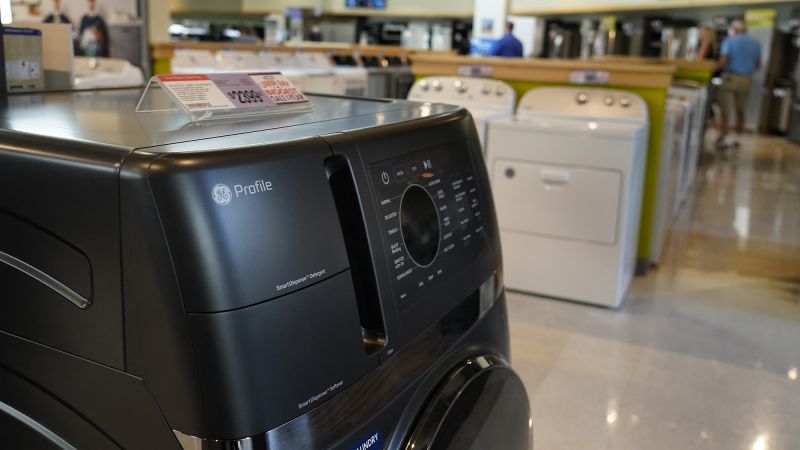
Why GE Appliances will make more washing machines in Kentucky instead of China. It’s not what you think
CNN
Some of President Donald Trump’s steepest tariffs are on products like washing machines, and on Thursday, GE Appliances said it would spend a half a billion dollars to make even more of them in the United States.
Some of President Donald Trump’s steepest tariffs are on products like washing machines, and on Thursday, GE Appliances said it would spend a half a billion dollars to make even more of them in the United States. Tariffs, however, weren’t the driving factor behind the decision, the company’s CEO says, but they did serve as an accelerant. GE Appliances announced it would spend $490 million to move some washing machine production from China and build a high-tech clothes care operation at its massive industrial park and headquarters in Louisville, Kentucky, where it already churns out washers and dryers for the US market. The move of more than a dozen front-load washer models comes as US trade policy uncertainty has reached a high-stakes fever pitch as Trump’s July 9 tariffs deadline approaches. GE Appliances move that is expected to be complete in 2027 and add 800 jobs, has been in the works for six years — shortly after a new line of front-load washers launched in 2019 — and follows a several-year stretch of high-dollar investments made to bolster the company’s US manufacturing footprint, CEO Kevin Nolan told CNN. “We’ve had a strategy that making appliances in America makes sense; it’s an economic thing, and it’s also how we can serve our customers in a better, more efficient way,” Nolan said, adding that GE appliances is “not a company that was saying, ‘Hey, we’re going to outsource everything, and oh my God, now we’ve got to bring it back.’”


Former judges side with Anthropic and raise concerns about Pentagon’s use of supply chain risk label
Nearly 150 retired federal and state judges have filed an amicus brief on Tuesday supporting AI company Anthropic in its lawsuit against the Trump administration for designating it a “supply chain risk,” CNN has learned.

Attacks on commercial ships in the Middle East this month have all but closed the vital Strait of Hormuz to oil tankers. One of the few alternative routes for oil exports from the region goes through the Red Sea. But now even that lifeline is in danger.

When Mona Panjwani opened One40 Rooftop, a swanky restaurant in lower Manhattan last year, one of the biggest dilemmas besides the menu was choosing the reservation platform.

What could get more expensive because of the war in Iran?

Gas prices have skyrocketed due to the US-Israel war on Iran, putting even more financial strain on many Americans’ wallets.

United Food and Commercial Union Local 7, the union representing the 3,800 striking workers, said that JBS failed to meet its demands during contract negotiations over higher wages, life-saving safety equipment and improved healthcare.

Every day brings a new complaint — or three — from the Trump administration about the American news media’s coverage of the Iran war.

Traffic through the strait, normally the conduit for a fifth of global oil output, has been severely curtailed since the start of the Iran conflict. But Iran itself is shipping oil through the waterway in almost the same volumes as before the war, earning the cash needed to sustain its economy and war effort.

How Anthropic may benefit from its fight with Trump

The price of oil rose to its highest level since July 2022 Sunday evening as the Trump administration suggested the war with Iran could last several more weeks and President Donald Trump called on the international community for help reopening the Strait of Hormuz to oil tankers.

When Melanie Galeaz posted a fan edit of “Heated Rivalry,” she didn’t know it would lead to her dream job.

The worst global oil crisis in decades could become a major problem for the Federal Reserve, whose policymakers meet this week to determine the next moves for the US economy.

President Donald Trump’s attack dog atop the FCC, Brendan Carr, garnered lots of attention on Saturday for threatening the licenses of local broadcasters over news coverage he deemed to be “fake.”