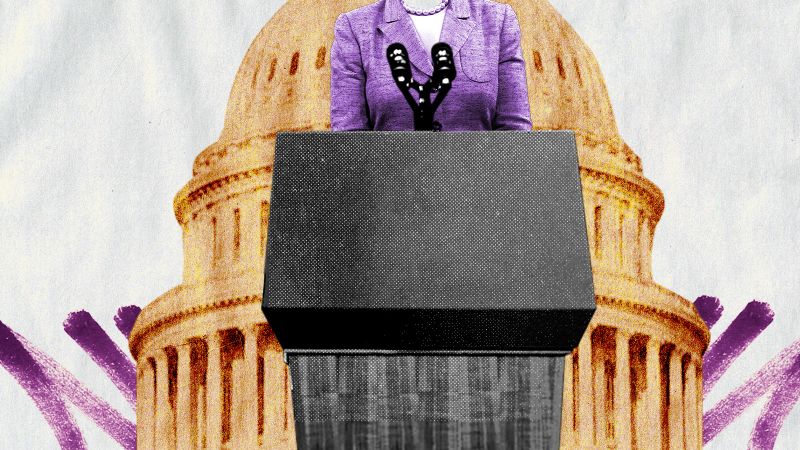
Why fewer women (and men) are running for Congress this year
CNN
Vice President Kamala Harris is making history as the second woman to lead a major-party presidential ticket. But down the ballot, fewer women are running for office.
Vice President Kamala Harris is making history as just the second woman to lead a major-party presidential ticket – and, notably, the first Black woman and first South Asian. But lower down the ballot, fewer women are running for office this year. After several election cycles that saw a record number of female candidates make bids for Congress, the decline across both parties and chambers is striking – especially among Republicans. The number of Republican women running for the House this cycle dropped about 36% from 2022, while the number running for Senate dropped by about 45%, according to data from the Center for American Women and Politics at Rutgers. For Democrats, the decline in total number of female candidates from two years ago was smaller – a 7% drop for the House and a 9% drop for the Senate. But the numbers among women may not tell the whole story. That’s because the number of men running for office has declined, too, which strategists on both sides of the aisle chalk up to this being a presidential election year with a particularly narrow House battlefield compared with the 2022 midterms. But even as a percentage of total candidates, the number of women running for the House this year is down from 2022, when a record number of them won election to the 118th Congress. As a percentage of total candidates within their party, Republican women have had a more significant drop in 2024, making up 18% of total House GOP candidates compared with 21% during the 2022 midterms. (The percentage for Democratic women has stayed relatively constant since 2020.) In the Senate, women make up a higher percentage of Democratic candidates than they did two years ago, but it’s the opposite for Republican women.


President Donald Trump has said ICE agents will head to US airports tomorrow amid a partial government shutdown. Follow for live updates

Cuba is working to restore the electricity supply after another island-wide blackout left more than 10 million people without power.

President Donald Trump said Sunday border czar Tom Homan will be in charge of deploying Immigration and Customs Enforcement agents to airports on Monday, with Homan telling CNN the agents will help with security at entrances and exits to ease the Transportation Security Administration’s workload.

Donald Trump wants us to believe that a deal with Cuba is close at hand. After this past week, I am not so sure.

President Donald Trump has said ICE agents will head to US airports tomorrow amid a partial government shutdown. Follow for live updates

President Donald Trump said Sunday border czar Tom Homan will be in charge of deploying Immigration and Customs Enforcement agents to airports on Monday, with Homan telling CNN the agents will assist with security at entrances and exits to ease TSA workload amid a partial government shutdown.

Janet Mills and her allies are counting on a gender gap to narrow Platner’s wide lead ahead of the June 9 primary to decide who will face incumbent Republican Sen. Susan Collins. They are betting that the unfiltered style that has brought Platner widespread attention as someone who could help Democrats reach young men will backfire with women.

Why do people “pledge allegiance” to a “state” that is no longer a state? And what spurs someone to not just attack innocent people, but to then make a statement of loyalty while doing so?

A Supreme Court case examining state deadlines for election ballots sent in the mail is just the tip of the spear in President Donald Trump’s war on mail-in voting.

As a shrinking number of Transportation Security Administration agents work to keep hourslong security lines moving despite not being paid, President Donald Trump stepped into the fray Saturday, announcing he will send Immigration and Customs Enforcement officers to airports by Monday if Congress doesn’t agree to a plan to end the partial government shutdown.

Donald Trump wants us to believe that a deal with Cuba is close at hand. After this past week, I am not so sure.

The search for missing 84-year-old Nancy Guthrie, mother of “Today” show host Savannah Guthrie, has stretched into another anguished week, with mounting pressure on investigators and a family grappling with uncertainty.

Cuba’s Ministry of Energy announced Saturday evening that entire island has suffered another electrical blackout, leaving more than 10 million people without power.