Why C.N. Annadurai was buried at the Marina and the row it triggered
The Hindu
C.N. Annadurai, Tamil Nadu's first Chief Minister, was buried on Marina Beach, sparking political controversy and lasting memorials.
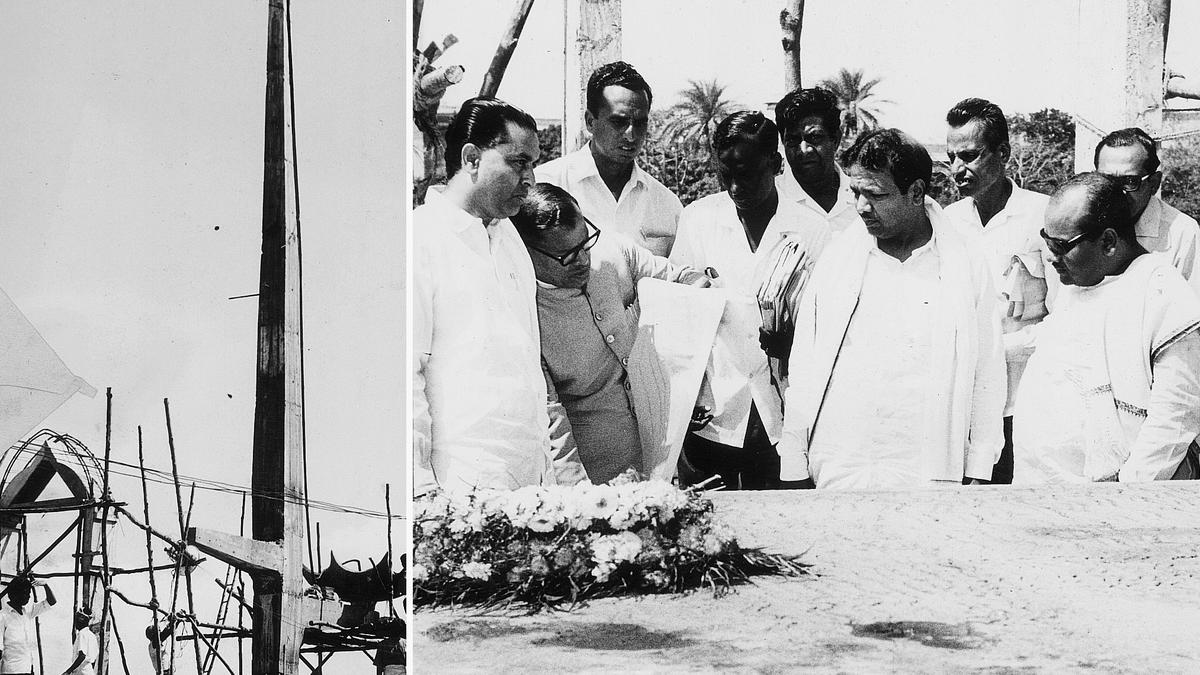
Soon after C.N. Annadurai, India’s first Chief Minister belonging to a regional party and founder of the DMK, died in office on February 3, 1969, the Tamil Nadu government decided to bury him on the sands of the Marina, the world’s second longest beach, in Madras. The decision did not go down well with the Congress, the principal Opposition party in the State. The resting place of Anna, as he was popularly called, was identified behind the statue of poet Kambar, opposite the University of Madras buildings. The funeral took place on February 4. “The mortal remains of C.N. Annadurai were to-day buried in the golden sands of the beach with full military honours, amidst moving scenes of grief and sorrow. As volleys of small arms were fired and platoons of the defence services reversed arms and the wail of the mourning multitude rent the air, the body was laid to rest,” says a report in The Hindu dated February 5, 1969.
“Morning found the gun carriage drawn up below the 29 steps of the Rajaji Hall which Mr. Annadurai ascended 23 months ago to be sworn in as Chief Minister of Tamil Nadu. Rajaji Hall, which then echoed to the joyous greetings of the people, was to-day enveloped by gloom, as he lay in state,” the report adds. Ministers V. R. Nedunchezhiyan, K. A. Mathiazhagan, S. Madhavan, and S. J. Sadiq Pasha were the “pall-bearers” who brought out the body draped with the national flag and the red-and-black DMK flag. “As the body was placed on the gun carriage, the crowd broke down and cries of ‘Ayoh Anna’ rent the air. The firing party presented arms, and officers in uniform saluted,” according to the report.
The burial spot, formerly an octogonal concrete structure with cement benches put up for the convenience of beach-goers, was slightly modified and a rectangular pit six feet deep, four feet wide and eight feet long was dug. The floor of the pit was plastered with cement, and its inner sides were lined with green-coloured linoleum. Anna’s body was placed in a teakwood coffin by the pallbearers. On the hexahedron-shaped coffin was inscribed: “C. N. Annadurai, age 60, Died on February 3, 1969”.
The funeral ceremony lasted about 10 minutes, at the end of which the then Works Minister, M. Karunanidhi, requested the vast congregation to observe one-minute silence in memory of Anna, who was an embodiment of of “duty, dignity and discipline”.
At that time, a controversy had erupted over why Anna was buried and not cremated. Karunanidhi had told the news agency PTI that in burying Anna, an ancient practice of the Tamils had been followed. He said that even now it was the custom in Tamil Nadu to resort to burial when important members of a family died. Besides, it was proposed to erect a “Samadhi” for Anna. “Only if a Samadhi was erected over the buried body of a leader, it would evoke reverence,” he said.
Days later, after he succeeded Anna as the Chief Minister, Karunanidhi, according to The Hindu report, had explained how he was forced to select the site on the Marina for burial of Anna. “Mr. Karunanidhi said it was the exact spot to which Mr. Annadurai had summoned him and Mr. Arangannal [legislator] to discuss party politics on his return from the U.S. (from treatment),” the report said.
The issue of Anna’s burial instead of cremation and his final resting place, however, remained politically alive, with Congress MLAs Vinayakam and P.G. Karuthimaran raising the issue in the Assembly. On February 25, Karunanidhi informed the House that the decision to bury Anna’s body instead of cremating it was taken only with the approval of his family members. He said there was nothing “sudden or unilateral” about the decision. He had earlier informed C. Subramaniam, the president of the Tamil Nadu Congress Committee, and E.V.K. Sampath about the decision.


Anuradha Jonnalagadda took over as in-charge Vice-Chancellor of the University of Hyderabad, focusing on continuity during the transition.

Telangana government awaits committee report on TGSRTC staff absorption, with decisions to be made at an appropriate time.

Telangana's revised pay scale implementation for employees will take timer. The tenure of Pay Revision Commission extended. Govt likely to take decision on reccomendation based on its report.

Vizianagaram's SP A.R. Damodar highlights 20 accident-prone areas and urges drivers to prioritize safety with helmets and seat belts.

Kerala HC stays disqualification of SNDP Yogam leaders, reversing a single judge's order regarding financial and regulatory compliance issues.

Karnataka announces daily supply of 10,000 LPG cylinders to hotels, easing the commercial shortage for the hospitality industry.

Malayalam superstar Mohanlal will be reuniting with filmmaker Priyadarshan, it was announced recently. It will mark the 100th film of Priyadarshan and is backed by Mohanlal’s longtime collaborator, Antony Perumbavoor

Gautham Vasudev Menon loses Madras High Court appeal, ordered to pay ₹4.25 crore to R.S. Infotainment with interest.

AIADMK faces its toughest challenge in 53 years as it prepares for the crucial 2026 T.N. Assembly elections.

Lakmé Fashion Week x FDCI 2026 in Mumbai: What worked and what didn’t

Telangana CM announces underpass beneath Begumpet Airport runway to alleviate traffic congestion in Hyderabad.

Congress leader Ramesh Chennithala claims an alliance between Pinarayi Vijayan, Modi, and Shah aims to undermine UDF in Kerala elections.

CCB arrests Bengaluru couple for running a fake government job scam, cheating over 100 victims out of crores.