Why better wastewater management could help solve Bengaluru’s water crisis
The Hindu
Bengaluru faces water issues due to drought, flooding, and over-dependence on groundwater. A decentralised wastewater treatment policy could be the way forward to create a sustainable water system. The recently concluded conference discussed various facets of effective wastewater management, with experts from India and abroad. To solve the city's water problems, an entire system change is needed. #WaterResilience #WastewaterReuse #Bengaluru #WELLLabs #EAWAG #BangaloreApartmentsFederation
If the thought of using sewage water to garden your plants or flush your toilet makes you shudder, you are probably not alone. “There is a term called the yuck factor, and the term is there globally,” says Dr. Veena Srinivasan, the executive director of WELL Labs, a Bengaluru-based research and innovation centre for water management.
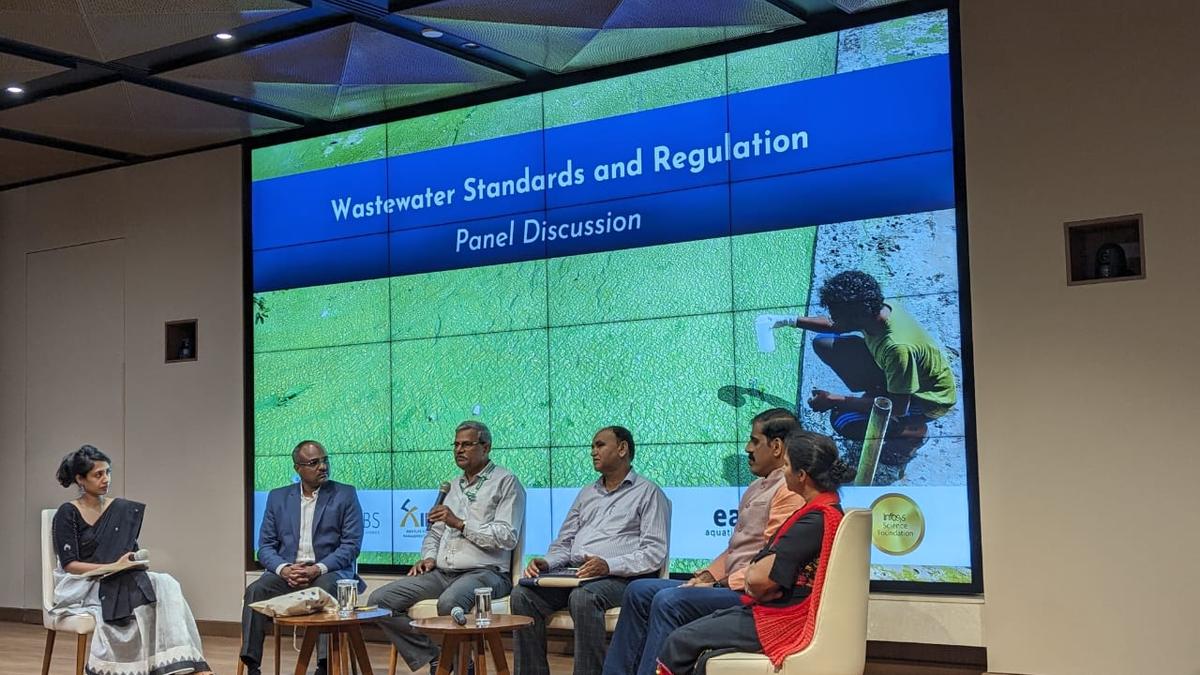
And yet, getting over this yuck factor is an important aspect of creating more sustainable water systems, as the recently concluded conference titled Building Water-Resilient Cities: Strategies for Wastewater Reuse in Urban India reiterated.
“There’s a psychological block,” agrees B.P. Ravi, IFS, Principal Secretary, Forests and Ecology, Government of Karnataka, who delivered the welcome address at this conference, a collaboration between WELL Labs, Swiss Federal Institute of Aquatic Science and Technology (EAWAG) and Bangalore Apartments Federation.
But he also indicated that we may soon have no other choice. “We are pumping water every day. About 1,500 million litres of water per, using energy against gravity,” says Mr. Ravi, adding that this is simply unsustainable in the long run. “The solutions are available, (but) change at the individual, family and community level needs to happen.”
“Bengaluru’s water problems may be contradictory,” states the executive summary of a report titled How Water Flows Through Bengaluru: Urban Water Balance Report, which was released at the conference. While this fast-expanding city, prone to drought and flooding, is getting increasingly dependent on groundwater, a fast-depleting resource, “the amount of wastewater treated by centralised infrastructure remains low”.
A decentralised wastewater treatment policy could be the way forward, going by Dr. Srinivasan’s comment at the launch of this report.
“Bangalore is unique for having a decentralised policy. If we’re able to make this a success, the city can show the rest of the world how to establish a circular water economy,” she states, adding that the point of the report was this: to think about the city’s water in an integrated fashion.


CM announces Cabinet Sub-Committee on Musi rejuvenation; rehabilitation for all displaced

Ramanathapuram identifies 145 polling stations as sensitive, ensuring security with paramilitary forces ahead of assembly elections, says DEO.

BJP Puducherry president V. P Ramalingam files nomination for Raj Bhavan, joined by Union Minister Mandaviya and Khushbu Sundar.

History-sheeter 'Thoppai' Ganesh shot dead by police in Chennai after attacking officers during attempted escape.

The government plans to amend the FCRA, introducing new regulations for NGO asset management and accountability for key functionaries.

The draft policy for “Responsible Digital Use Among Students”, released on Monday by the Department of Health and Family Welfare, has recommended that parents set structured routines with clear screen-time rules and prioritise privacy, safety, and open conversation with children on digital well-being.

Police Observer Sushant Kumar Saxena conducts surprise inspection at Shencottai police station, reviewing warrants and security arrangements ahead of elections.

Andhra Pradesh government to launch key projects in April, focusing on industrial growth and infrastructure development, says Nara Lokesh.

Lok Sabha refers the Corporate Laws (Amendment) Bill to a JPC amid opposition concerns over CSR provisions dilution.

SHG members in Kanniyakumari use snakes and ladders to raise election awareness and boost voter turnout.

Government accelerates consultations for early implementation of the Women’s Reservation Act to ensure women’s representation in 2029 elections.

CM A. Revanth Reddy distributes ₹1 crore insurance cheques to families of deceased Electricity department employees, enhancing financial security for workers.

The Bengaluru Traffic Police (BTP) registered 634 cases of drunk driving during a week-long special enforcement drive conducted across the city between March 16 and March 22.