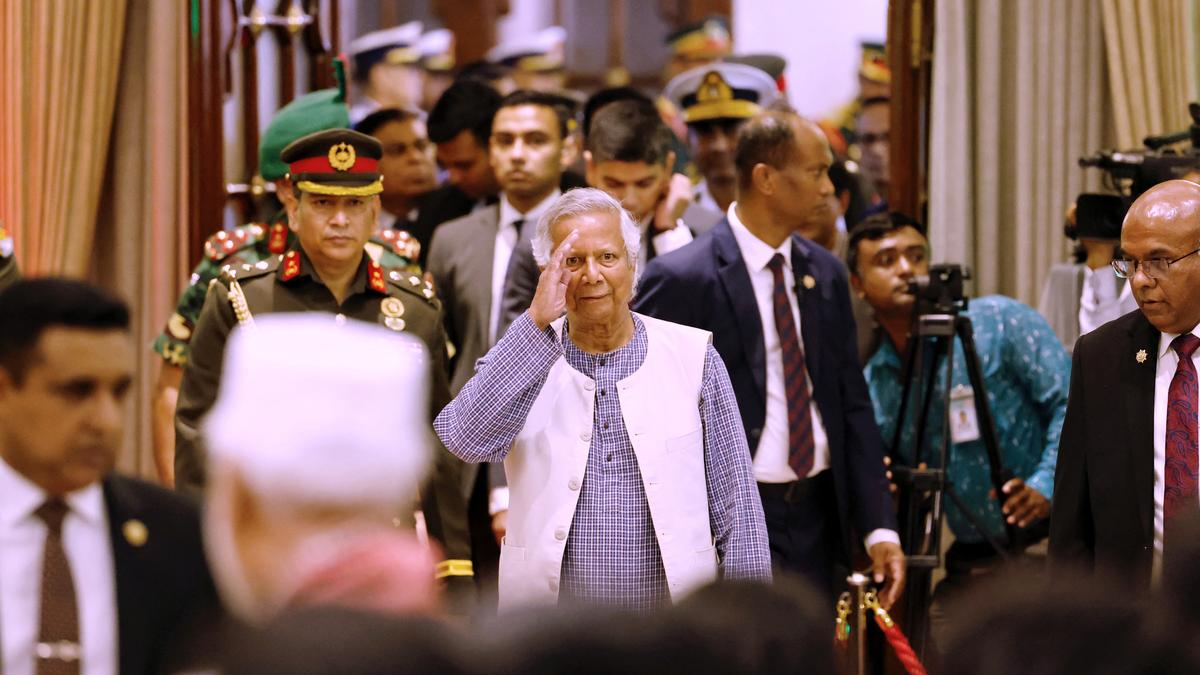
Why Bangladesh chose Yunus to steady the ship Premium
The Hindu
Muhammad Yunus leads Bangladesh towards democracy, empowering women and challenging autocratic rule, with global support and social entrepreneurship.
In Muhammad Yunus Bangladesh has the opportunity to shake off 15 years of autocratic rule with a new leader who gave opportunities to women to participate more fully in society.
One cannot think of a more qualified person to lead Bangladesh at the moment. Mr. Yunus, a former university professor of economics, is the founder of the Grameen Bank. Dubbed the “Banker to the Poor”, he is better known now as a social entrepreneur and civil society leader than an academic. He assumes charge as head of the interim government of Bangladesh at a time when there is general disgust in the country with political parties.
Consequently, civil society groups have come to the fore. Mr. Yunus is undoubtedly the most prominent face of Bangladesh civil society groups. He clearly has the support of the students who shed much blood overthrowing the Sheikh Hasina regime through the mass uprising they led.
His name was proposed by the leaders of the student protest with others accepting it enthusiastically. No government, neither its police nor its military, is happy when they kill their own citizens, for reasons that seem not so convincing. It is not surprising then that the Bangladesh Army refused to fire on its own people, asking Ms. Hasina to quit in view of the popular uprising.
Theglobally acknowledged initiative of Mr. Yunus, the Grameen Bank, owes its existence to the inability of the banking system to lend to the poor.
Mr. Yunus rebelled against his training in economics, when he found that the poor in Bangladesh work hard but cannot escape poverty because of their debt burden. Paradoxically, it is the poor who need credit, but no bank will lend to them.
At first, he borrowed money in his name and lent it to the poor. He found that the poor were indeed credit worthy. Then he experimented with a state-owned agricultural bank with similar results. Finally, when he found that the state was unwilling to scale-up microcredit to the poor, he founded his own social business – the Grameen Bank.


Saudi Arabia expels Iranian military staff amid escalating tensions and ongoing missile attacks during the U.S.-Israeli war on Iran.

Russia claims control of Potapivka village in Ukraine's Sumy region amid ongoing military efforts to establish a buffer zone.

Iranian missile strikes on Israeli towns cause widespread damage and injuries, marking a significant escalation in the ongoing conflict.

As Gor makes first trip as U.S. Special envoy to South Asia, Delhi watches strategic signals closely
Sergio Gor's inaugural trip as U.S. Special Envoy to South Asia signals strategic U.S. engagement amid regional tensions.

Slovenians vote in a tight election between liberal and populist candidates, impacting the country's future domestic and foreign policies.

Netanyahu asserts U.S.-Israel alliance fights Iranian threats, emphasizing global security after missile strikes on Israeli and European targets.

Israeli settlers attack Palestinian villages in the West Bank, causing injuries and destruction amid ongoing settlement expansion.

Britain asserts no evidence of Iran planning missile strikes on Europe, despite Israeli claims of missile capabilities.

UNESCO reports over half of countries have banned phones in schools due to concerns about attention, cyberbullying, and social media impact.

Analysis reveals a U.S.-operated Patriot missile likely caused a pre-dawn explosion in Bahrain, injuring numerous civilians.

Sri Lanka raises fuel prices by 25% amid ongoing West Asia conflict, impacting petrol and diesel costs significantly.

Iran strikes near Israeli nuclear research center as Trump threatens attacks on Iranian power plants
Iran's missile strikes near Israel's nuclear site escalate tensions as Trump threatens retaliation against Iranian power plants.

Saudi Arabia intercepts one of three ballistic missiles targeting Riyadh amid ongoing regional tensions and threats from Iran.