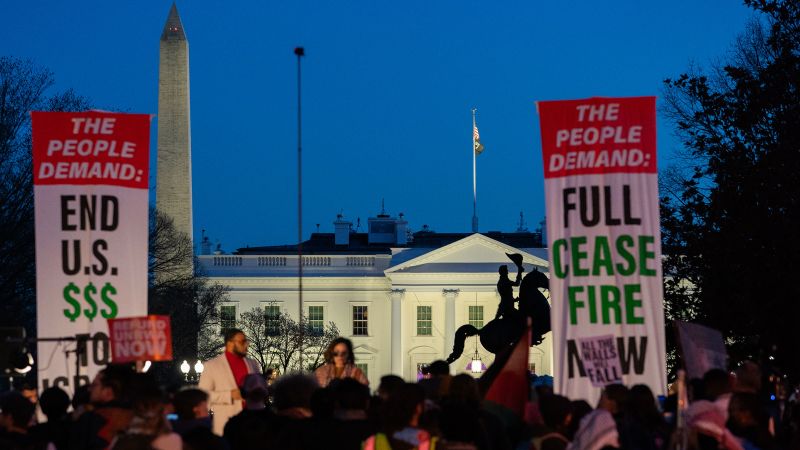
White House shifts plans from hosting iftar dinner to meeting with Muslim leaders after pushback over starving Gazans
CNN
The White House has shifted plans for President Joe Biden to host an iftar dinner Tuesday night to break the Ramadan fast with Muslim community leaders, instead deciding to hold a meeting with the group as the administration faces anger and concern from Arab, Palestinian, and Muslim American communities amid the Israel-Hamas war.
The White House has shifted plans for President Joe Biden to host an iftar dinner Tuesday night to break the Ramadan fast with Muslim community leaders, instead deciding to hold a meeting with the group as the administration faces anger and concern from Arab, Palestinian, and Muslim American communities amid the Israel-Hamas war. Biden will still host a small dinner with senior Muslim administration officials, a White House official said, but outside attendees will only go to the meeting after significant pushback from expected attendees, sources told CNN. “There was a significant amount of pushback from attendees that it would be inappropriate to raise the humanitarian crisis in Gaza over dinner,” a person familiar with the meeting told CNN. “There’s a famine in Gaza, 23 children have died from starvation in Northern Gaza. I don’t think anybody would be comfortable sharing those stories and images over dinner.” Another source familiar with the plans said that there was little interest from participants in wanting to eat and celebrate and that it became clear it would be more fitting to hold a policy discussion. CNN had previously reported that several people who were invited to attend have declined, sources said, citing frustration with the administration’s support of Israel amid the humanitarian crisis in Gaza. And a third source told CNN, “Basically the sentiment we heard over and over again was that anybody going to the iftar while Palestinians are being killed and starved should be ashamed of themselves.”


A federal judge on Friday blocked President Donald Trump’s administration from enforcing most of his executive order on elections against the vote-by-mail states Washington and Oregon, in the latest blow to Trump’s efforts to require documentary proof of citizenship to vote and to require that all ballots be received by Election Day.

Protests and vigils are taking place nationwide after an ICE agent fatally shot a woman in Minneapolis. Follow for live updates.

President Donald Trump continued his threats towards Greenland on Friday, as he insisted that if the United States did not act Russia or China would occupy it in the future.

President Donald Trump this week lashed out at congressional Republicans like he rarely has before.

A Border Patrol agent shot two people in Portland, Oregon, during a traffic stop after authorities said they were associated with a Venezuelan gang, another incident in a string of confrontations with federal authorities that have left Americans frustrated with immigration enforcement during the Trump administration.

The Bella 1 had been tailed by a US Coast Guard cutter across the Atlantic Ocean for almost two weeks when the ship’s crew employed a novel tactic to evade the US military: painting a Russian flag on its hull.

The Washington National Opera on Friday announced it is parting ways with the Kennedy Center after more than a decade with the arts institution.

‘It’s uninvestible’: Trump’s Venezuela pitch met with skepticism from oil executives

FBI Director Kash Patel has named Christopher Raia, a seasoned career agent, to replace Dan Bongino as deputy director, according to people briefed on the matter.

President Donald Trump faced Republican defections on a series of split votes this week, but his willingness to call out members of his own party convinced some wavering lawmakers to stay in line.

Trump’s description of the Mexican trafficking world – one dominated by a few cartels that can be swiftly defeated – is at odds with how the crime organizations actually operate, experts say.

The Virginian man accused of planting two bombs in Washington, DC, five years ago pleaded not guilty Friday to federal charges of transporting and attempting to use explosives.

A US State Department team traveled to Venezuela on Friday for the first time since the ouster of Nicolás Maduro, according to a US official. CNN’s Stefano Pozzebon reports from Bogota.