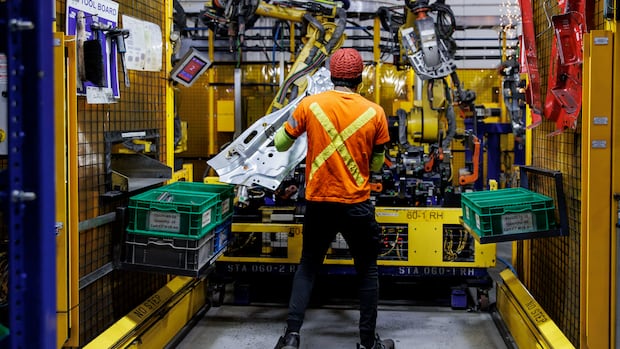
Which industry in each province is most threatened by tariffs?
CBC
Before U.S. President Donald Trump terminated trade negotiations with Canada late Thursday night, premiers were clashing over which tariff-beleaguered industries should be prioritized.
With Ontario’s auto industry pitted against the canola industry of the prairies, and B.C. raising concerns that the lumber industry is not getting the attention it deserves, Team Canada was looking increasingly splintered.
Trump's latest actions have resulted in a more united front across provincial borders. But as tariffs remain, so do those underlying tensions.
Here’s a breakdown of the industries most under threat by tariffs in each province, and what premiers are saying as Canada tries to negotiate new trade relationships.
B.C. Premier David Eby made headlines earlier this month when he suggested the federal government is not prioritizing the lumber industry.
“Steelworkers in Ontario, when their jobs are in trouble … it's treated as a national emergency, and rightly so,” Eby said at an Oct. 14 news conference.
“What we’re asking for today is … that same sense of emergency is shared for the forest sector in this country.”
Eby made those comments after the Trump administration increased timber and lumber tariffs by 10 percentage points on top of the existing 35 per cent tariff.
Although B.C.’s largest export to the United States is energy and raw minerals, wood products are a “very close second,” according to Trevor Tombe, an economics professor at the University of Calgary.
The forestry industry supports over 100,000 jobs in B.C., according to the B.C. Lumber Trade Council.
Oil and gas is by far Alberta’s largest industry, with petroleum accounting for 81 per cent of Albertan exports to the U.S. last year.
So far, the industry has escaped many of the harshest direct tariffs from the U.S., Tombe said, but it's still impacted by changes in American trade policy.
“U.S. trade policy to other countries around the world has been quite considerable, and it has resulted in slower rates of economic growth,” he said. “What that does is lower demand for energy, and that lowers oil prices.”
Non-renewable resource revenue was down $1.4 billion from what had been projected in the Alberta budget, mainly thanks to lower crude oil prices coupled with a stronger Canadian dollar, according to a provincial fiscal update from the first quarter of 2025.


There was a time when Manitobans used to consider Saskatchewan a rural, underdeveloped backwater.

The Agricultural Producers Association of Saskatchewan (APAS) found some reasons to celebrate the 2026-27 provincial budget, but it takes issue with the amount designated for the province's Water Security Agency (WSA).

The family of an Edmonton woman who died in Honolulu last year is pushing for Hawaiian authorities to re-open the case.

It was around this time in 2020 that everything changed.

With its emergency shelter beds frequently running at 50 per cent over capacity and demand so great that it's forced to refer some women escaping domestic violence elsewhere, Gillian's Place in St. Catharines will soon be able to offer a broader range of services to more victims of gender-based violence.

The ceiling of the CAW Student Centre at the University of Windsor is decorated by flags of numerous nations — among them, Iran.

Turmoil in Iran, a major disruption in world oil markets, and stratospheric gasoline prices in Canada and beyond. What's racking motorists and governments in 2026 also faced them in 1979, sparked by the Iranian Revolution.

Five decades later, and Thunder Bay's Music World Academy remains a family-run business.

Dalton Dubois of Guelph, Ont., made history at the recent Paris Fashion Week when she became the first transgender model to walk the runway for Chanel Exclusive.

Work is scheduled to begin over the summer at the site of the former Clinton Creek asbestos mine, about 65 kilometres northwest of Dawson City, Yukon.

They may be bitter rivals in the House of Commons, but outside the chamber, recent events may have led to Conservative Leader Pierre Poilievre and Prime Minister Mark Carney forging a bond.

Local fans and industry insiders say the province’s move to ban the reselling of event tickets for more than their original value is a step in the right direction, but some say there are still larger issues that need to be addressed.

This First Person column is the experience of Mehdi M. Kashani, who lives in Toronto. For more information about CBC's First Person stories, please see the FAQ.