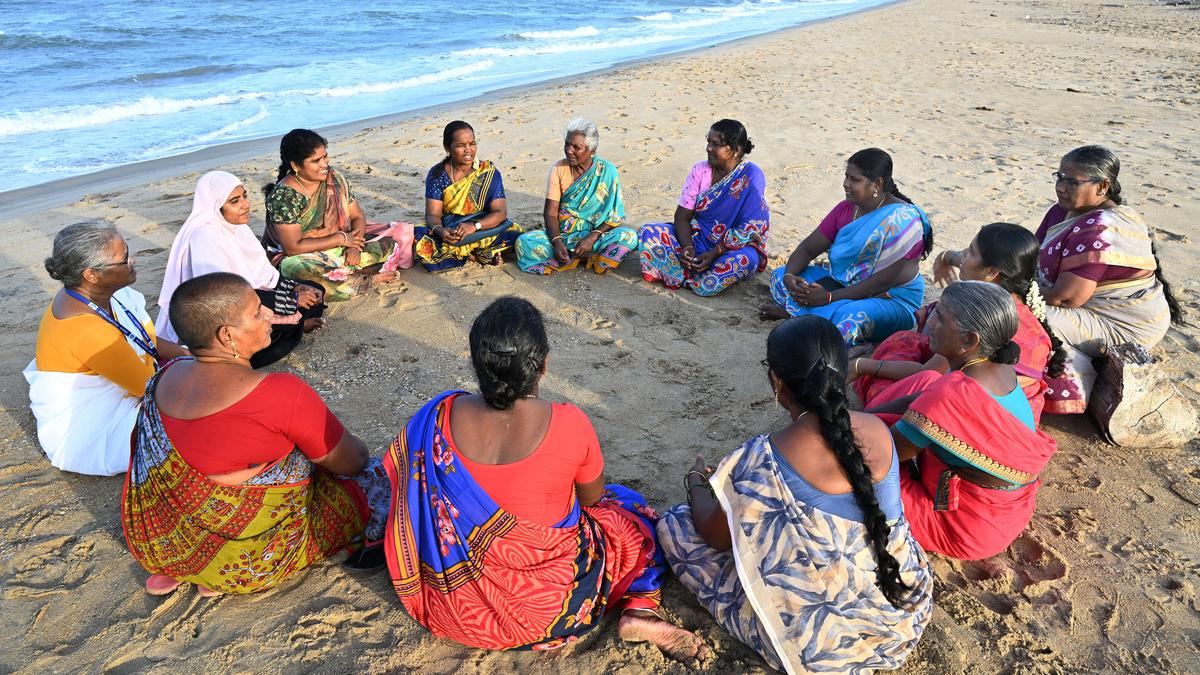
Where women turn the tide
The Hindu
Women in Tamil Nadu and Puducherry challenge patriarchal norms, gaining power and influence in coastal fishing communities.
In the contiguous coastal hamlets of Tamil Nadu’s Mayiladuthurai and Nagapattinam districts and Puducherry’s Karaikal district, a quiet but resolute change is taking place with women finding their feet, even amid the patriarchal ‘panchayatar’ system that makes decisions in fishing communities. For generations, public decision-making in these communities was controlled by men under the deeply entrenched ‘panchayatar’ system, a structure unique to coastal fishing villages. Each week, male elders from different sections convene ‘oor kootams’ (village assemblies) that rule on issues ranging from domestic disputes to political matters. Though they are supposed to be open to all, these meetings have long excluded women. Their presence was considered inappropriate or even rebellious.
No woman has been appointed as a ‘panchayatar’ yet and the structure remains rigidly patriarchal. However, sustained organising at the grassroots — largely by women and backed by NGO Social Need Education and Human Awareness (SNEHA) — is paving the way for a change. Once sidelined, women’s collectives are recognised as serious stakeholders. Today, ‘panchayatars’ are increasingly compelled to consult them before taking major decisions.
At Nambiyar Nagar in Nagapattinam, women were allowed, for the first time, to make announcements on the stage during the annual temple festival three years ago. This broke a long-standing barrier. At nearby Kameshwaram, the women’s collective has installed a board declaring its opposition to ‘nalangu’ gifts, the customary offerings from women’s families during rites of passage.
At Poompuhar in Mayiladuthurai, the community has pledged not to sell banned tobacco products or liquor, while opposing child marriage and usury. At Karaikal, women from local collectives join ‘panchayatars’ from all 10 coastal villages in garlanding the statue of Singaravelar, a celebrated labour leader, who hailed from the fishing community. Seven coastal villages in Karaikal have kept liquor shops out of their communities, a major step in asserting control over public health and safety. Most notably, through sustained organising, women from all the three districts have compelled male ‘panchayatars’ to declare their opposition to ‘sambandhi seer’, a form of dowry.
“Before joining the collective, none of us had bank accounts. Now, we all do. The only joint account our husbands have is with us,” laughs K. Kalaimathi, president of the Fisherwomen’s Federation at Kollidam in Mayiladuthurai.
The Fisherwomen Society, a government-recognised institution in coastal villages, was intended to function independently from male-run societies. Many still operate in parallel with the men’s bodies, but years of sustained advocacy has enabled some of these institutions to become autonomous. Village fisherwomen associations also help in community savings. Members contribute ₹200-₹500 a month. The funds thus pooled are distributed in rotation. Financial matters are discussed at open forums, and leaders are elected democratically. “In microfinance groups, if one woman defaults, others suffer. Here, if someone struggles, others step in to help,” says Ms. Kalaimathi.
These collectives also promote livelihood through small-scale enterprises: production of spice mixes in Tharangambadi and Sirkazhi; detergents and sanitisers in Kollidam; and prawn pickles in Thirumullaivasal. These products are popular even abroad. “Earlier, when we gathered for meetings, men mocked us. Now, they ask us how we manage our finances so well,” says M. Maheswari of Chinnamedu, Tharangambadi, while S. Deepalakshmi adds, “Financial independence has reduced our reliance on exploitative microfinance and loan sharks.”


Delhi CM Rekha Gupta presents the Economic Survey 2025-26, highlighting growth in income and fiscal deficit details.

Ready for IPL 2026? The Chennai Super Kings’ 'Roar 26' event delivered several Dhoni moments, fan frenzy and an energetic AR Rahman concert.

An alleged dating app scam in Hyderabad's Jubilee Hills has reportedly swindled a man of ₹28,000 at a pub.

T.N. Chief Secretary and DGP visit Governor at Lok Bhavan, presenting flowers in courtesy call.

Eight TSPC Maoists arrested in Hazaribag, Jharkhand, with weapons and ammunition seized during a police operation.

Four ambulances of a Jewish community service in London were set ablaze in a suspected antisemitic hate crime.

Gautham Manohar hopes his photographs serve as reminders of the Earth’s delicate beauty

Thousand Lights faces parking chaos and traffic congestion despite its political significance and ongoing development efforts.

Generic semaglutide increases accessibility, but doctors caution against misuse and quality concerns

Haryana Police removes 857 links to Badshah's 'Tateeree' for objectionable content, ensuring a safer digital environment.

Congress criticises Modi for not leveraging the upcoming BRICS+ Summit to address the West Asia crisis amid U.S. tensions.

Nagapattinam faces underdevelopment and resource challenges, impacting its rich heritage and the livelihoods of its fishing community.

One of the best games of 2025 makes it over to the PC, with a harder mode and bristling with new graphic tech