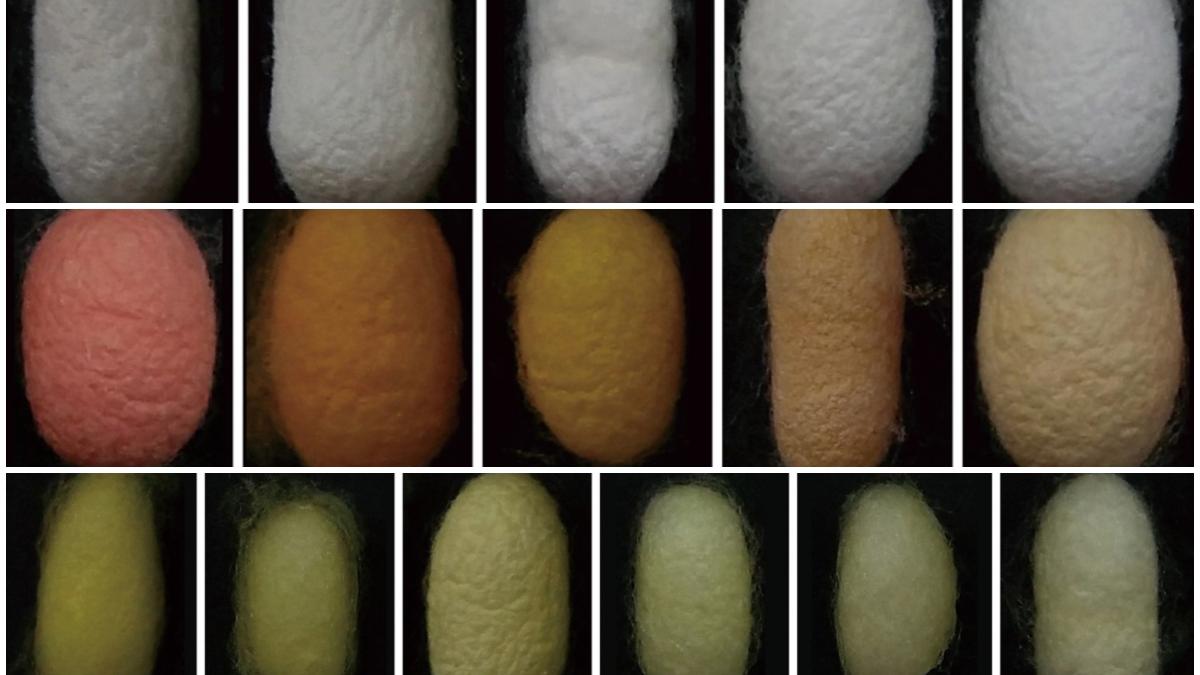
Where do the wild colours of domesticated silkworm cocoons come from? Premium
The Hindu
Silk, drawn from the cocoons of the domesticated silk moth, is 5,000 yrs old. Wild moths feed on mulberry leaves while domesticated moth depends on human care. Silkworms’ cocoons come in an eye-catching palette of colours thanks to carotenoids and flavonoids. Research on domestication conducted in China, Japan and India is beginning to unravel where these colours come from, and how they are a product of the forces of domestication.
Silk, the queen of fibres, is drawn or reeled from cocoons of the silk moth (Bombyx mori). Humans domesticated it more than 5,000 years ago in China, from the wild moth (Bombyx mandarina). The ancestral moth is today found in China, the Korean Peninsula, Japan, and far eastern Russia, whereas the domesticated moth is reared all over the world, including in India. In fact, India is the world’s second largest producer of raw silk after China.
Caterpillars, also known as silkworms, of both these species feed exclusively on leaves of mulberry plants (genus Morus). The domesticated moth is much larger than its wild progenitor, and thus extrudes a longer silk fibre to build its larger cocoon, up to 900 metres long. But it depends wholly on human care for its survival and reproduction. Since having been domesticated, it has lost the ability to fly, and since its need for camouflage no longer exists, it has also lost its caterpillar and adult-stage pigmentation.
‘Wild’ silks – which include the muga, tasar, and eri silks – are obtained from other moth species: namely, Antheraea assama, Antheraea mylitta, and Samia cynthia ricini. These moths survive relatively independently of human care, and their caterpillars forage on a wider variety of trees. Non-mulberry silks comprise about 30% of all silk produced in India. These silks have shorter, coarser, and harder threads compared to the long, fine, and smooth threads of the mulberry silks.
The ancestral mulberry moth makes (boringly uniform) brown-yellow cocoons. In contrast, domesticated silk moth cocoons come in an eye-catching palette of yellow-red, gold, flesh, pink, pale green, deep green or white. Human handlers selected the differently coloured cocoons whenever they emerged, possibly in the hope of breeding for coloured silks. But they were disappointed: the pigments that coloured the cocoons are water-soluble, so they gradually fade away. The coloured silks we see in the market are instead produced by using acid dyes.
We know today that the cocoon’s pigments are derived from chemical compounds called carotenoids and flavonoids, which are made by the mulberry leaves. Silkworms feed voraciously on the leaves, absorb the chemicals in their midgut, transport them via the hemolymph – arthropods’ analogue of blood – to the silk glands, where they are taken up and bound to the silk protein. Mature caterpillars then spin out the silk proteins and associated pigment into a single fibre. The caterpillar wraps the fibre around itself to build the cocoon.
The adult moth hatches (or ecloses) from the cocoon. In this process, the fibre is broken in many places. Superior quality silk however comes from an unbroken fibre, so unhatched cocoons are used for reeling. There is a contentious ‘economics versus ethics’ debate here about creating a species that depends wholly on humans (and whose unhatched cocoons we drown in hot water for better quality silk), but that is for another article.
The differently coloured cocoons arise from mutations in genes responsible for the uptake, transport, and modification of carotenoids and flavonoids. The mutant strains have become a valuable resource for scientists to study the molecular basis of how, in a relatively short span of 5,000 years, artificial selection generated such spectacular diversity.


Discover the Minor Planet Centre, the key hub for tracking and verifying observations of small solar system bodies.

In this week's Science for All newsletter, XX explains

Test your knowledge with the quiz on Science films at the Oscars through history

Set between the Siwalik hills and the plains, Butwal offers travellers a mix of regional cuisine, pilgrimage trails to Lumbini and the comfort of Hyatt’s new hospitality landmark

Explore 2026's wallpaper trends in India, highlighting botanicals and handmade designs that enhance modern homes with nature-inspired aesthetics.

Mercedes-Benz CLA 250+ with EQ Technology review: design, performance, range and features explained. Discover how the new electric CLA combines advanced AI, long range, fast charging and futuristic styling for the next generation of luxury EVs.

AI tool for sparrow conservation

BTS’s comeback with ‘Arirang’ marks a major global music event. When does the album release, and where can you watch their concert live stream? We have all the details

The 2026 U.S. cholesterol guidelines urge starting screening and treatment at 30 to prevent cardiovascular disease effectively.

Olam Festival 2026 in Thiruvananthapuram returns March 27-29 with 120+ vendors, music, art, and cultural zones.

A few storytellers in Thiruvananthapuram share their journeys, challenges, and evolving methods on World Storytelling Day, inspiring young minds.

76-year-old Kurian Jacob from Kerala triumphs with seven medals, including five golds, at the Open Masters Games in Abu Dhabi.

Explore the nature of the human mind as an emergent property of brain activity and complex neural interactions.