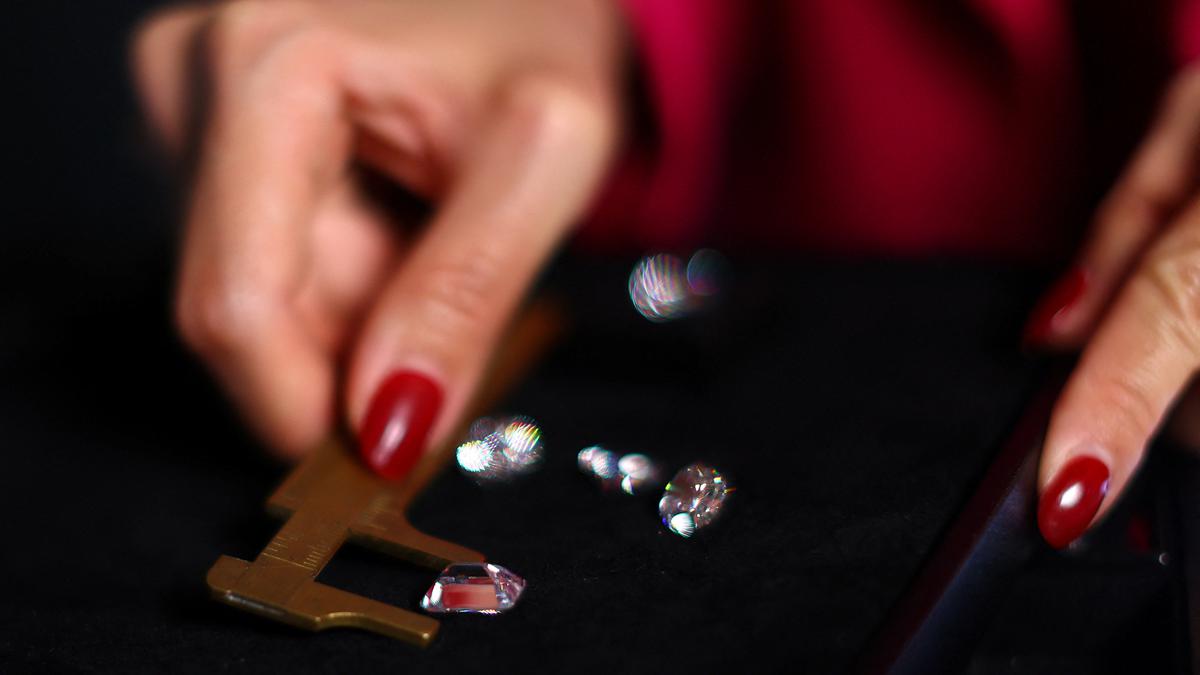
When science meets art: recycled metal and lab-grown gems
The Hindu
For some a natural diamond, created over billions of years, is the ultimate luxury, but an award-winning British designer sees greater worth in jewellery crafted using laboratory-grown gems and metal from recycled cans.
For some a natural diamond, created over billions of years, is the ultimate luxury, but an award-winning British designer sees greater worth in jewellery crafted using laboratory-grown gems and metal from recycled cans.
Anabela Chan said she chose her materials after witnessing what she said were poor working conditions in diamond mines.
"These are some of the most precious and valuable commodities in the world, that just didn't make any sense to me," she said, in her Knightsbridge boutique in central London.
Instead, her designs rely on lab-grown diamonds, recycled aluminium from cans and pearls grown using regenerative farming techniques.
Chan's company does not give sales figures but said it had seen strong demand since the COVID-19 pandemic. She won the "Game Changer" category at the British Luxury Awards in November.
According to Edahn Golan Diamond Research & Data, the lab-grown jewellery market has seen annual growth of 20% in recent years, driving global profits to $15 billion.
As more producers enter the market, selling prices for lab-grown diamonds have fallen, and brands are looking to differentiate themselves.


AI tool for sparrow conservation

BTS’s comeback with ‘Arirang’ marks a major global music event. When does the album release, and where can you watch their concert live stream? We have all the details

The 2026 U.S. cholesterol guidelines urge starting screening and treatment at 30 to prevent cardiovascular disease effectively.

Olam Festival 2026 in Thiruvananthapuram returns March 27-29 with 120+ vendors, music, art, and cultural zones.

A few storytellers in Thiruvananthapuram share their journeys, challenges, and evolving methods on World Storytelling Day, inspiring young minds.

76-year-old Kurian Jacob from Kerala triumphs with seven medals, including five golds, at the Open Masters Games in Abu Dhabi.

Explore the nature of the human mind as an emergent property of brain activity and complex neural interactions.

CERN's Large Hadron Collider discovers the Xi-cc-plus particle, enhancing understanding of quantum mechanics and baryon behavior.

Vibha Batra’s latest book, Spotless (Hachette India) is a novel in verse for young adults

In its first edition, the Madras Art Salon spotlights the works of journalist and artist Narayan Lakshman at The Botanical Club, a social space in the British Deputy High Commission, Chennai

Cholesterol enhances melanoma cell invasion by making nuclei squishier, revealing a potential treatment target in cancer progression.

The designers reinterpret the Swedish artist’s symbolic forms and colour energy through contemporary resortwear silhouettes

Discover the inspiring legacy of Bibha Chowdhuri, a pioneering woman in physics and a trailblazer in STEM history.