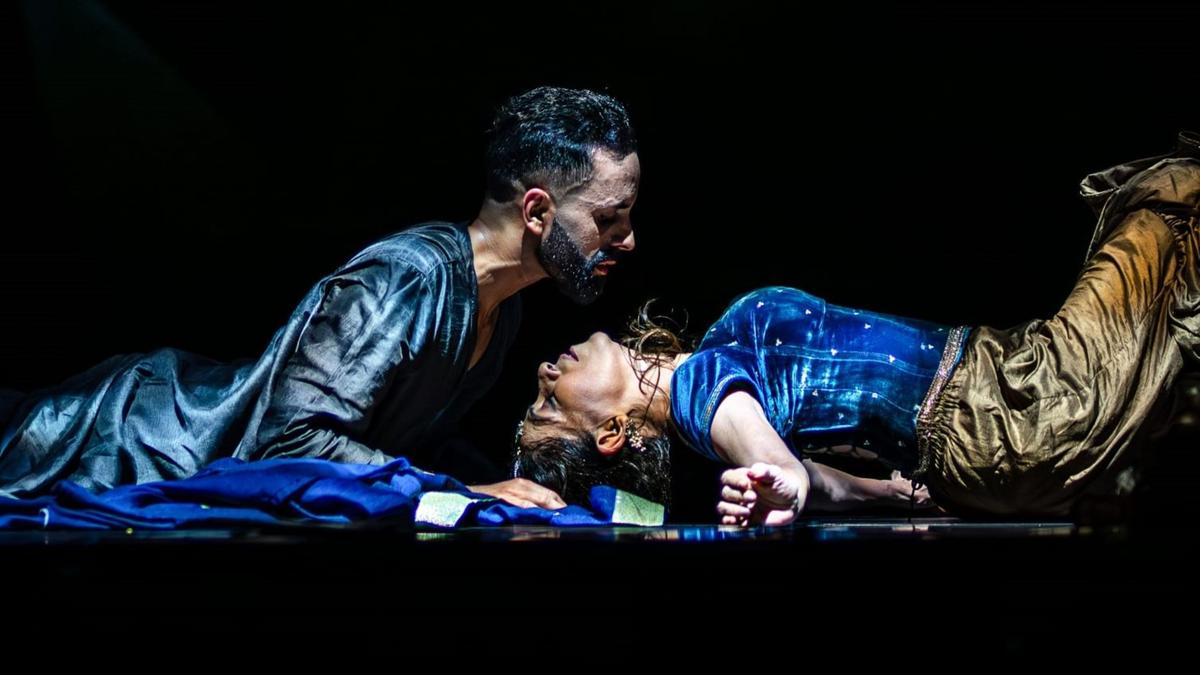
When dance becomes a medium to ask questions
The Hindu
Kathak exponent Aditi Mangaldas will perform in Bengaluru as part of Jagriti’s annual festival, SwarTaal
She is petite and can easily be overshadowed by taller dancers, but this lasts only till the dance begins. When that happens, irrespective of who is dancing with her, your eyes refuse to move from her grace, beauty and the passion with which she moves on stage. She is none other than the doyen of Kathak, Aditi Mangaldas, a perfect balance of being rooted in traditional culture, form and modernism.
If on one hand she is depicting our mythology through Kathak, she also talks about social issues that stir her soul using the contemporary form. Aditi will be in Bengaluru with her dance choreography, Immersed, as part of SwarTaal, Jagriti’s annual festival of Indian classical music and dance aimed at celebrating classical performance arts, music and theatre. The other artistes at SwarTaal are Kapila Venu and TM Krishna.
Immersed, Aditi says, over phone from her home in Delhi, is about Krishna. “He is one of the most beloved and interesting gods in the Hindu pantheon. Literature, architecture, dance, music, poetry, sculpture... there are visions of Krishna everywhere! Can one make Krishna into a belief or a concept? Can one hold Krishna as something fixed and static? Can he be of any gender, class or faith? To me, Krishna is the everflowing river, the unquenchable flame, life itself.”
An artiste who has dedicated her life to Kathak and dance, Aditi started dancing when really young. “I cannot attribute the decision of taking to dance to myself. My parents realised I shared my day’s experiences by jumping on a table and dancing away. My mother wanted to dance when she was young but was not allowed to and then my parents decided to put me through music, dance and visual arts to give me an overall education.”
This was when she was four, Aditi says. “Nothing happened till one day I went to a dance class and fell in love with the teacher, Kumudini Lakhia (the legendary Kathak dancer) and she became my guru. That is how Kathak happened to me.”
Kathak has had a challenging history, says Aditi. “It has travelled through temples, Mughal courts, kothas, proscenium stages and now is one of the foremost styles through which a contemporary work can be created. When dancer Akram Khan uses Kathak as a source for dance, it shows Kathak had not only its classical entrants but also possibilities of explorations inherent within itself. Kathak has many windows that one can open. This has excited and challenged me as a dancer.”
Aditi trained from the age of five to 22 under Kumudini Lakhia and Birju Maharaj from age 22 to 26. “They were magical years. I refer to them in the present tense, as their work lives on. Their perception was also different from the others. Kumudiniji was always ‘Kathak without Krishna’, while Maharajji was ‘Kathak is Krishna’. Yet, they could, together, live, dance and explore the dance simultaneously and together, proving that having diverse viewpoints do not mean hating one another, but celebrating the difference just as in nature and life.”


South African naturalist Steve Boyes speaks on ghost elephants, ancestral tracking, and Werner Herzog’s documentary exploring Angola’s elusive highland giants

Actor-director Amol Palekar will receive META's Lifetime Achievement award for 2026 on March 25 in New Delhi.

India's artists unite against rising censorship, advocating for creative freedom and support for marginalized voices in the arts.

Written and directed by Kunal, the film also stars Sparsh Shrivastava and Vanshika Dhir

This year, Bharatnatyam artistes will present the Tyagaraja Aradhane as a dance performance

This year, Bharatnatyam artistes will present the Tyagaraja Aradhane as a dance performance

The actor, along with director Sushant Shah, speak about their upcoming series ‘Chiraiya’, Divya’s process of working on the dialect, Sushant’s approach to telling a story about women, and more

An independent video, ‘Feel the Spark’ by Raleigh Rajan with vocals by Ciera Dumas that celebrates Tamil literary giants, garnered 1.4 million views in less than 36 hours.

In ‘Jack Ryan: Ghost War’, John Krasinski is back as the savvy CIA analyst, diving headfirst into a high-stakes mission that unravels a deadly conspiracy and pits him against a rogue black-ops unit

Shriram Bharatiya Kala Kendra’s Shankarlal festival showcased rare ragas, radiant artistry, and inclusive performances, from Pt Madhup Mudgal’s serene morning ragas to Ramana Balachandran’s Saraswati veena.

Explore "Threads that Bind: The Kantha Project," an exhibition in Delhi reimagining kantha as a medium of repair and renewal.

Sean Penn skips the Oscars to meet Ukraine's Zelenskyy, who praises him as a "true friend" amid the war.

The teaser of Tamil star Suriya’s much-awaited film with director Venky Atluri, titled Vishwanath and Sons, was unveiled by the makers on Monday