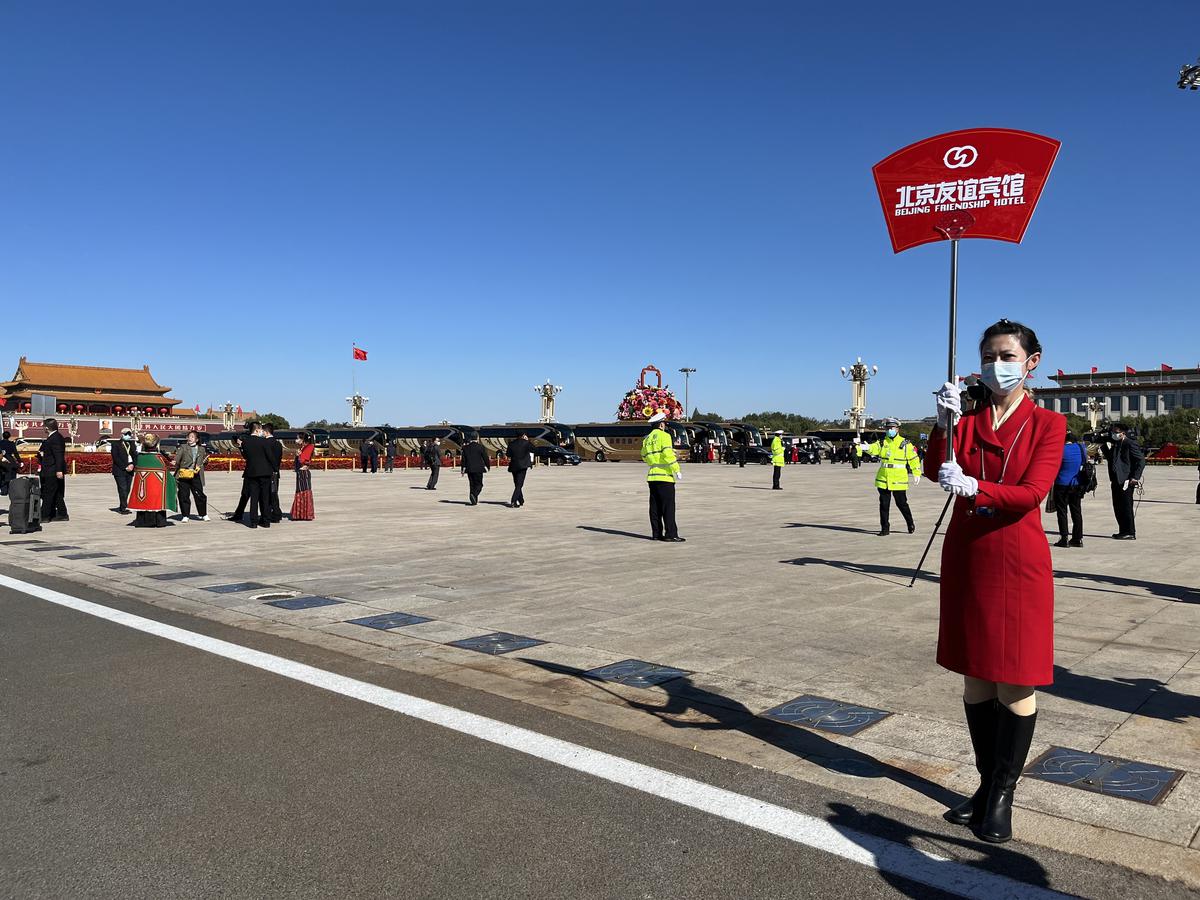
When Beijing became a bubble within a bubble for the 20th National Congress of China’s Communist Party
The Hindu
Journalists covering the event had to live in a “closed loop” cut off from the rest of the city, country and the world
If China remains, three years into the pandemic, a “zero-COVID” bubble isolated from the world, the Chinese capital, for a few weeks in October, became a bubble within a bubble.
As China’s leaders gathered for a once-in-five-years congress of the Communist Party, to mark the start of a third five-year term for Xi Jinping, the capital was the most secure place in China. Residents of any city that logged even a single COVID-19 case were essentially barred from travelling to Beijing, which was also, as is the case for most party congresses, covered in a blanket of security.
And even within the Beijing bubble, for the course of a week in mid-October, a few buildings became yet another bubble within a bubble — a sterile, high-security conclave for any congress attendee. Journalists covering the event had to live in what was a “closed loop” that extended to a few hotels and congress venues, and was cut off from the rest of the city, country and the world.
I entered the closed loop on a cold and smoggy Wednesday morning, a good three days before the closing session that was open to the media. Entering the loop required a PCR test and presenting your seven-day travel history to prove you did not leave Beijing. In China, of course, this is all done through apps. There is a Beijing Health Kit that logs all your test results — every Beijing resident is required to take a test every three days, without which you cannot enter a shopping mall or hospital or even hail a cab — and a travel app that, based on your phone number, tracks where you have been.
There is no hiding from the ‘zero-COVID’ regime, under which neighbourhoods are locked down for just a single case and all close contacts are sent to quarantine facilities. The world may have moved on from lockdowns and mass testing, but China certainly hasn’t.
Authorities went all out to ensure that COVID-19 wouldn’t disrupt the congress — and Xi’s coronation. Reporters in the closed loop were tested not just daily but twice a day — once in the morning and once at night. No wonder that they managed to pull off the event without any cases being reported in the bubble.
The elaborate arrangements and suffocating security shed some light on Chinese Communist Party politics. The congresses are elaborately choreographed spectacles that drag on for a week with much pomp and circumstance, although all the outcomes — from the amended party Constitution, which further enshrined Xi’s unrivalled position as a “core” leader for years to come, to the unveiling of the next leadership of the Politburo, which was stacked fully with Xi’s men — were decided well in advance. Close to 2,300 delegates from all over China were flown in just to rubber-stamp the decisions.


Saudi Arabia expels Iranian military staff amid escalating tensions and ongoing missile attacks during the U.S.-Israeli war on Iran.

Russia claims control of Potapivka village in Ukraine's Sumy region amid ongoing military efforts to establish a buffer zone.

Iranian missile strikes on Israeli towns cause widespread damage and injuries, marking a significant escalation in the ongoing conflict.

As Gor makes first trip as U.S. Special envoy to South Asia, Delhi watches strategic signals closely
Sergio Gor's inaugural trip as U.S. Special Envoy to South Asia signals strategic U.S. engagement amid regional tensions.

Slovenians vote in a tight election between liberal and populist candidates, impacting the country's future domestic and foreign policies.

Netanyahu asserts U.S.-Israel alliance fights Iranian threats, emphasizing global security after missile strikes on Israeli and European targets.

Israeli settlers attack Palestinian villages in the West Bank, causing injuries and destruction amid ongoing settlement expansion.

Britain asserts no evidence of Iran planning missile strikes on Europe, despite Israeli claims of missile capabilities.

UNESCO reports over half of countries have banned phones in schools due to concerns about attention, cyberbullying, and social media impact.

Analysis reveals a U.S.-operated Patriot missile likely caused a pre-dawn explosion in Bahrain, injuring numerous civilians.

Sri Lanka raises fuel prices by 25% amid ongoing West Asia conflict, impacting petrol and diesel costs significantly.

Iran strikes near Israeli nuclear research center as Trump threatens attacks on Iranian power plants
Iran's missile strikes near Israel's nuclear site escalate tensions as Trump threatens retaliation against Iranian power plants.

Saudi Arabia intercepts one of three ballistic missiles targeting Riyadh amid ongoing regional tensions and threats from Iran.