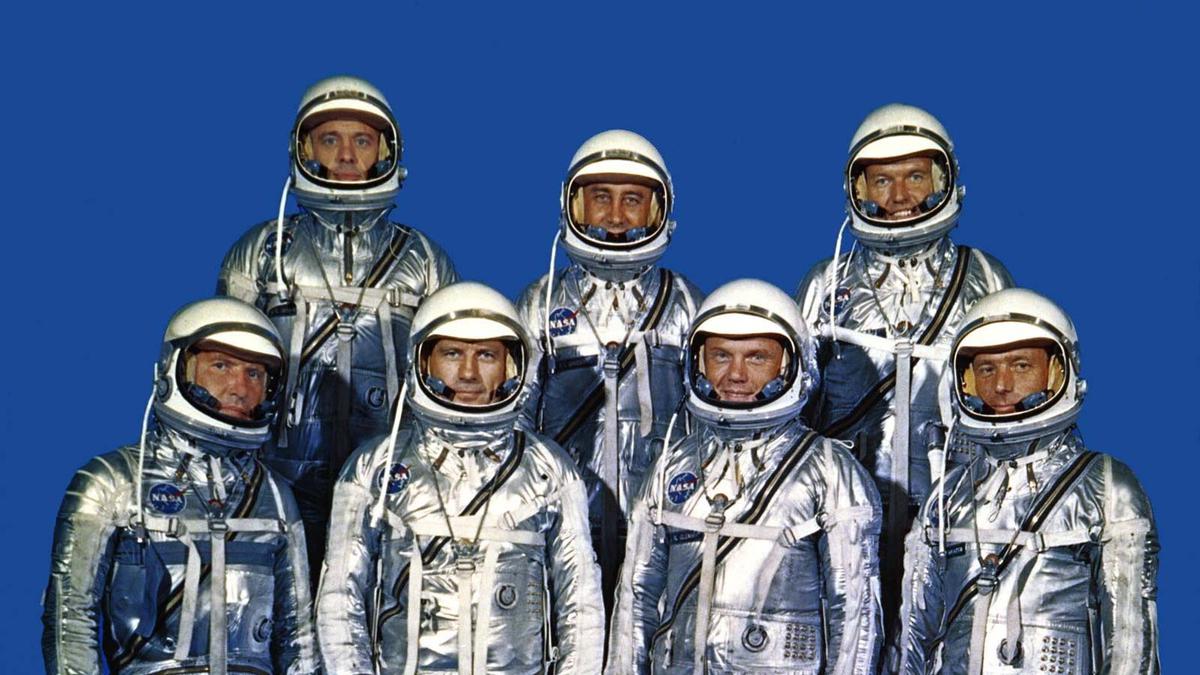
When America met its Original Seven astronauts Premium
The Hindu
On April 9, 1959, NASA formally announced the selection of the U.S.’ first seven astronauts for Project Mercury to the nation and the world. A.S.Ganesh talks about the rigorous procedure that led to the selection of Scott Carpenter, Gordon Cooper, John Glenn, Gus Grissom, Wally Schirra, Alan Shepard, and Donald Slayton, and the successful careers that they had…
When growing up as a child, many now have the dream of becoming an astronaut in the future. Few grow up to realise that dream due to various reasons. If this is the case now, when space exploration continues to be on the rise, imagine how difficult it must have been to become an astronaut when different countries were pursuing the idea for the first time.
Naturally then, astronauts who achieved any firsts are likely to be remembered for a long time. If one of the firsts they achieved was the fact that they were announced as the first astronauts of their country, then they would be even more popular in all likelihood. The Mercury Seven – a group of seven astronauts selected by NASA to fly spacecraft for Project Mercury – are a case in point.
Also referred to as the Original Seven and Astronaut Group 1, the Mercury Seven were the first seven astronauts of the U.S. In an event that took place in the ballroom of the Dolley Madison House on Lafayette Square in Washington, DC on April 9, 1959, their names were formally announced, making it known to the country and the world the fate that awaited them. The place where the announcement was made served as the first headquarters of the newly formed space agency NASA, less than a year old itself.
It was T. Keith Glennan, NASA administrator, who introduced them to the gathered audience, even as they were seated at a long table on what was a makeshift stage. Glennan called out their names in alphabetical order (last names), saying “Malcolm S. Carpenter, Leroy G. Cooper, John H. Glenn, Virgil I. Grissom, Walter M. Schirra, Alan B. Shepard, and Donald K. Slayton … the nation’s Mercury astronauts!”
Before the event concluded, it was clear to each one of them that their lives would no longer be the same as public attention was almost always going to be on them. As test pilots, most of them had little exposure to media, meaning that photo calls and answering numerous questions posed by the gathered reporters were all a new experience.
But then, these seven were men who had made their way through one of the toughest selection processes ever. With nobody knowing what it would take to travel and survive into the unknown realm of space, there was no correct criteria to select people who would be the U.S.’ first astronauts. Those on the panel decided to err on the side of caution, placing the bar really high.
After considering multiple high-risk professions, NASA staff, along with U.S. President Dwight D. Eisenhower, decided that the country’s active military pilots provided for the best candidates. Based on their performance as test pilots and medical history, 110 people were selected, who also ticked the other selection criteria, which, among others, included being a male, not over 40 years old, and less than 5 feet 11 inches (1.80 m) in height.


Discover the Minor Planet Centre, the key hub for tracking and verifying observations of small solar system bodies.

In this week's Science for All newsletter, XX explains

Test your knowledge with the quiz on Science films at the Oscars through history

Set between the Siwalik hills and the plains, Butwal offers travellers a mix of regional cuisine, pilgrimage trails to Lumbini and the comfort of Hyatt’s new hospitality landmark

Explore 2026's wallpaper trends in India, highlighting botanicals and handmade designs that enhance modern homes with nature-inspired aesthetics.

Mercedes-Benz CLA 250+ with EQ Technology review: design, performance, range and features explained. Discover how the new electric CLA combines advanced AI, long range, fast charging and futuristic styling for the next generation of luxury EVs.

AI tool for sparrow conservation

BTS’s comeback with ‘Arirang’ marks a major global music event. When does the album release, and where can you watch their concert live stream? We have all the details

The 2026 U.S. cholesterol guidelines urge starting screening and treatment at 30 to prevent cardiovascular disease effectively.

Olam Festival 2026 in Thiruvananthapuram returns March 27-29 with 120+ vendors, music, art, and cultural zones.

A few storytellers in Thiruvananthapuram share their journeys, challenges, and evolving methods on World Storytelling Day, inspiring young minds.

76-year-old Kurian Jacob from Kerala triumphs with seven medals, including five golds, at the Open Masters Games in Abu Dhabi.

Explore the nature of the human mind as an emergent property of brain activity and complex neural interactions.