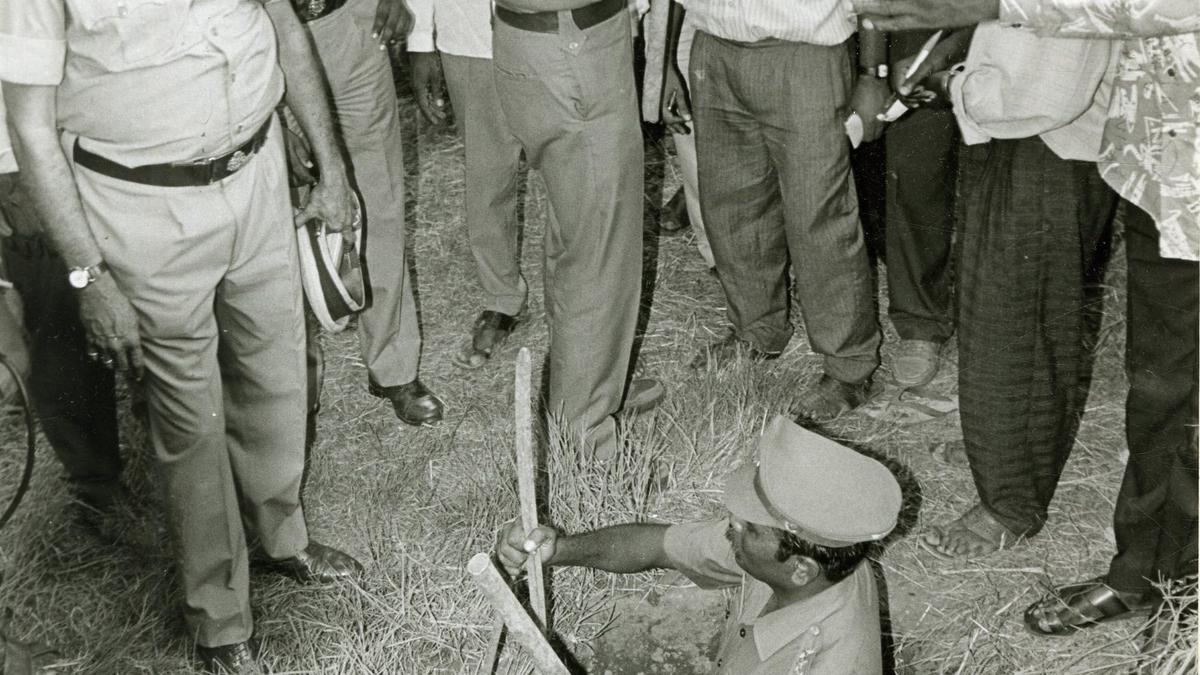
When 43 LTTE militants escaped from the Vellore Fort after digging a 153-foot tunnel
The Hindu
LTTE militants escape Vellore Fort through tunnel, sparking manhunt; captured later, raising questions about security measures.
Around 3 a.m. on August 15, 1995, policemen on night patrol on Sivagnanam Road at T. Nagar in Chennai stopped two men on a cycle-rickshaw. A constable noticed a handbag and tried to examine its contents. In a flash, one of the men bit a cyanide capsule tied around his neck and almost instantly dropped dead. In the confusion, the other man rode away on a cycle kept nearby with the bag. The police found a Vellore tailor shop’s label on the dead man’s shirt. A few hours later, at the Egmore Railway Station, a policeman in plainclothes, who had worked in the ‘Q’ Branch, noticed a group of 11 waiting to board a Madurai-bound train. He found their Tamil accent different. Suspecting something, he quietly approached the Railway Police. As a posse of policemen walked towards the group, two of them bit cyanide capsules. One of them died and the other was later hospitalised. A few women constables of the Government Railway Police overpowered some of the fleeing men. Angry at being caught, some of them bit the women in a vain bid to escape.
It did not take long to conclude that the men involved in the two incidents shared a common link. All belonged to the Liberation Tigers of Tamil Eelam (LTTE), the Sri Lankan Tamil outfit, which was banned in India in 1991, following the assassination of former Prime Minister Rajiv Gandhi. It emerged that 43 hardcore LTTE militants, including four women, all of whom were housed in a special camp in the Vellore Fort, had escaped after digging a 153-foot-long tunnel in the Tippu Mahal. The tunnel was dug from one of the bathrooms to the moat. “Two batches of six militants each escaped on the night of August 13, while a group of 11 slipped out after midnight on Monday. The rest fled afterwards,” reported The Hindu in its August 16, 1995 edition.
The daring escape had sent shock waves as the camp was well-guarded: it had five watchtowers and two companies of the Central Reserve Police Force to assist the Tamil Nadu Police. Chief Minister Jayalalithaa immediately convened a meeting with Chief Secretary N. Haribhaskar and Director-General of Police V. Vaikunth to work out a strategy to recapture the militants. The Superintendent of Police of North Arcot-Ambedkar district (as Vellore was known then) was suspended, along with officers in charge of security at the camp. The government announced a reward of ₹10,000 for anyone sharing information about the escaped militants. It ordered a judicial inquiry headed by Justice T.N. Singaravelu, a retired judge of the Madras High Court. This was not the first time that the LTTE militants had escaped in Tamil Nadu. In November 1992, 18 militants had escaped from the Tippu Mahal itself. In January 1991, the police opened fire in the Vellore camp, when 400-odd militants attempted to break open the window bars and attack the policemen. Some of them had climbed the terrace of the Tippu Mahal and threw stones and bricks at the policemen standing below. An attempt to set ablaze Sub-Inspector Kannappan after dousing him with kerosene was foiled. A militant, Indiran, 21, was killed in the police firing.
Yet, this was the first time that the militants had escaped by digging a tunnel. “The elaborate planning was proved by the fact that the escapees organised themselves into groups and fanned out to different areas. While one group was believed to have arrived in the city by train, another did so by bus. The direction the other groups took was not known,” wrote The Hindu in a report, ‘LTTE escape: Many questions unanswered’. It said, “People in Vellore expressed surprise and disbelief when reporters told them about the militant’s escape by digging a tunnel using old and rusted pipes and other improvised tools. They were anxious to know whether the tunnel had been dug beyond the rampart wall of the fort. How could they do such a job when the fort had a very deep rocky foundation? they wondered.”
When journalists wanted to have a look at the tunnel on day one, the police refused permission. , citing the judicial inquiry. However, on August 19, journalists from Madras were taken to inspect the tunnel, which had just an 1-1/2 foot x 1-1/2 foot entry point on the first floor of the Tippu Mahal. The exit point of 3 feet x 3 feet was located in between the fort and the moat walls on the western side. “Both the entry and exit points looked so hideous that pressmen were reluctant to pass through the tunnel despite the readiness of the police to allow them. Commandos Sathya and Perumal told this correspondent that they could crawl through the tunnel within three minutes, though the route was zigzag at some points,” read a report. Many of the escaped militants were captured later.
(Assistance for overcoming suicidal thoughts is available on the State’s health helpline 104, Tele-MANAS 14416, and Sneha’s suicide prevention helpline 044-24640050.)


Union Minister Kiren Rijiju meets Tamil Nadu Bishops and pastors to discuss minority welfare and counter anti-BJP narratives.

Japan may consider minesweeping in the Strait of Hormuz post-ceasefire, says Foreign Minister Motegi, amid ongoing regional tensions.

Delhi University job fair guidelines excluding School of Open Learning students spark protests over equity and access to opportunities.

Rwanda's Fanny Utagushimaninde, at 15, becomes the youngest player to score a T20 international century.

Assembly polls 2026: Follow updates from The Hindu on the upcoming elections in five States, on March 22, 2026

Currently, only the services in the 32 series stop at the section of the road adjacent to the Broadway terminus, temporarily closed on account of reconstruction work. Small traders association tells R. Ragu that ensuring the services now accommodated at the temporary terminus at Island Grounds stop at NSC Bose road would benefit visitors to the markets in Parrys

The Hindu photo feature on Aragam which is now known as book village. Photos and text by Imran Nissar

The silent reading movement in the Mylapore-Mandaveli-RA Puram area showed up first at Nageswara Rao Park around two years ago, with modest ambitions, when Balaji launched it along with other reading enthusiasts from the region. This initiative has now moved parks, and seems to set to get entrenched in one. Due to renovation work at Nageswara Park, the reading session became irregular. With the Nageswara Rao park work gaining more surface area, it had to be shifted elsewhere. And it seems set to continue with a newly discovered green patch in RK Nagar in the Sundays to follow.

Explore Tamil Nadu's upcoming four-cornered election contest, featuring key players DMK, AIADMK, TVK, and Naam Tamizhar Katchi.

Trump plans to deploy ICE officers for airport security unless Democrats fund the Department of Homeland Security amid ongoing shutdown.

Cuba experiences its second nationwide blackout in a week, exacerbated by an ongoing U.S. oil blockade and energy crisis.

Kamal Haasan urges Tamil media to avoid the term "censorship" in films, advocating for artistic freedom and recognition of certification.

Pottalurani residents boycott elections again, demanding closure of fish waste processing units impacting health and environment.