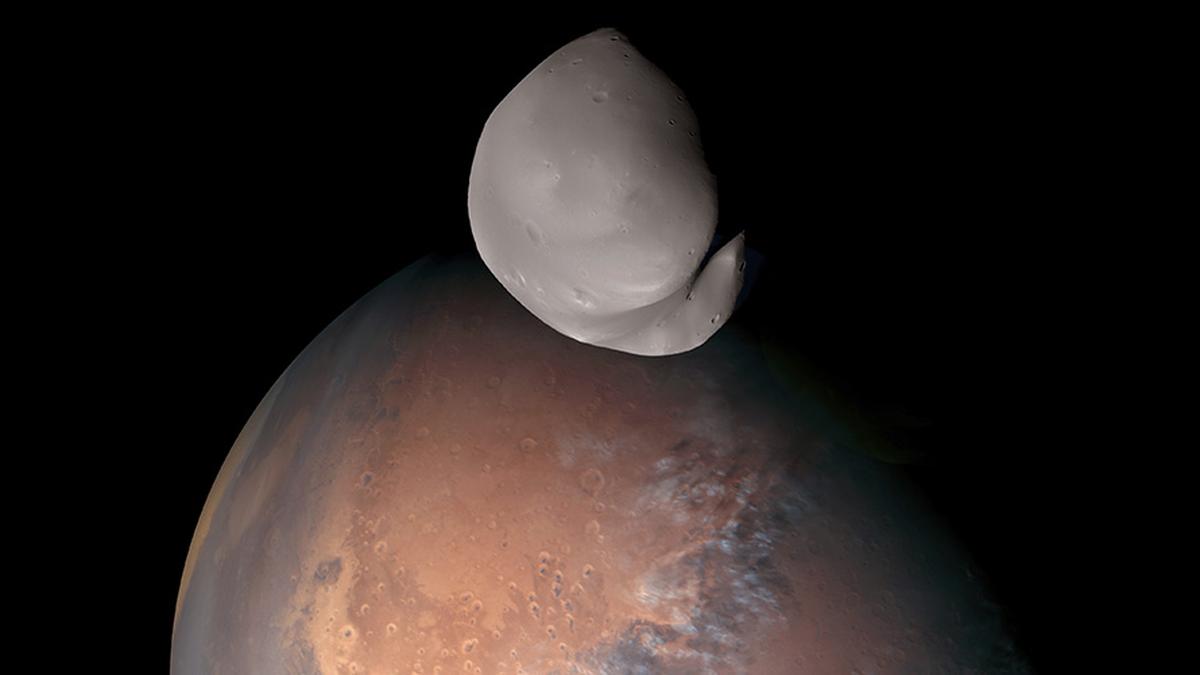
What would it take to turn Mars into a life-friendly planet like the earth? Premium
The Hindu
To sustain people beyond Earth will take a lot of time, energy and imagination. But engineers and scientists have started to chip away at the many challenges.
When I was in middle school, my biology teacher showed our class the sci-fi movie “Star Trek III: The Search for Spock.”
The plot drew me in, with its depiction of the “Genesis Project” – a new technology that transformed a dead alien world into one brimming with life.
After watching the movie, my teacher asked us to write an essay about such technology. Was it realistic? Was it ethical? And to channel our inner Spock: Was it logical? This assignment had a huge impact on me.
Fast-forward to today, and I’m an engineer and professor developing technologies to extend the human presence beyond Earth.
For example: I’m working on advanced propulsion systems to take spacecraft beyond Earth’s orbit. I’m helping to develop lunar construction technologies to support NASA’s goal of long-term human presence on the Moon. And I’ve been on a team that showed how to 3D-print habitats on Mars.
To sustain people beyond Earth will take a lot of time, energy and imagination. But engineers and scientists have started to chip away at the many challenges.
After the Moon, the next logical place for humans to live beyond Earth is Mars.


76-year-old Kurian Jacob from Kerala triumphs with seven medals, including five golds, at the Open Masters Games in Abu Dhabi.

Explore the nature of the human mind as an emergent property of brain activity and complex neural interactions.

CERN's Large Hadron Collider discovers the Xi-cc-plus particle, enhancing understanding of quantum mechanics and baryon behavior.

Vibha Batra’s latest book, Spotless (Hachette India) is a novel in verse for young adults

In its first edition, the Madras Art Salon spotlights the works of journalist and artist Narayan Lakshman at The Botanical Club, a social space in the British Deputy High Commission, Chennai

Cholesterol enhances melanoma cell invasion by making nuclei squishier, revealing a potential treatment target in cancer progression.

The designers reinterpret the Swedish artist’s symbolic forms and colour energy through contemporary resortwear silhouettes

Discover the inspiring legacy of Bibha Chowdhuri, a pioneering woman in physics and a trailblazer in STEM history.

Discover the inspiring legacy of Bibha Chowdhuri, a pioneering woman in physics and a trailblazer in STEM history.

Ashdeen’s Spring 2026 collection features saris inspired by the designer’s Parsi gara archive

Red ochre burials, ritual markings and myths across cultures show that red repeatedly marks liminal thresholds such as puberty, sacrifice and death; anthropologists argue that the colour functions as a technology of collective ritual and value, binding communities through shared symbolic acts

India approves 23 institutions for quantum labs under the National Quantum Mission, aiming to advance quantum technology and research.

India approves 23 institutions for quantum labs under the National Quantum Mission, aiming to advance quantum technology and research.