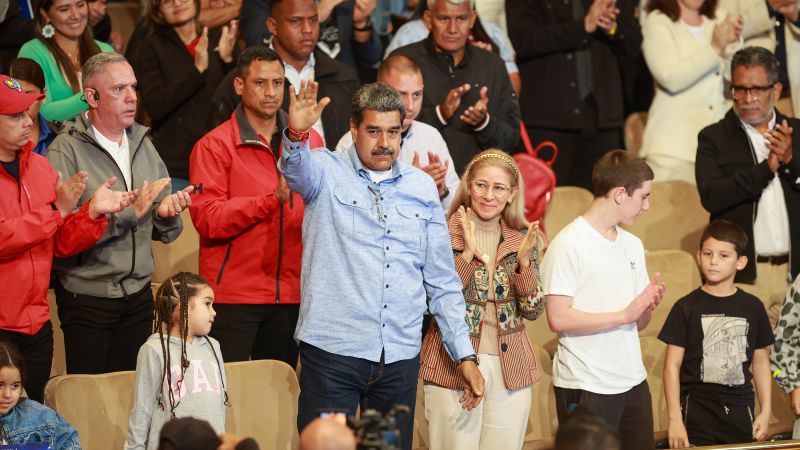
What to expect in Venezuela’s presidential election as strongman Maduro faces his biggest test yet
CNN
Millions of Venezuelans are expected to cast their ballots on Sunday, July 28, in what many see as the most consequential election in the country since strongman leader Nicolás Maduro came to power more than a decade ago.
Millions of Venezuelans are expected to cast their ballots on Sunday, July 28, in what many see as the most consequential election in the country since strongman leader Nicolás Maduro came to power more than a decade ago. The vote pits the authoritarian Maduro – who has overseen unprecedented levels of poverty and emigration from the country – against Edmundo Gonzalez Urrutia – a quiet, bird-loving grandfather who has built a strong following despite being the opposition’s third choice after its two preferred candidates were barred from running. But experts warn that the result of the vote may well be contested. Maduro has a habit for clinging to power, they point out: his government has long been accused of rigging votes and the 2018 election that returned Maduro to office was described as illegitimate by an alliance of 14 Latin American nations, Canada and the United States. Maduro, who took the mantle of the populist Chavismo movement after his predecessor Hugo Chavez’s death in 2013, is seeking his third consecutive six-year term in office. His last race was largely boycotted by the opposition. The Organization of American States called that vote a “farce,” noting that it was “held with a generalized lack of public freedoms, with outlawed candidates and parties and with electoral authorities lacking any credibility, subject to the executive power.” At campaign events this year – usually rollicking, dance-filled affairs – Maduro has framed his opponents as “fascist” and “manipulable,” claiming that they would privatize the country’s healthcare and oil industry and “give away our wealth.” Though under his watch, Venezuela has seen the rapid collapse of its democracy and nearly eight million of its people flee the country. Inflation has soared and food shortages spread as the country underwent “the single largest economic collapse for a non-conflict country in almost half a century,” as the International Monetary Fund put it.


An Air Canada plane traveling from Montreal collided with an emergency vehicle on the runway at New York City’s LaGuardia Airport in the late hours of Sunday night, killing two pilots and injuring dozens of people.

Top Senate Republicans on Capitol Hill believe their party is unified behind a plan to reopen the Department of Homeland Security. Now, they need to sell the plan to Democrats.

Markwayne Mullin will serve as Donald Trump’s next Department of Homeland Security secretary, elevating the US senator to helm the agency at the center of the president’s controversial immigration enforcement effort and an ongoing shutdown.

President Donald Trump’s sudden turnabout and, according to him, rapidly advancing peace talks made for an abrupt shift in the administration’s approach to the Iran war.

The Supreme Court’s conservative majority appeared dubious of state laws that allow the counting of mail ballots that arrive at election offices after Election Day as justices heard oral arguments in a challenge to Mississippi’s five-day grace period for mail ballots.

The chief district judge in New Jersey appointed Robert Frazer, a career prosecutor, to serve as US attorney for the state, ending for now a dispute over the legality of the office’s leadership that threatened to derail criminal investigations.

Tens of thousands of taxpayer dollars were spent on expenses for hair and makeup artists and a horse for the advertisement showcasing outgoing Department of Homeland Security Secretary Kristi Noem in front of Mount Rushmore, according to invoices seen by CNN.

President Donald Trump was presented Sunday with a potential off-ramp to the more than month-long Department of Homeland Security shutdown: fund every part of the department except enforcement operations by Immigration and Customs Enforcement, two sources familiar with the conversations told CNN.

Immigration and Customs Enforcement agents are heading to 13 airports today to help with crowd management as travelers at some airports wait in hours-long security lines amid the DHS shutdown. Follow here for the latest.

A consortium of the nation’s top architectural and historic preservation groups is targeting President Donald Trump’s plans to temporarily close and extensively renovate the Kennedy Center, filing a new lawsuit Monday that asks a federal judge to indefinitely halt the project.

ICE agents sent to airports as TSA callouts remain high; separately, two people have died after a plane collided with a fire truck at New York’s second biggest airport. Follow for live updates

Mike Pence used to dream of following two successful Donald Trump terms with his own turn in the White House.

An Air Canada plane was damaged after colliding with a vehicle on a runway at New York’s LaGuardia Airport Monday, according to video from the scene and air traffic control audio.