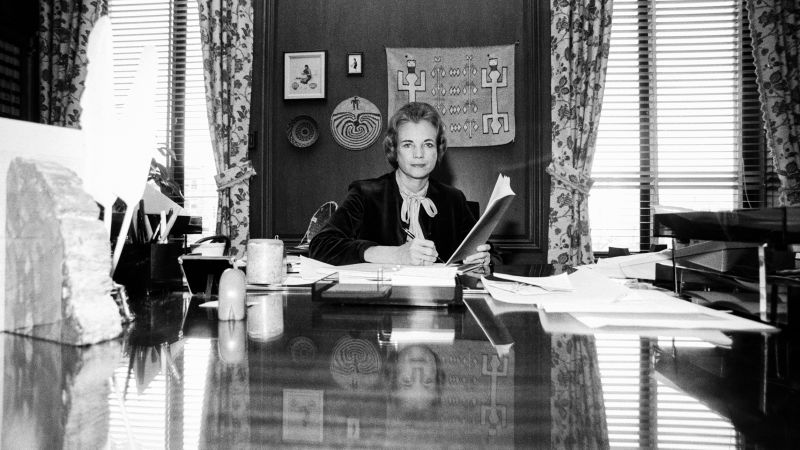
What Sandra Day O’Connor’s papers reveal about a landmark Supreme Court decision – and why it could be overturned soon
CNN
The newly opened papers of the late Justice Sandra Day O’Connor reveal the internal deliberations of a groundbreaking Supreme Court case that gave US regulators significant latitude to protect the environment and public health – and show how the ruling almost never happened.
The newly opened papers of the late Justice Sandra Day O’Connor reveal the internal deliberations of a groundbreaking Supreme Court case that gave US regulators significant latitude to protect the environment and public health – and show how the ruling almost never happened. The 40-year-old milestone, Chevron USA v. Natural Resources Defense Council, has become a target of the current Supreme Court and appears likely to be rolled back in a pair of pending cases this term. “Chevron deference,” as it is commonly called, generally requires judges to accept federal agencies’ interpretations of open-ended or vaguely worded statutes regarding their mandates. Conservative critics, including Justice Neil Gorsuch, believe it has led to excessive regulation of American business by executive branch agencies. Defenders of regulatory power, including the court’s three liberals, counter that agencies – with their focused expertise – are needed to safeguard public health and welfare. More broadly, O’Connor’s contemporaneous notes now open at the Library of Congress offer a view into how nine justices communicate in private, revealing personal predilections and some exasperation as they negotiate against looming deadlines. In the Chevron case, testing the protections of the Clean Air Act, the papers reveal an overall tentativeness among justices as they struggled with statutory intricacies and worked toward compromise while teetering on the loss of a quorum (only six of the nine justices were on the final tally). Yet Chevron v. NRDC became a seminal opinion, cited in lower court opinions and law review articles more than just about any other case.


A statue of Christopher Columbus has been erected outside of an ornate federal office building on the White House grounds — the latest sign of the Trump administration’s efforts to reshape cultural and historical representations across the nation’s capital.

Kentucky Gov. Andy Beshear, speaking in JD Vance’s home state of Ohio on Saturday, tore into the vice president, questioning his Appalachian roots and telling voters they “deserve better.”

President Donald Trump has said ICE agents will head to US airports tomorrow amid a partial government shutdown. Follow for live updates

Cuba is working to restore the electricity supply after another island-wide blackout left more than 10 million people without power.

President Donald Trump said Sunday border czar Tom Homan will be in charge of deploying Immigration and Customs Enforcement agents to airports on Monday, with Homan telling CNN the agents will help with security at entrances and exits to ease the Transportation Security Administration’s workload.

Donald Trump wants us to believe that a deal with Cuba is close at hand. After this past week, I am not so sure.

President Donald Trump has said ICE agents will head to US airports tomorrow amid a partial government shutdown. Follow for live updates

President Donald Trump said Sunday border czar Tom Homan will be in charge of deploying Immigration and Customs Enforcement agents to airports on Monday, with Homan telling CNN the agents will assist with security at entrances and exits to ease TSA workload amid a partial government shutdown.

Janet Mills and her allies are counting on a gender gap to narrow Platner’s wide lead ahead of the June 9 primary to decide who will face incumbent Republican Sen. Susan Collins. They are betting that the unfiltered style that has brought Platner widespread attention as someone who could help Democrats reach young men will backfire with women.

Why do people “pledge allegiance” to a “state” that is no longer a state? And what spurs someone to not just attack innocent people, but to then make a statement of loyalty while doing so?

A Supreme Court case examining state deadlines for election ballots sent in the mail is just the tip of the spear in President Donald Trump’s war on mail-in voting.

As a shrinking number of Transportation Security Administration agents work to keep hourslong security lines moving despite not being paid, President Donald Trump stepped into the fray Saturday, announcing he will send Immigration and Customs Enforcement officers to airports by Monday if Congress doesn’t agree to a plan to end the partial government shutdown.

Donald Trump wants us to believe that a deal with Cuba is close at hand. After this past week, I am not so sure.