What is ‘Take It Down Act’ signed by Donald Trump to combat ‘revenge porn’?
The Hindu
The Take It Down Act criminalizes non-consensual intimate image sharing, requiring removal within 48 hours, with bipartisan support.
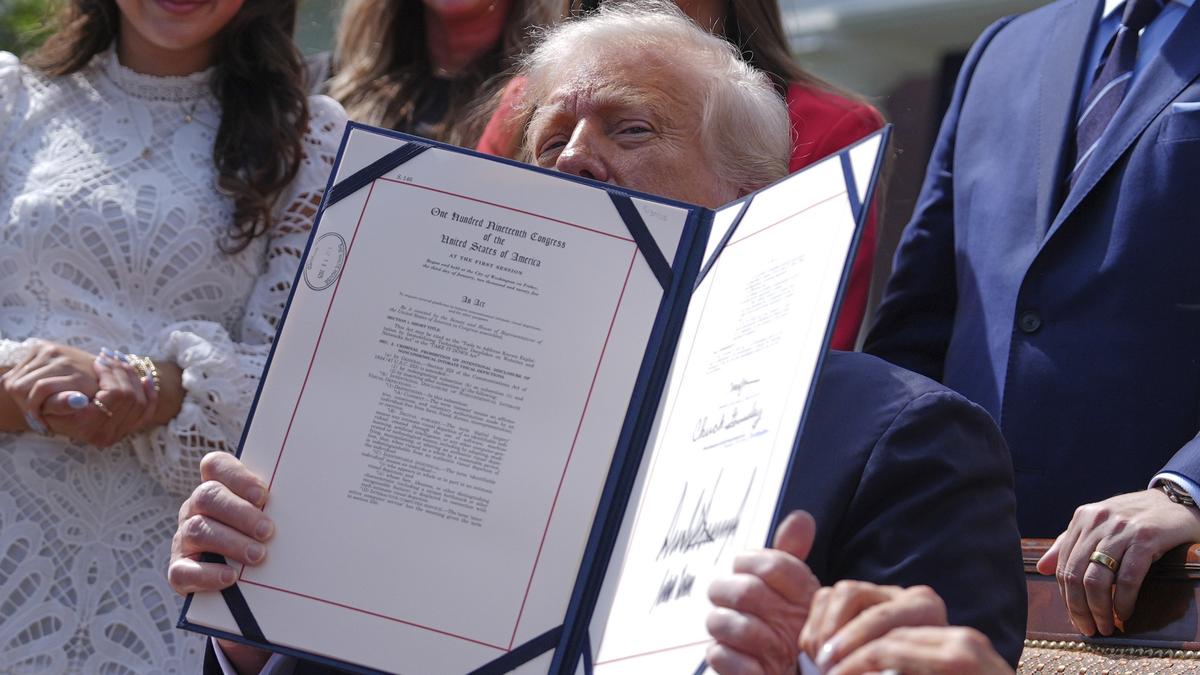
U.S. President Donald Trump signed a bill making it a federal crime to post “revenge porn” - whether it is real or generated by artificial intelligence. The ‘Take It Down Act,’ passed with overwhelming bipartisan congressional support, criminalizes non-consensual publication of intimate images, while also mandating their removal from online platforms.
The Take It Down Act makes it illegal to “knowingly publish” or threaten to publish intimate images without a person’s consent, including AI-created “deepfakes.” It also requires websites and social media companies to remove such material within 48 hours of notice from a victim. The platforms must also take steps to delete duplicate content. Many states have already banned the dissemination of sexually explicit deepfakes or revenge porn, but the Take It Down Act is a rare example of federal regulators imposing on internet companies.
The Take It Down Act has garnered strong bipartisan support and has been championed by Melania Trump, who lobbied on Capitol Hill in March, saying it was “heartbreaking” to see what teenagers, especially girls, go through after they are victimized by people who spread such content.
The Act was inspired by Elliston Berry and her mother, who visited his office after Snapchat refused for nearly a year to remove an AI-generated “deepfake” of the then 14-year-old.
Meta, which owns and operates Facebook and Instagram, supports the legislation.
An online boom in non-consensual deepfakes is currently outpacing efforts to regulate the technology around the world due to a proliferation of AI tools, including photo apps digitally undressing women.
While high-profile politicians and celebrities, including singer Taylor Swift and Democratic congresswoman Alexandria Ocasio-Cortez, have been victims of deepfake porn, experts say women not in the public eye are equally vulnerable.


Saudi Arabia expels Iranian military staff amid escalating tensions and ongoing missile attacks during the U.S.-Israeli war on Iran.

Russia claims control of Potapivka village in Ukraine's Sumy region amid ongoing military efforts to establish a buffer zone.

Iranian missile strikes on Israeli towns cause widespread damage and injuries, marking a significant escalation in the ongoing conflict.

As Gor makes first trip as U.S. Special envoy to South Asia, Delhi watches strategic signals closely
Sergio Gor's inaugural trip as U.S. Special Envoy to South Asia signals strategic U.S. engagement amid regional tensions.

Slovenians vote in a tight election between liberal and populist candidates, impacting the country's future domestic and foreign policies.

Netanyahu asserts U.S.-Israel alliance fights Iranian threats, emphasizing global security after missile strikes on Israeli and European targets.

Israeli settlers attack Palestinian villages in the West Bank, causing injuries and destruction amid ongoing settlement expansion.

Britain asserts no evidence of Iran planning missile strikes on Europe, despite Israeli claims of missile capabilities.

UNESCO reports over half of countries have banned phones in schools due to concerns about attention, cyberbullying, and social media impact.

Analysis reveals a U.S.-operated Patriot missile likely caused a pre-dawn explosion in Bahrain, injuring numerous civilians.

Sri Lanka raises fuel prices by 25% amid ongoing West Asia conflict, impacting petrol and diesel costs significantly.

Iran strikes near Israeli nuclear research center as Trump threatens attacks on Iranian power plants
Iran's missile strikes near Israel's nuclear site escalate tensions as Trump threatens retaliation against Iranian power plants.

Saudi Arabia intercepts one of three ballistic missiles targeting Riyadh amid ongoing regional tensions and threats from Iran.