What is new in Ladakh’s government job reservation policy? | Explained Premium
The Hindu
New regulations in Ladakh provide 95% government job reservation, language policies, and hill council composition changes.
The story so far:
On June 3, President Droupadi Murmu notified four Regulations for the Union Territory (U.T.) of Ladakh, defining new policies on reservation, languages, domiciles, and composition of hill councils for Ladakh, which became a Union Territory in 2019. The notified regulations were The Ladakh Official Languages Regulation, 2025; The Ladakh Civil Services Decentralisation and Recruitment (Amendment) Regulation, 2025; The Ladakh Autonomous Hill Development Councils (Amendment) Regulation, 2025; and The Union Territory of Ladakh Reservation (Amendment) Regulation, 2025.
The Regulations pave the way for 85% reservation for resident Ladakhis in government jobs. The Rules notified empowered the tehsildar to issue the domicile certificates. To be considered “domiciles” and thus eligible for the 5% quota in government jobs in the U.T., non-local residents must prove a continuous 15-year stay in the U.T. starting from October 31, 2019. Added with the 10% quota for the Economically Weaker Sections, the total government job reservation in the U.T. now stands at 95%, one of the highest in the country.
According to the 2011 Census, Ladakh’s population is 2,74,289, and nearly 80% are tribals. The U.T. has a majority Buddhist population in Leh and a sizeable Muslim population in Kargil.
Another recently notified policy said that at least one-third of the seats in the hill councils of Leh will be reserved for women, on a rotational basis across jurisdictions, and the official languages of the U.T. will be English, Hindi, Urdu, Bhoti, and Purgi.
After the special status of Jammu and Kashmir under Article 370 of the Constitution was read down on August 5, 2019, the former State was split into two Union Territories — J&K and Ladakh, the latter without a legislative Assembly. After initial euphoria, the Ladakhi civil society groups began protests demanding protection of land, resources, and employment. Concerns arising out of big businesses and outsiders acquiring land and jobs led people to protest and observe shutdowns. Cutting across party lines, locals and a former BJP MP demanded restoration of protection as granted under Article 35A of the Constitution, which was revoked with Article 370 in 2019. Article 35A lets the J&K legislature decide the “permanent residents” in the former State, prohibits a non-J&K resident from buying property, and ensures job reservation for its residents.
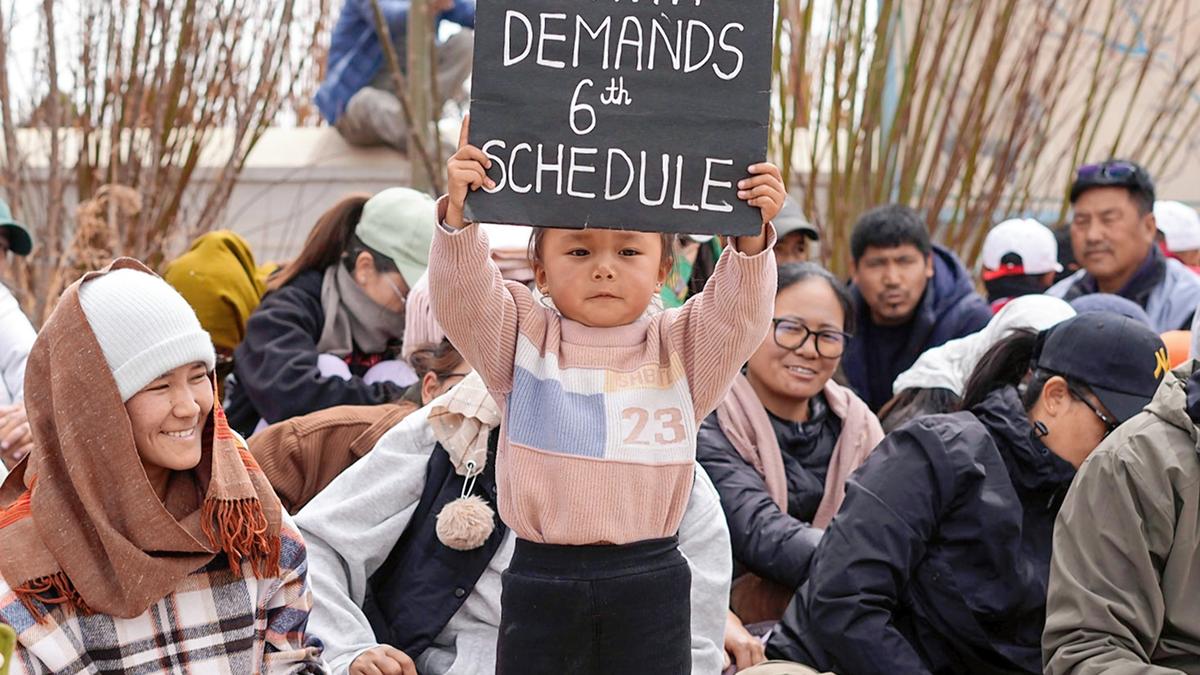
In 2020, the People’s Movement for Constitutional Safeguard or the Leh Apex Body (LAB) was formed, backed by the powerful Ladakh Buddhist Association. In 2021, the LAB and the Kargil Democratic Alliance came together to fight for constitutional safeguards for the region. Together, they came up with four key demands: inclusion under the Sixth Schedule of the Constitution (giving tribal status and autonomy over land), Statehood, separate Lok Sabha seats for Leh and Kargil districts, and filling of existing government vacancies.


Deputy Chief Minister Udhayanidhi Stalin laid the foundation for a new synthetic track in Salem's multi-purpose sports complex.

Congress claims dissolving Manipur's Assembly is essential for restoring peace and addressing the people's grievances in ongoing crisis.

A South Indian spread at Ammani Mess in Coimbatore

Karnataka's II PUC practical exams will be web-streamed and monitored with CCTV to prevent malpractice and ensure integrity.

Young India Skills University achieves milestone by training over 1,000 students in skill-based programmes

Mettur Dam's water level is at 104.52 feet, with inflow at 360 cusecs and discharge at 11,000 cusecs.

Haris Beeran urges the Election Commission to resolve issues hindering overseas Indians' electoral participation and access to voter information.

Coimbatore’s Annapoorna launches filter coffee lip balm

BMTC will provide special metro-feeder bus services for Chitra Santhe on January 4, 2026, ensuring convenient travel for visitors.

T.N. Finance Secretary launches The Hindu Year Book 2026, a vital reference for 2025's key events and insights.

Northeast students protest at Jantar Mantar for justice following Anjel Chakma's murder, demanding a thorough investigation and accountability.

Discover the crucial role of elbow bony tips in arm function and how to prevent and treat related pain effectively.

Explore Telangana's pivotal events, government decisions, and economic developments that shaped 2025 in this comprehensive wrap-up.