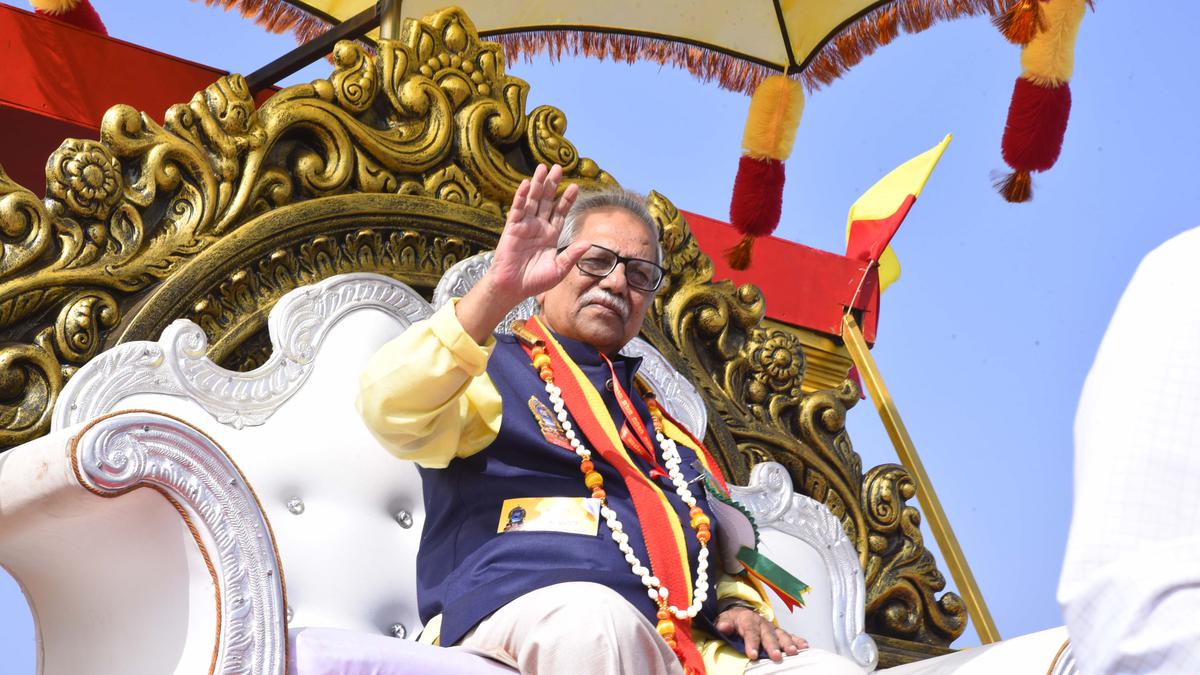
What has double engine government done for Kannada, asks Kannada Sahitya Sammelana president Doddarange Gowda
The Hindu
President of the 86th Akhila Bharata Kannada Sahitya Sammelana and renowned poet Doddarange Gowda claimed that Sanskrit got ₹643 crore and Tamil ₹23 crore while Kannada got ₹3 crore between 2017 and 2020 for classical language research
In an embarrassment to the BJP leaders who keep harping on the benefits of a ‘double engine government’, president of 86 th Akhila Bharata Kannada Sahitya Sammelana and renowned poet Doddarange Gowda sought to know what the State and Union governments had really done for the cause of Kannada, particularly with regard to its classical language status.
In his address, copies of which were circulated among mediapersons, Mr. Gowda compared the fund allocation to classical languages for studies and research to bring out the discrimination.
“This is not a complaint from Kannada alone but also of other classical languages, including Tamil, Telugu, Malayalam and Odiya. The Union Government released grants a amounting to ₹643 crore between 2017 and 2020 for studies in Sanskrit. For the same period, grants released for studies and research in Kannada was ₹3 crore and for Tamil ₹23 crore. Between 2017 and 2021, the grant released for Tamil was ₹42 crore. If such is the situation, what is the use of getting classical language status? What has the Union government, which keeps talking about the benefits of double engine government, done for Kannada?”
Mr. Gowda said the responsibility of bringing the money due towards studies in classical language is on the ruling dispensation in Karnataka. He suggested setting up a high-level committee under the chairmanship of Minister for Kannada and Culture to pursue the issue. He also suggested constitution of a committee led by additional chief secretary to study the Tamil Nadu model on classical language studies, and emulate the same.
In his 48-page address, Mr. Gowda dealt with issues concerning Kannada and Kannadigas at length, but chose to highlight only a few of them in his speech.
One of them is the need for facilitating technical education in Kannada. He suggested setting up ‘Kannada Jnana Vijnana Tantrajna Karypade’ (Kannada Knowledge Science Technology Task Force) and bringing out ‘Word Corpus’ to suggest Kannada equivalent for various technical terms.
“This apart, curriculum for technical education in Kannada should be framed. The government should encourage students who come forward to pursue technical education completely in Kannada by bearing their educational expenses,” he said.


Palla urges NDA leaders to unite for grassroots outreach, enhancing public trust through balanced welfare and development initiatives.

Horses shone at Auroville's 2026 event, showcasing equestrian talent through dressage, derby, and show jumping competitions.

Telangana Governor Shiv Pratap Shukla attends Bihar Foundation Day celebrations in Hyderabad, honoring Bihar's historical and cultural contributions.

Samsung workers protest for the reinstatement of 27 suspended employees, citing unfulfilled promises from the Labour Minister.

The Vice-Chancellor of Rajiv Gandhi University of Health Sciences (RGUHS) B. C. Bhagavan said on Sunday that the university will soon open a research centre on Yoga and Naturopathy on 60-acre land in Bengaluru.

UT Matters: Construction of Uppar drain road overbridge in Puducherry to be completed in four months, amid traffic regulations.

Union Minister Dharmendra Pradhan highlights Bharat Innovates' aim to elevate Indian deep-tech startups to the global stage.

In an exclusive interview, DMK MLA Ezhilan discusses Tamil Nadu's 2026 elections, party structure, and local governance challenges.

Minister Satish Jarkiholi asserts confidence in retaining Davangere and Bagalkot seats in upcoming bypolls amid addressing internal discontent.

Sunil Ambekar of RSS emphasizes national unity, defending road prayer restrictions and promoting awareness of shared ancestry in India.

Opposition MPs and activists voice strong concerns against proposed amendments to the Transgender Persons Act at a Delhi hearing.

Four Assam police commandos injured in an extremist attack during a gunfight in Tinsukia district, officials report.

Campaigning intensifies in Ernakulam district as candidates engage voters ahead of the crucial Assembly polls.