What does spaceflight do to the human body? | Explained Premium
The Hindu
Explore the effects of spaceflight on the human body, including on bones, muscles, the heart, the brain, and the eyes, and what researchers do and don’t know about mitigating or reversing them.
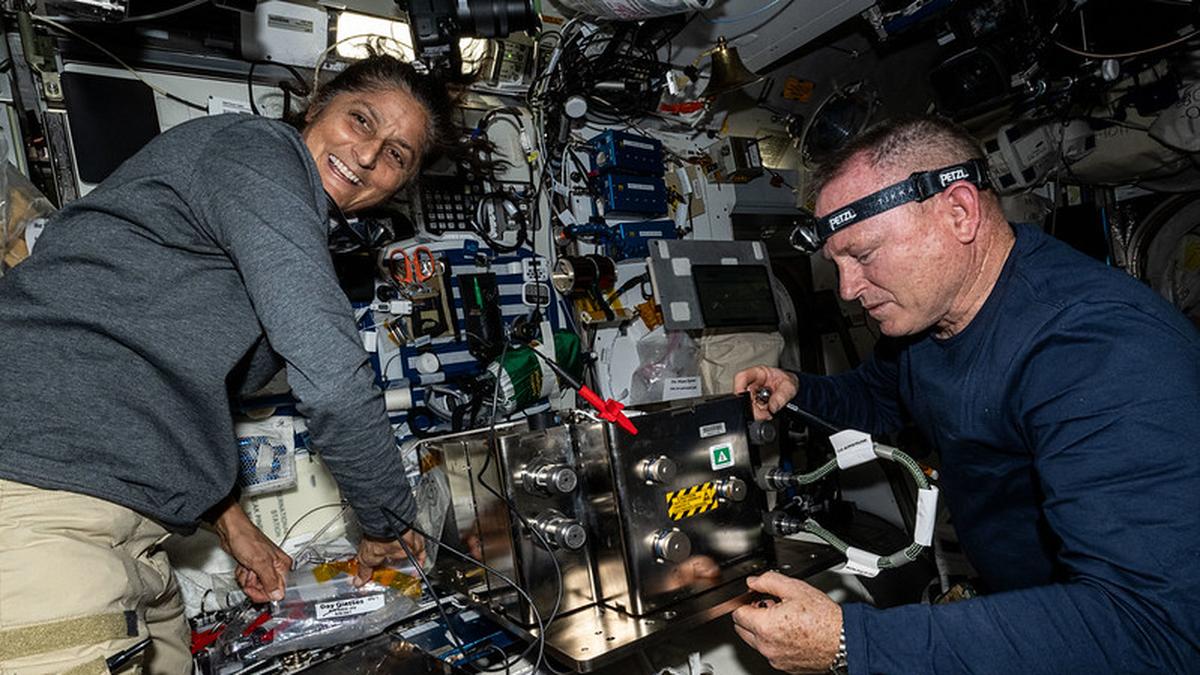
The story so far: On August 24, NASA said Boeing’s Starliner crew capsule that took astronauts Sunita Williams and Barry Wilmore to the International Space Station (ISS), as part of its first crewed test flight, wasn’t safe enough to transport them back. Instead, NASA extended Williams’s and Wilmore’s stay onboard the ISS until February 2025, when they will return in a SpaceX crew capsule to be launched in September 2024. Boeing’s Starliner will have to undock and return uncrewed.
It’s easier to identify ‘space’ millions of kilometres away from the earth than it is near the planet because the conditions transition from ‘earth-like’ to ‘space-like’ gradually. In aeronautic and astronautic circles, space begins from the Karman line, which is 100 km above sea level. Similarly, the force of gravity can be said to be approaching zero several billion kilometres from a massive body but is nonetheless present. This is why the astronauts onboard the ISS experience microgravity, not zero gravity.
Thus, space may be a vast expanse but different parts of space can confront astronauts with wildly different ambient conditions. The Van Allen radiation belts around the earth are a good example. They lie above the Karman line, from 640 km to 58,000 km up. They consist of charged particles from outer space that have become trapped in the earth’s magnetic field. Researchers worked out the amount of radiation these belts expose astronauts to during the U.S. Apollo programme (not harmful) and thereon also determined astronauts’ exposure in outer space, where the belts won’t protect them. In this article, ‘space’ means above the Karman line and in microgravity conditions.
While hundreds of astronauts have flown to space, they don’t make up a cohort large enough for researchers to study them and reliably elucidate all the effects of spaceflight on their bodies. They have also spent very different amounts of time there and have reported different symptoms after different trips. However, some broad trends have emerged centred on the body’s bones, digestion, eyes, heart, muscles and nerves. All these organs and systems in response to environmental conditions on the earth.
For example, in microgravity, bones become weaker, which might force the body to deposit the ‘excess’ mineral content in the kidneys, leading to renal stones. Food may move more slowly through the gut and lead to weight gain. Around 20% of all astronauts and 70% of those involved in long-duration spaceflight develop a disease called spaceflight-associated neuro-ocular syndrome (SANS): more fluids enter the head and build up at the back of the eye, affecting eyesight.
Because of the body’s weightless experience, the heart is required to do less work and could shrink. Similarly, other parts of the musculature could shed muscle mass and strength. The blood loses more red blood cells per day than it does on the ground (a 2022 study in Nature Medicine quantified the loss rate but couldn’t discern the cause), which means astronauts’ diets need to be adjusted to deliver more energy for their bodies to make more of these cells. The brain works constantly on the earth to help the body maintain its balance, sense of orientation, and positional stability using signals from various parts of the body, including the eyes and the inner ear. These signals deviate from ‘normal’ in space and force the brain to work harder to determine proper balance.
If these are the symptoms, researchers have identified some important shared causes: radiation exposure, confined and hostile environments, distance from the earth, and gravitation, among others. The second among them also speaks to psychological factors like fatigue, loss of morale, and a sense of helplessness vis-à-vis the astronauts’ family’s needs on the earth.


The government plans to amend the FCRA, introducing new regulations for NGO asset management and accountability for key functionaries.

The draft policy for “Responsible Digital Use Among Students”, released on Monday by the Department of Health and Family Welfare, has recommended that parents set structured routines with clear screen-time rules and prioritise privacy, safety, and open conversation with children on digital well-being.

Police Observer Sushant Kumar Saxena conducts surprise inspection at Shencottai police station, reviewing warrants and security arrangements ahead of elections.

Andhra Pradesh government to launch key projects in April, focusing on industrial growth and infrastructure development, says Nara Lokesh.

Lok Sabha refers the Corporate Laws (Amendment) Bill to a JPC amid opposition concerns over CSR provisions dilution.

SHG members in Kanniyakumari use snakes and ladders to raise election awareness and boost voter turnout.

Government accelerates consultations for early implementation of the Women’s Reservation Act to ensure women’s representation in 2029 elections.

CM A. Revanth Reddy distributes ₹1 crore insurance cheques to families of deceased Electricity department employees, enhancing financial security for workers.

The Bengaluru Traffic Police (BTP) registered 634 cases of drunk driving during a week-long special enforcement drive conducted across the city between March 16 and March 22.

GHMC intensifies action against property tax defaulters, seizing properties and offering a One Time Settlement scheme for payments.

CCB arrests three drug peddlers in Mangaluru, seizing ₹2.5 lakh worth of MDMA and other valuables.

TVK's 28 candidates in Puducherry include former BJP MLAs, a sitting Independent, and a retired police IG.

BRS submits notice on private member bill to Speaker