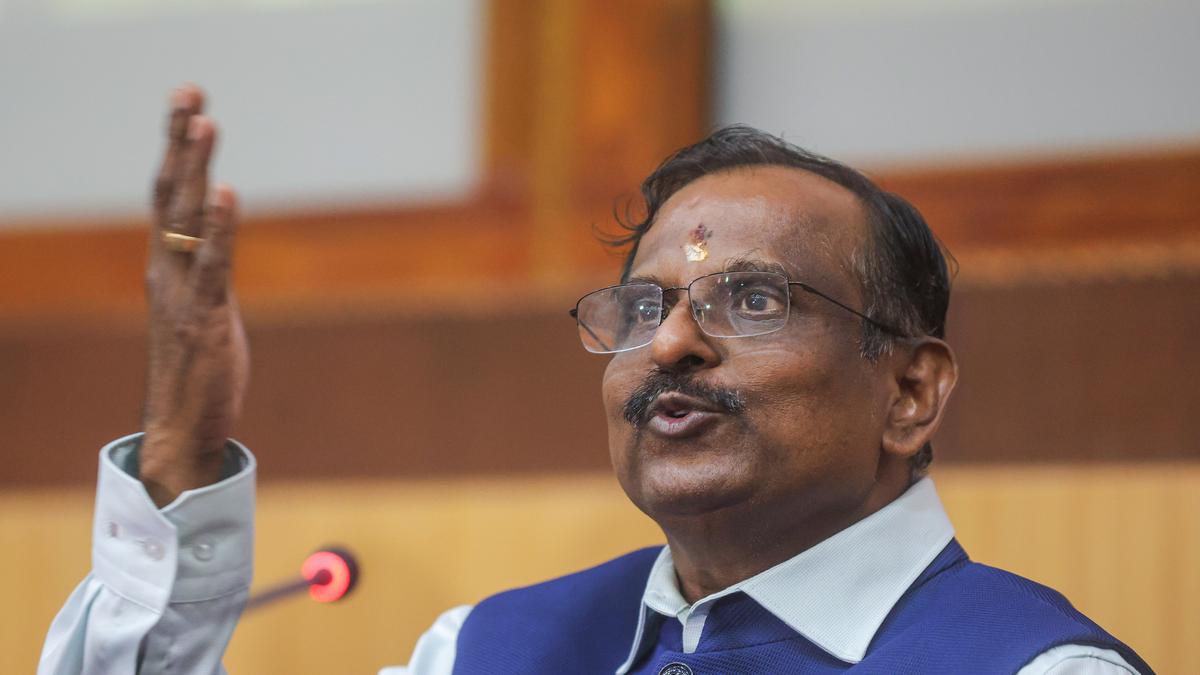
We want to restart cryogenic stage in flight for mission advantages: ISRO chief
The Hindu
ISRO Chairman discusses successful CE20 cryogenic engine test and Space Docking Experiment at Aero India International Seminar 2025.
A day after ISRO successfully carried out the ignition trial of the indigenous CE20 cryogenic engine, its Chairman and Secretary of Department of Space V Narayanan on Saturday (February 8, 2025) said that the test would be advantageous to missions.
The Chairman also said there were no glitches as reported in the media in ISRO's first Space Docking Experiment (SpaDeX) mission.
"We want to restart the cryogenic stage in the flight for mission advantages. So, we recently carried out a test towards that," Narayanan told PTI on the sidelines of the 15th Biennial Edition of Aero India International Seminar 2025, held in Bengaluru.
On February 7, ISRO successfully carried out the ignition trial of the indigenous CE20 cryogenic engine powering the upper stage of LVM3, with a multi-element igniter under vacuum conditions, which simulates the engine ignition in the vacuum condition of space. This test was carried out in the High-Altitude Test Facility at ISRO Propulsion Complex in Mahendragiri, Tamil Nadu.
According to an ISRO release, during this test, the ignition of the engine Thrust Chamber was carried out with a multi-element igniter in vacuum, under the tank pressure conditions that are expected to prevail at the time of restarting the cryogenic engine in flight.
The performance of the engine and the facility during the test was normal and as expected, it added.
On reports in the media on glitches in the SpaDeX mission, Narayanan said, "No glitches, right now it is docked. We are going step by step. We are studying and then we are planning to do a lot of experiments." On January 16, the space agency successfully performed the docking of satellites as part of the Space Docking Experiment (SpaDeX) and it also announced that post docking, control of two satellites as a single object was successful. In this mission, NVS-02 navigation satellite was successfully injected into the intended Geosynchronous Transfer Orbit.


Discover the Minor Planet Centre, the key hub for tracking and verifying observations of small solar system bodies.

Discover the Minor Planet Centre, the key hub for tracking and verifying observations of small solar system bodies.

In this week's Science for All newsletter, XX explains

Test your knowledge with the quiz on Science films at the Oscars through history

Set between the Siwalik hills and the plains, Butwal offers travellers a mix of regional cuisine, pilgrimage trails to Lumbini and the comfort of Hyatt’s new hospitality landmark

Explore 2026's wallpaper trends in India, highlighting botanicals and handmade designs that enhance modern homes with nature-inspired aesthetics.

Mercedes-Benz CLA 250+ with EQ Technology review: design, performance, range and features explained. Discover how the new electric CLA combines advanced AI, long range, fast charging and futuristic styling for the next generation of luxury EVs.

AI tool for sparrow conservation

BTS’s comeback with ‘Arirang’ marks a major global music event. When does the album release, and where can you watch their concert live stream? We have all the details

The 2026 U.S. cholesterol guidelines urge starting screening and treatment at 30 to prevent cardiovascular disease effectively.

Olam Festival 2026 in Thiruvananthapuram returns March 27-29 with 120+ vendors, music, art, and cultural zones.

A few storytellers in Thiruvananthapuram share their journeys, challenges, and evolving methods on World Storytelling Day, inspiring young minds.

76-year-old Kurian Jacob from Kerala triumphs with seven medals, including five golds, at the Open Masters Games in Abu Dhabi.