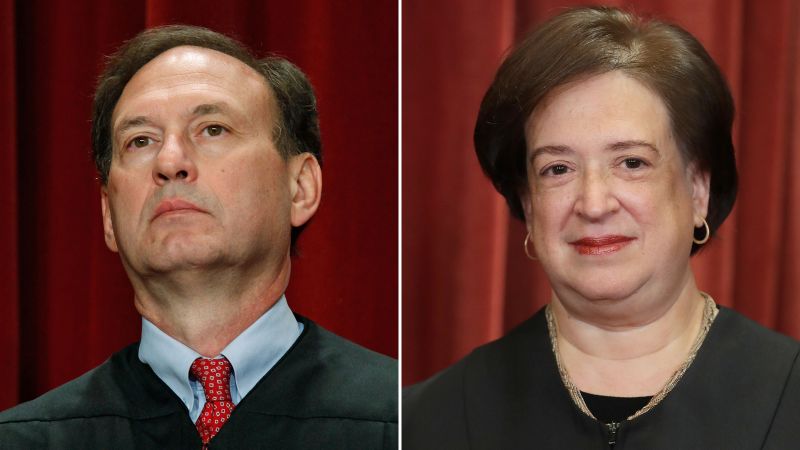
‘We enjoy this sometimes’: The rhetorical battle between Justices Alito and Kagan at the Supreme Court
CNN
Alito and Kagan are sharp-tongued strategic questioners and both keenly aware of which other justices might be in play – open to persuasion – during arguments in a case
The morning after Donald Trump was reelected president, Justices Samuel Alito and Elena Kagan began jousting more than usual. They personify the ideological and political gulf on America’s highest court. Alito, a 74-year-old Trenton, New Jersey, native is prepared to tear through decades-old landmarks, while Kagan, a 64-year-old New Yorker and one of three remaining liberals, clings to them. The rhetorical sparring this session highlights a pattern between two forceful justices that is likely to intensify when the Trump administration takes office and bold new policies face lawsuits. On the bench and in opinions, Alito has been markedly irritated in recent years, even as his positions on the law have largely prevailed. His mood has helped fuel speculation over his possible retirement with a new Republican president in office to appoint his successor. Still, 74 is relatively young for a justice to leave the bench. And Alito remains engaged in the courtroom Q-and-A, unlike some justices as they neared retirement, including Anthony Kennedy as he came close to his 2018 departure. More than other justices on their respective sides, conservative Alito and liberal Kagan are sharp-tongued strategic questioners. They are both keenly aware of which other justices might be in play – open to persuasion – during arguments in a case. They come to the courtroom armed and ready to expose the weaknesses of positions voiced at the lectern by opposing lawyers.


For over a month, Transportation Security Administration employees have been showing up to work at US airports without getting paid.

CNN’s 5 Things AM brings you the news you need to know every morning.

Both President Donald Trump and first lady Melania Trump have encouraged Susie Wiles to take the time she needs away from the White House to deal with her treatment, but Wiles argued she does not plan to do so, people familiar said.

A transparency law passed by Congress has forced the release of more Epstein files than ever before, but some lawmakers and victims are exploring ways to push the Justice Department to disclose even more information from the voluminous trove that’s being withheld.

Former US National Counterterrorism Center Director Joe Kent sat Wednesday for an extensive interview with former Fox News host and right-wing podcaster Tucker Carlson, his first public comments since he resigned from his post, citing concerns about the war with Iran.

When Attorney General Pam Bondi and Deputy Attorney General Todd Blanche arrived on Capitol Hill Wednesday afternoon, they hoped to boost members’ confidence on their handling of the Jeffrey Epstein investigation. Within half an hour, Democratic lawmakers had walked out.

Cuba is going dark under US pressure. How the crisis unfolded and why its troubles are far from over
Almost three months after the US effectively imposed an oil blockade on Cuba that worsened its energy crunch, nearly every aspect of Cuban society has been feeling the strain.

The Department of Homeland Security has been ensnared by a partial government shutdown as Congress did not act to fund the agency by the end of Friday. But nearly all DHS workers will remain on the job — even if many won’t get paid until the lapse ends — and the public probably won’t notice much of a change.

The USS Gerald R. Ford aircraft carrier is moving away from operations tied to the Iran war and sailing to the US Navy’s base in Crete for repairs after a fire broke out in the ship’s laundry area last week, a US official said.

An American college student visiting friends for spring break has gone missing in Spain, his family said, adding police have his phone.

A typically friendly setting for one of their own turned tense on Capitol Hill Wednesday with senators grilling Markwayne Mullin for roughly three hours as he vies to become President Donald Trump’s next Department of Homeland Security chief.

Top Trump administration officials testified publicly Wednesday for the first time since the launch of the Iran war three weeks ago.

The White House is temporarily lifting key limits on the shipping of oil, gas and other commodities throughout the US, in its latest effort to counter rising energy prices sparked by its war with Iran.