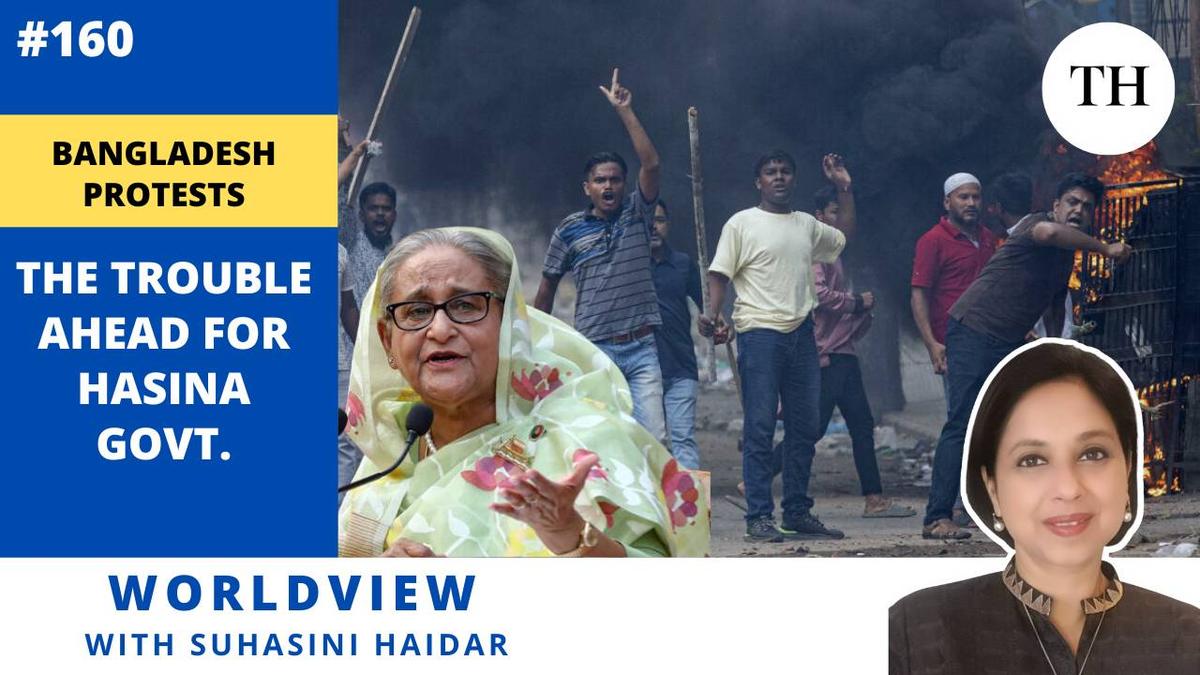
Watch: Bangladesh protests: The trouble ahead for Hasina government
The Hindu
A look at the international reaction to the crackdown in Bangladesh, India’s position, and the possible diplomatic fallout
Nearly 200 are dead from violent student protests and firing by forces in Bangladesh – is PM Sheikh Hasina, who won elections just a few months ago, losing her grip on gen-next, and will the unrest India’s closest neighbour is grappling with, spill over?
But first, Bangladesh is taking a pause from days of brutal violence as forces took on student protestors demonstrating against the quota system. A look at the situation right now, although information remains restricted.
July 1: Protests by students began after the Supreme Court upheld an earlier government order maintaining about 56% of all government jobs would be reserved for freedom fighters – the mukti jodha/ mukti bahini of Bangladesh’s liberation in 1971, their children and even grandchildren. The students on the street said they were fighting what they saw as a move to make the bureaucracy politically aligned to the ruling Awami League.
There’s a lot more on the underlying social, historical and political tensions in this podcast at The Hindu with my colleague Kallol Bhattacherjee.
July 14: In a statement appealing for calm, PM Hasina actually fuelled protestors anger- by saying that those protesting were Razakars- a term used for those Bangladeshis who supported Pakistan in 1971, seen as traitors. The protests battled police, set fire to government buildings IT centres, vandalized a metro station.
Shoot at sight orders, a nationwide curfew, internet bans followed. The army and paramilitary Rapid Action Forces were called in, as the violence spiralled out of control.
July 21: The supreme court’s appellate bench struck down the earlier order, bringing down quotas for freedom fighters and families to 5%. The order helped restore calm, although students groups still demand an apology from PM Hasina, and the resignation of her ministers for the crackdown. In 3 weeks, nearly 200 had been killed, thousands injured - including hundred with eye injuries from pellets and bullets fired by the forces.


Russia claims control of Potapivka village in Ukraine's Sumy region amid ongoing military efforts to establish a buffer zone.

Iranian missile strikes on Israeli towns cause widespread damage and injuries, marking a significant escalation in the ongoing conflict.

As Gor makes first trip as U.S. Special envoy to South Asia, Delhi watches strategic signals closely
Sergio Gor's inaugural trip as U.S. Special Envoy to South Asia signals strategic U.S. engagement amid regional tensions.

Slovenians vote in a tight election between liberal and populist candidates, impacting the country's future domestic and foreign policies.

Netanyahu asserts U.S.-Israel alliance fights Iranian threats, emphasizing global security after missile strikes on Israeli and European targets.

Israeli settlers attack Palestinian villages in the West Bank, causing injuries and destruction amid ongoing settlement expansion.

Britain asserts no evidence of Iran planning missile strikes on Europe, despite Israeli claims of missile capabilities.

UNESCO reports over half of countries have banned phones in schools due to concerns about attention, cyberbullying, and social media impact.

Analysis reveals a U.S.-operated Patriot missile likely caused a pre-dawn explosion in Bahrain, injuring numerous civilians.

Sri Lanka raises fuel prices by 25% amid ongoing West Asia conflict, impacting petrol and diesel costs significantly.

Iran strikes near Israeli nuclear research center as Trump threatens attacks on Iranian power plants
Iran's missile strikes near Israel's nuclear site escalate tensions as Trump threatens retaliation against Iranian power plants.

Saudi Arabia intercepts one of three ballistic missiles targeting Riyadh amid ongoing regional tensions and threats from Iran.

Iran's death toll exceeds 1,500 amid escalating war, with heavy airstrikes and shifting U.S. and Israel strategies reported.