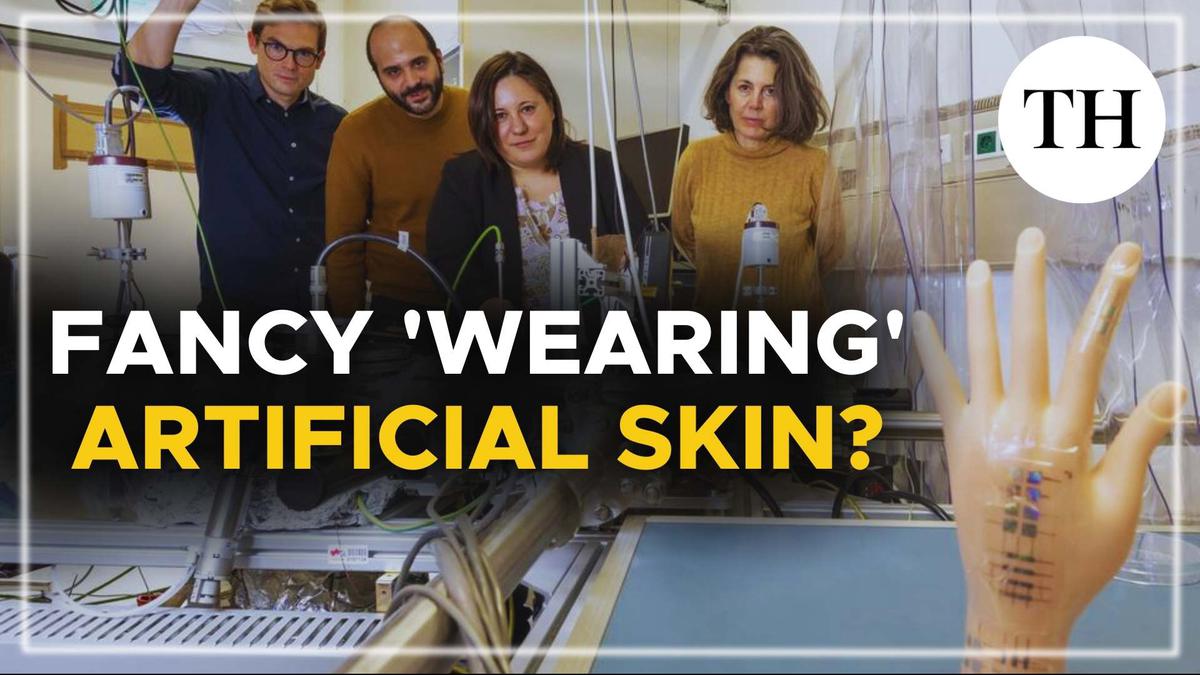
Watch | ‘Artificial skin’ prototype developed by scientists in Austria
The Hindu
All about the new artificial skin prototype developed by scientists at TU Graz in Austria
Scientists at TU Graz in Austria, have developed a prototype for artificial skin. Sometimes in winter, it gets so cold in Graz that you can hardly feel your fingertips.
Just like wearables, this prototype gets really close to the human skin. Last year, Dr. Anna Maria Coclite and her team of researchers from the Institute of Solid State Physics at Graz University of Technology (TU Graz) presented the results of their research to the European Research Council, to land Proof of Concept funding for their project ‘SmartCore’.
Dr. Coclite and her team had succeeded in developing a three-in-one “smart skin” hybrid material, which closely resembles human skin by simultaneously sensing pressure, moisture and temperature and converting them into electronic signals. With 2,000 individual sensors per square millimetre, the hybrid material is more sensitive than a human fingertip, giving it its reputation, and, at 0.006 millimetres thick, many times thinner than human skin.
The team argued that by reacting to these three human sensory impressions, the smart skin prototype surpasses all electronic skin materials on the market to date which only react to pressure and temperature.
The Hindu spoke to Dr Coclite for more on this unique concept.
Read more: The finer touch: when ‘artificial skin’ is more sensitive than the original
Reporting: Ramya Kannan


Discover the Minor Planet Centre, the key hub for tracking and verifying observations of small solar system bodies.

In this week's Science for All newsletter, XX explains

Test your knowledge with the quiz on Science films at the Oscars through history

Set between the Siwalik hills and the plains, Butwal offers travellers a mix of regional cuisine, pilgrimage trails to Lumbini and the comfort of Hyatt’s new hospitality landmark

Explore 2026's wallpaper trends in India, highlighting botanicals and handmade designs that enhance modern homes with nature-inspired aesthetics.

Mercedes-Benz CLA 250+ with EQ Technology review: design, performance, range and features explained. Discover how the new electric CLA combines advanced AI, long range, fast charging and futuristic styling for the next generation of luxury EVs.

AI tool for sparrow conservation

BTS’s comeback with ‘Arirang’ marks a major global music event. When does the album release, and where can you watch their concert live stream? We have all the details

The 2026 U.S. cholesterol guidelines urge starting screening and treatment at 30 to prevent cardiovascular disease effectively.

Olam Festival 2026 in Thiruvananthapuram returns March 27-29 with 120+ vendors, music, art, and cultural zones.

A few storytellers in Thiruvananthapuram share their journeys, challenges, and evolving methods on World Storytelling Day, inspiring young minds.

76-year-old Kurian Jacob from Kerala triumphs with seven medals, including five golds, at the Open Masters Games in Abu Dhabi.

Explore the nature of the human mind as an emergent property of brain activity and complex neural interactions.