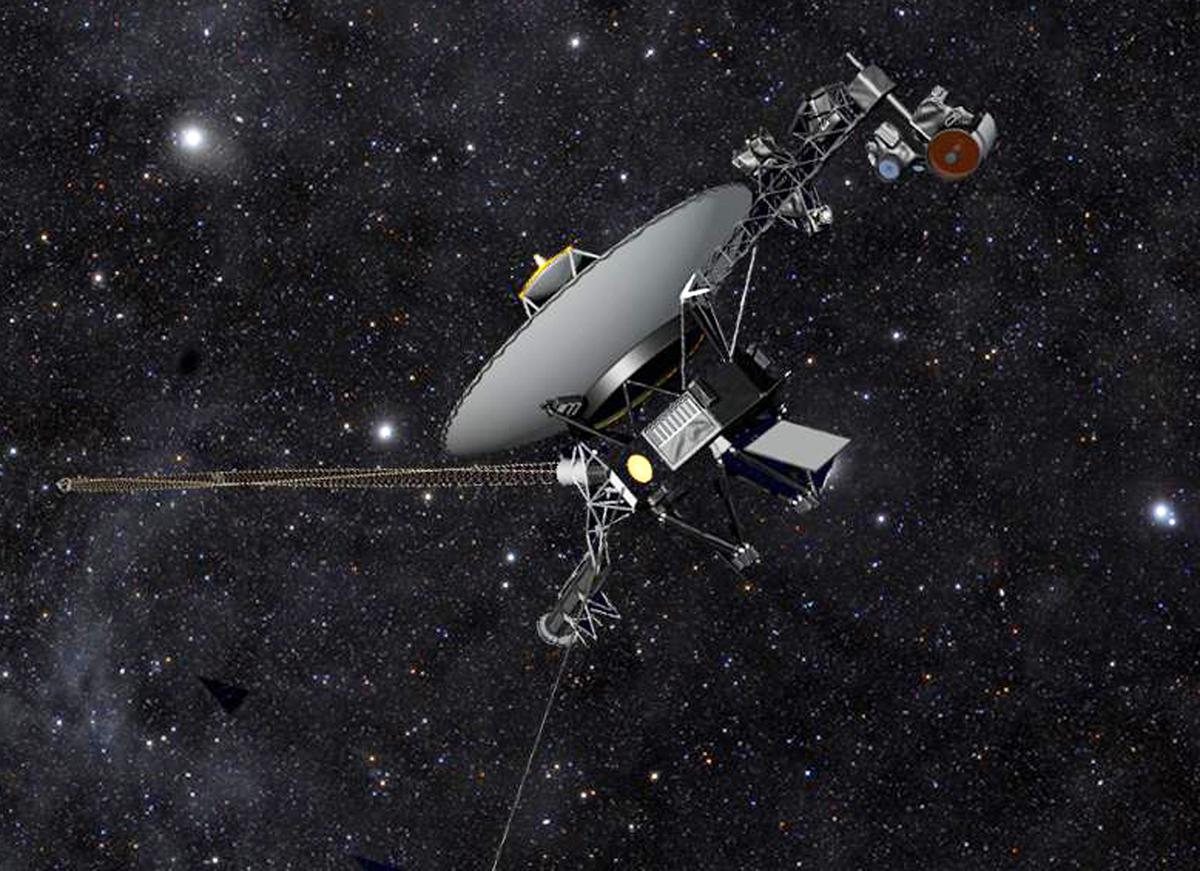
Voyager 1’s tryst with Jupiter and Saturn
The Hindu
On November 6, 1980, Voyager 1 snapped a picture of Saturn while still 8 million km away from it. Scientists discovered a 15th moon orbiting Saturn from the photo the following day. In a year in which it has completed 45 years of operation, A.S.Ganesh takes a look at some of the many learnings from Voyager 1’s visits to Jupiter and Saturn…
You must be aware that the twin Voyager probes are now travelling in interstellar space, 45 years since their launch. Before they got there, however, they visited the gas giants in our solar system, gleaning a wealth of information from the flybys. While Voyager 2 flew by all four gas giants – Jupiter, Saturn, Uranus, and Neptune, – Voyager 1 focussed on Jupiter and Saturn.
Even though Voyager 1 is the first spacecraft to travel beyond the solar system and reach interstellar space, it wasn’t the first of the probes to be launched. Launched on September 5, 1977 – two weeks after Voyager 2 – Voyager 1, however, was the first to race to Jupiter and Saturn.
The Voyager missions were planned in such a way that they could maximise a special alignment of the outer planets that happens only once in 176 years. This alignment aided the spacecraft to efficiently use their limited fuel as they moved like a slingshot from one planet to another using gravitational assist.
All the successes that Voyager 1 has achieved might have come to nothing right on the day of the launch. Its rocket came within 3.5 seconds of running out of fuel, meaning Voyager 1 wouldn’t have even got off the ground.
Once it did, however, it raced past its twin, going beyond the asteroid belt before Voyager 2 did. And in April 1978, Voyager 1 beamed back the first pictures of Jupiter back to Earth. By March 1979, it had spotted a thin ring around the giant planet. Apart from sending back detailed photographs of Jupiter’s Galilean moons (Io, Europa, Ganymede, and Castillo), Voyager 1 also found two new moons – Thebe and Metis.
Voyager 1 collected plenty of data and also made some interesting discoveries about Jupiter’s satellites. Following its closest approach to Jupiter on March 5, 1979, when it came within 2,80,000 km, it headed over to Saturn, a journey that took it just a little over a year.
Just like how its visit to Jupiter had a lot of findings, so it was with Saturn as the ringed planet revealed many of its secrets. As it flew ever closer to Saturn in October-November 1980, Voyager 1 spotted a number of moons, observed its rings and already known moons, and collected data that had scientists digging for decades.


Discover Niraba, a collaboration merging Odisha's sabai grass weaving and dhokra craft into contemporary furniture and lighting design.

How do you create a Christmas tree with crochet? Take notes from crochet artist Sheena Pereira, who co-founded Goa-based Crochet Collective with crocheter Sharmila Majumdar in 2025. Their artwork takes centre stage at the Where We Gather exhibit, which is part of Festivals of Goa, an ongoing exhibition hosted by the Museum of Goa. The collective’s multi-hued, 18-foot crochet Christmas tree has been put together by 25 women from across the State. “I’ve always thought of doing an installation with crochet. So, we thought of doing something throughout the year that would culminate at the year end; something that would resonate with Christmas message — peace, hope, joy, love,” explains Sheena.

Max Born made many contributions to quantum theory. This said, he was awarded the Nobel Prize for physics in 1954 for establishing the statistical interpretation of the ____________. Fill in the blank with the name of an object central to quantum theory but whose exact nature is still not fully understood.

Join the Moms of Kochi for the Purple Carnival, a vibrant lifestyle exhibition featuring stalls, competitions, and entertainment on December 13-14.

Human-rating emerges as a crucial process ensuring that space systems like LVM-3 can safely carry humans by adding redundancy, robust abort capabilities, and rigorous testing

Discover how golden apple snails' eye regeneration offers insights into restoring human vision through genetic understanding and CRISPR technology.

Discover how microwave ovens can superheat water, leading to unexpected boiling when disturbed. Stay safe while heating.

INDN has launched in NYC’s NoMad. Indian food goes 21+ here, with savoury cocktails, nostalgic small plates and a bar that refuses desi clichés — much to one dad’s horror

EU scientists predict 2025 will be among the hottest years on record, highlighting urgent climate change concerns and inadequate global action.

Explore the complete review of the 2025 Tata Sierra, India’s reborn SUV icon. From its standout design and premium cabin to refined petrol and diesel engines, advanced tech and competitive pricing, this in-depth breakdown reveals why the new Sierra is poised to lead the midsize SUV segment.

Elon Musk’s SpaceX is moving ahead with plans for an initial public offering that would seek to raise significantly more than $30 billion and target a valuation of about $1.5 trillion, Bloomberg News reported

Aditya-L1 and U.S. satellites uncover why the May 2024 solar storm behaved unusually, revealing significant magnetic field dynamics.

Harley-Davidson X440T introduces updated rider aids, refined performance and refreshed styling, offering a modern, city-focused evolution of the successful X440.