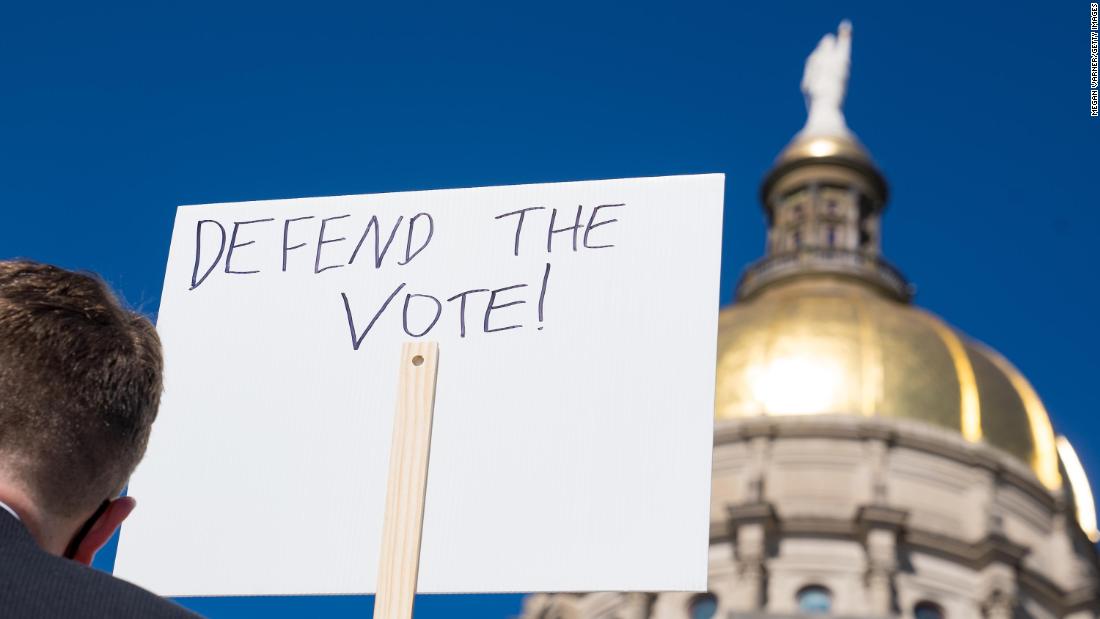
Voter ID requirements are really popular. So why are they so divisive?
CNN
There's no more contentious issue in the already heated debate over election reform than the requirement that all voters have a valid photo ID in order to cast a ballot. Republicans insist it's a common sense measure to cut down on the possibility of voter fraud. Democrats push back, noting that voter ID laws tend to disenfranchise minority voters at a far higher rate than white ones.
Polling on the issue is remarkably consistent, however, with a majority of Americans saying they support voters having to show some valid form of ID in order to cast their ballot. Which intrigued me -- given the massive political fight voter ID requirements have spawned in recent years. To get my questions answered, I reached out to Ariel Edwards-Levy who, in addition to being the single funniest person on Twitter, is also the polling and election analytics editor at CNN. We exchanged a series of emails over the last 36 hours on the subject. Our conversation is below.

A federal judge has blocked the Trump administration’s attempt to reallocate federal Homeland Security funding away from states that refuse to cooperate with certain federal immigration enforcement.

When the Justice Department released a first batch of Jeffrey Epstein files on Friday that included photographs of former President Bill Clinton, White House officials raced to amplify the importance of the new documents.

One year ago this week, Joe Biden was president. I was in Doha, Qatar, negotiating with Israel and Hamas to finalize a ceasefire and hostage release deal. The incoming Trump team worked closely with us, a rare display of nonpartisanship to free hostages and end a war. It feels like a decade ago. A lot can happen in a year, as 2025 has shown.

Two people are dead and others are missing after a fire and explosion tore into a nursing home on the outskirts of Philadelphia, Pennsylvania, spurring local responders, bystanders and staff to rush the elderly population to safety, Gov. Josh Shapiro said.

Botched Epstein redactions trace back to Virgin Islands’ 2020 civil racketeering case against estate
A botched redaction in the Epstein files revealed that government attorneys once accused his lawyers of paying over $400,000 to “young female models and actresses” to cover up his criminal activities

Some Medicare enrollees may soon be able to access super-popular drugs for obesity under a voluntary model program, the Centers for Medicare and Medicaid Services announced Tuesday. Eligible beneficiaries will only have to pay $50 a month.

The Justice Department’s leadership asked career prosecutors in Florida Tuesday to volunteer over the “next several days” to help to redact the Epstein files, in the latest internal Trump administrationpush toward releasing the hundreds of thousands of photos, internal memos and other evidence around the late convicted sex offender Jeffrey Epstein.

The US State Department on Tuesday imposed visa sanctions on a former top European Union official and employees of organizations that combat disinformation for alleged censorship – sharply ratcheting up the Trump administration’s fight against European regulations that have impacted digital platforms, far-right politicians and Trump allies, including Elon Musk.

A Delaware state trooper was killed along with the suspected gunman Tuesday during a shooting at a motor vehicle agency near Wilmington, authorities said.

Wyoming’s lone U.S. representative is running for the U.S. Senate seat being vacated by Cynthia Lummis, who isn’t seeking re-election.

A new lawsuit filed in Washington, DC’s federal court Monday challenges the Kennedy Center board of trustees’ move to add President Donald Trump’s name to the cultural institution.

Warning: This post contains language readers may find disturbing.

Some staff at the Department of Veterans Affairs are finding little to be merry about after the agency said it would eliminate tens of thousands of open, unfilled positions across the country as it looks to streamline its staffing.