VoltUp to raise $25 million to fund expansion
The Hindu
NEW DELHI
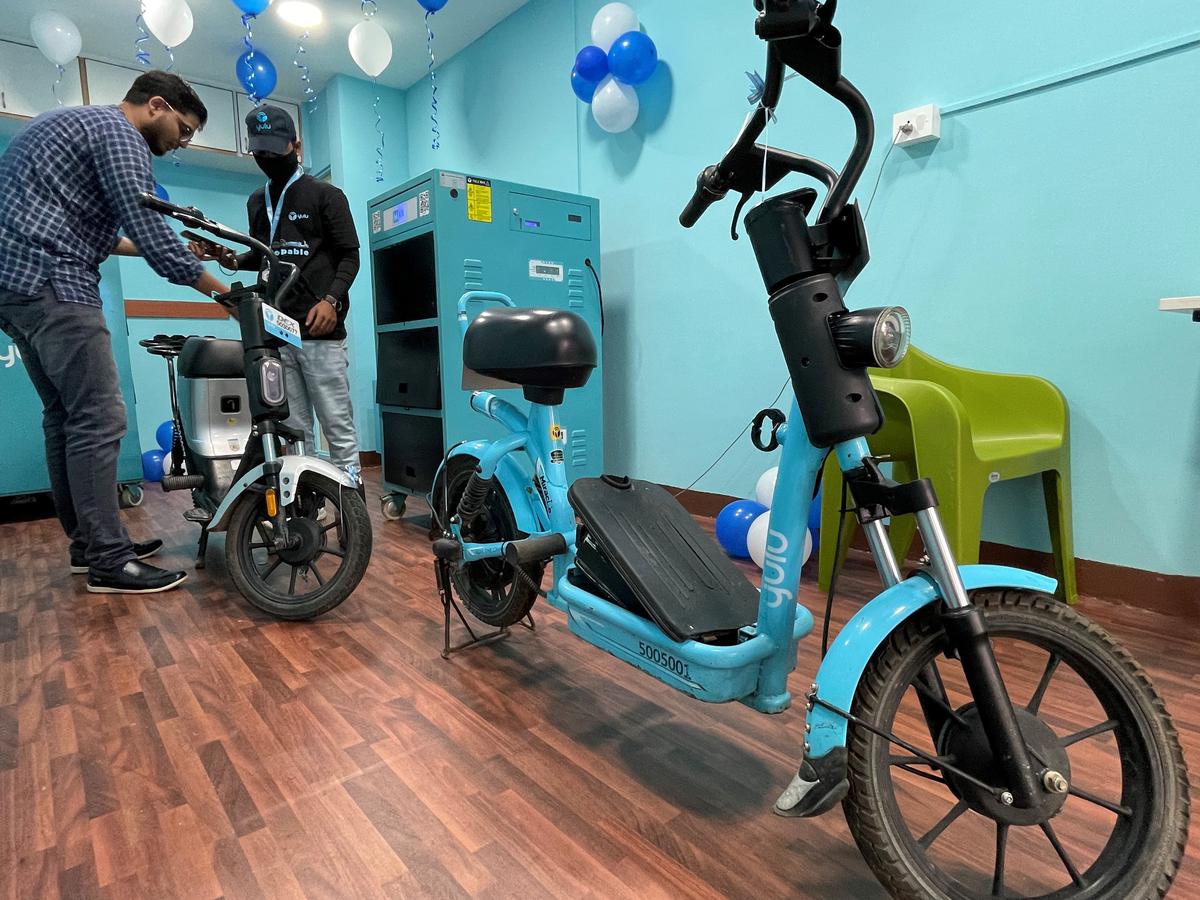
Mumbai-based Battery as a Service (BaaS) provider VoltUp is looking to raise up to $25 million or ₹200 crore as it looks to expand operations to atleast 30 cities with 500 battery swapping stations in the next financial year.
Currently, the start-up has presence in 10 cities, including Jaipur, Mumbai, Delhi and Lucknow, and 90 swapping stations. Each station has a slot to accommodate 12 batteries.
“We are a bootstrapped firm, and have invested ₹40-45 crore till now, and have raised ₹60 crore via debt,” said co-founder and CEO Siddharth Kabra. “We have now begun the process to raise funds and are looking at about $20-25 million to fund our expansion,” he added.
Mr. Kabra said according to conservative estimates, at least 10 million vehicles with swappable batteries would be sold in the next eight years, resulting in a $7-billion or ₹60,000-crore EV swapping market.
The two-wheeler EV market, he said, was expected to reach about 65 million by 2030, and of this conservatively 15% vehicles were likely to be supported by battery swapping.
In the January-March quarter, the company would also be introducing LFP (lithium iron phosphate battery) chemistry batteries, which are considered safer and long lasting than NMC (lithium-nickel-manganese-cobalt-oxide) chemistry batteries being used presently.
“The LFP batteries have almost 2,000 cycles of life compared with 800 cycles in NMC chemistry, and will weigh similar to the NMC batteries. The LFP batteries are also thermally more stable with higher operating temperature ranges,” he said.


Amazon said on Monday its Amazon Web Services region in Bahrain has been “disrupted” amid the current conflict in the Middle East

Petroleum Ministry directs reforms to enhance natural gas infrastructure, streamline approvals, and ease transition from LPG to PNG.

The Sora decision means the end of a blockbuster $1 billion deal between Disney and the ChatGPT maker that was announced a little more than three months ago.

Regulator mandates city gas distributors to provide piped gas to educational institutions within five days, supporting India's transition from LPG to PNG.

NHAI's Raajmarga InvIT listed on BSE, enhancing investor participation in highway infrastructure with strong demand and oversubscription.

HDFC Life Insurance faces ₹172 crore Income Tax order for alleged violations, plans to appeal the decision.

Air-conditioner makers in India are looking forward to FY27 with hope as the war in West Asia threatens to impact plastic component availability and consumer sentiment, adding to the challenges around raw material price and new energy label, a senior executive of a leading company has said.

Rupee falls 23 paise to an all-time low of 93.76 against the U.S. dollar amid foreign fund outflows and global uncertainties.

Stock markets surged nearly 2% as Trump paused strikes on Iran, boosting investor confidence amid easing geopolitical tensions.

Coal Minister urges State leaders to maintain stable coal prices amid rising global costs, assuring ample domestic supply.

Mahanagar Gas ensures reliable PNG and CNG supply in Maharashtra and Karnataka, offering customer benefits to encourage adoption.

OpenAI Chief Executive Sam Altman said on Monday he has stepped down from the board of directors of Helion Energy, the fusion startup he has backed since 2015

Nikhil Kamath and Quant MF back Swan Defence's oversubscribed ₹500 crore Offer for Sale, reflecting strong investor interest in defence stocks.