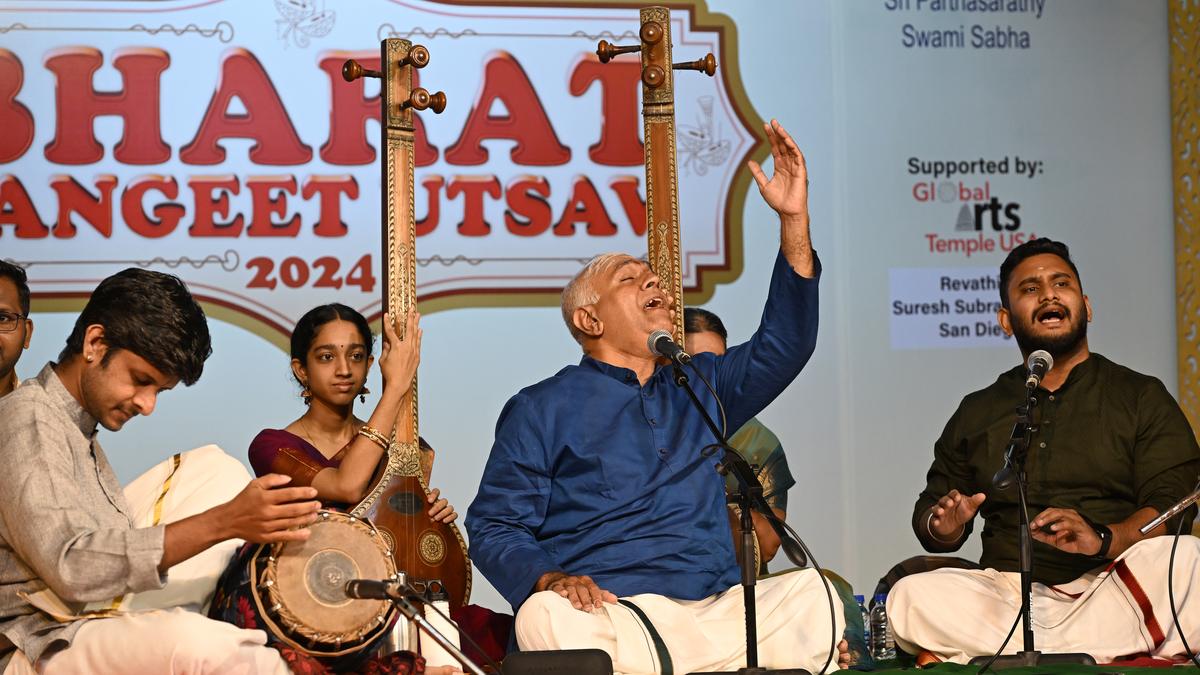
Vijay Siva displays the time-tested approach to Carnatic music
The Hindu
Flavours of the past
Restraint is the hallmark of refinement, it is said. N. Vijay Siva’s recent concert for Bharat Sangeet Utsav 2024, presented by Carnatica and Sri Parthasarathy Swami Sabha, stood as a testament to this. There were no frills and fancies as the seasoned vocalist treaded the time-tested fairway in his ‘Sampradaya Kutchery’ at Narada Gana Sabha Main Hall, in the company of L. Ramakrishnan (violin), N.C. Bharadwaj (mridangam) and S. Sunil Kumara (kanjira), with his disciple Sanjay Swaminathan lending vocal support.
Vijay Siva’s natural style, embodying the very essence of tradition, was ideally suited to the theme of the evening, and he might not have needed to strain a sinew for this assignment.
His opening piece, Syama Sastri’s ‘Neelayatakshi’ in Paras (Tisra Triputa), provided a solemn and reverential tone to the proceedings. Vijay Siva then took up the sangathi-laden ‘Saketha nagaranatha’ of Mysore Sadasiva Rao in Harikambhoji, set to Rupakam. The opening phrase of the charanam, ‘Raajita amara pala’, is a catchy option for niraval and kalpanaswaras, which Vijay Siva explored to the hilt .
The concert gained further momentum with a vibrant Lathangi alapana preceding Patnam Subramanya Iyer’s ‘Aparadhamulanniyu,’ enriched with a niraval at the charanam line, ‘Vega nannubrovumani.’ Here, Vijay Siva’s rendition, shimmering with intensity, yet tempered with just the right pace, was thoroughly enchanting.
Bhairavi and Sankarabharanam, unfurled as the main flavours of the recital, were explored through Narayana Thirthar’s Tarangam ‘Govinda ghataya’ and Tyagaraja’s ‘Manasu swaadheenamaina’ respectively. In between, an evocative rendition of the virutham ‘Panippagai mayilum’ from Thiruchendhil Kalambagam in Vasantha, followed by Papanasam Sivan’s composition on Muruga ‘Maa dayai nidhiyenum’ in the same raga, and the chittaswaram, added splendour aplenty.
Vijay Siva was at his characteristic best as he conjured the aura of Bhairavi , meticulously unravelling the raga’s old-world charm. Ramakrishnan, in his response, coaxed the bow and strings to telling effect to create a delightful melody . The Tarangam, then, swayed to the gait of Khanda Chapu before arriving at breathtaking swara exchanges at ‘Saradindu sama vadana’ in which Ramakrishnan, Bharadwaj and Sunil Kumar partnered with the singer for a rewarding joint venture.
The majesty of Sankarabharanam unfolded as the master and pupil took turns in the upper octave to ride a wave of crescendo before effecting a quiet retreat into the mandhra sthayi. Ramakrishnan was again in his element, coming up with a matching alapana. After a clinical rendition of the kriti ‘Manasu swaadheenamaina’, Vijay Siva embarked on a niraval in the beginning of anupallavi ‘Tanuvu taanu gaadani’, before indulging in a kalpanaswara cascade. Bharadwaj and Sunil Kumar displayed their rhythmic prowess throughout with an uncanny chemistry even while embellishing the concert. Clarity and energy marked their absorbing tani avartanam in Misra Chapu.


Khalid Rahman is reuniting with Malayalam superstar Mammootty after Unda (2019). The Thallumaala director has teamed up with the veteran for Mattancherry Mafia.

Bollywood actor Akshay Kumar paid tribute to the martial arts grandmaster and Hollywood’s action star, Chuck Norris, who passed away on Thursday, March 19, 2026.

Renowned Odissi dancer Madhumita Raut, aged 59, dies of cardiac arrest, leaving behind a legacy of artistic achievements.

Chuck Norris, iconic martial arts master and actor, dies at 86, leaving behind a legendary legacy and internet memes.

South African naturalist Steve Boyes speaks on ghost elephants, ancestral tracking, and Werner Herzog’s documentary exploring Angola’s elusive highland giants

Actor-director Amol Palekar will receive META's Lifetime Achievement award for 2026 on March 25 in New Delhi.

India's artists unite against rising censorship, advocating for creative freedom and support for marginalized voices in the arts.

Written and directed by Kunal, the film also stars Sparsh Shrivastava and Vanshika Dhir

This year, Bharatnatyam artistes will present the Tyagaraja Aradhane as a dance performance

This year, Bharatnatyam artistes will present the Tyagaraja Aradhane as a dance performance

The actor, along with director Sushant Shah, speak about their upcoming series ‘Chiraiya’, Divya’s process of working on the dialect, Sushant’s approach to telling a story about women, and more

An independent video, ‘Feel the Spark’ by Raleigh Rajan with vocals by Ciera Dumas that celebrates Tamil literary giants, garnered 1.4 million views in less than 36 hours.

In ‘Jack Ryan: Ghost War’, John Krasinski is back as the savvy CIA analyst, diving headfirst into a high-stakes mission that unravels a deadly conspiracy and pits him against a rogue black-ops unit