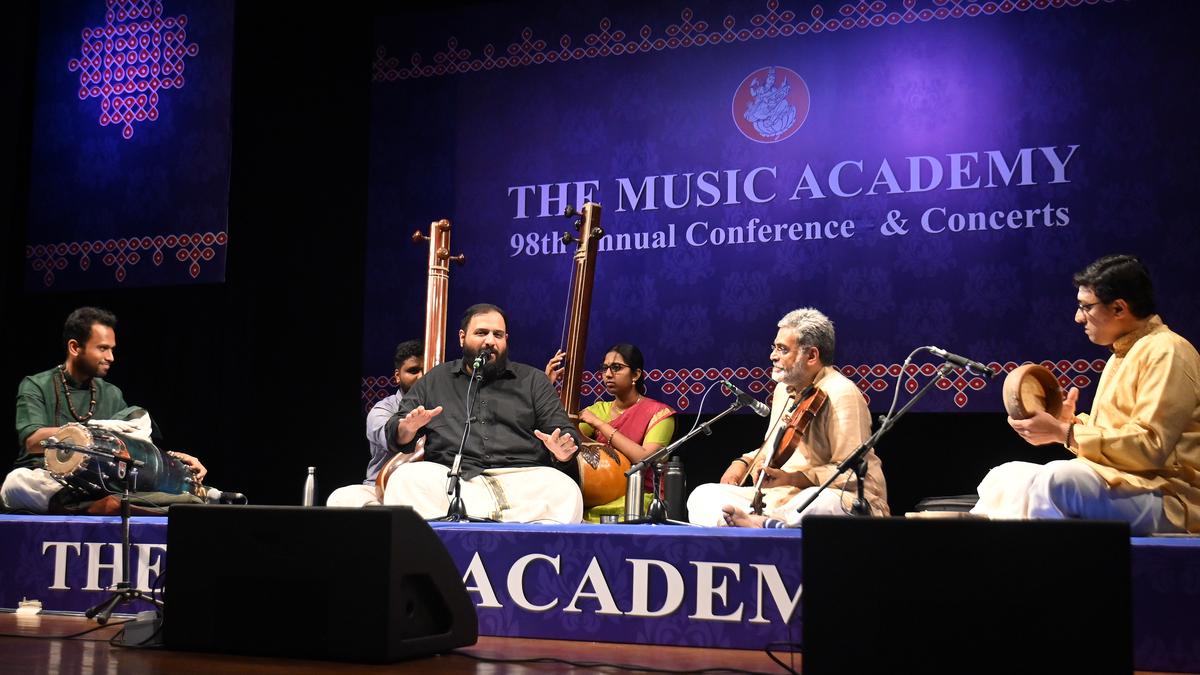
Vignesh Ishwar should play well his trump card — a strong voice
The Hindu
Vignesh Ishwar music is a blend of talent and tutelage
Vignesh Ishwar is among the more promising young vocalists of the new era. His current training under T.M. Krishna has helped shape his talent, and also steered his presentation style towards his guru’s, as was evident at his concert for The Music Academy’s 2024 December festival. There were moments that seemed straight out of Krishna’s concert playbook.
Vignesh’s talent table is outstanding, with his booming voice capping it. He has a good mix of tempos and largely the famed repertoire of old stalwarts. ‘Munnu ravana’ (Todi, Tyagaraja, Misra Jhampa), ‘Sankachakra’ (Poorna Chandrika, Dikshitar), ‘Epamu’ (Atana, Tyagaraja, Misra Chapu) and the rapid ‘Ninnu joochi’ (Sowrashtram, Patnam Subramania Iyer) are shining examples.
‘Munnu ravana’ in a brisker velocity with many accented syllables delivered via a strong voice was a cracker of a start. Vignesh’s rapid raft lifted the concert expectations instantly. It’s a moot point whether you amplify a canon voice further, as Vignesh chose to, or let the sound system tame it a bit to reach the ears at the optimum frequency. Vignesh followed the opening piece with ‘Sankachakra’ in Poorna Chandrika, with characteristic swaras in attractive ascends and descends, emphasising the rishabam and ‘p d p’ phrases. A softly rendered Hamir Kalyani raga showcased the serene half of Vignesh’s skillsets. Good rendition of ‘Venkata sailavihara’ by Subbaraya Sastry, which has a Dikshitaresque gait, evened out the opening frenzy.
Manodharma was well-distributed in the first three songs — niraval in ‘Munnu ravana’, swara in ‘Sankachakra’ and raga alapana in the Hamir Kalyani piece — this intelligence eludes many musicians as one hears a truckload of swaras early on in concerts, colliding with sensitivities.H.K. Venkatram’s exquisite accompaniment for ‘Venkatasaila vihara’ deserves special mention, as his alapana was authentic and crisp.
Vignesh’s Atana alapana was bright and generally on predictable lines. The sancharas in the top notes were attractive. ‘Epamu’ in Misra Chapu is among the few seminal kritis in this raga for elaboration. The first line of the pallavi is loaded with such a vast milieu of sangathis that the raga seems complete with it in itself. Vignesh’s further delineation of the kriti and especially the niraval at ‘Rajasekara’ seemed superfluous, as repetitions are difficult to avoid in such ragas. This is where he came close to be the carbon copy of the guru’s typical rendition.
Parveen Sparsh’s mridangam was organised and supportive with occasional pep when demanded. His playing for the slower ‘Venkatasaila vihara’ was noteworthy dovetailing well with the mood. Tani with Guru Prasanna was well-manicured exploiting the Misra Chapu contours.
Even as the Atana kriti took longer than ideal, Vignesh still found generous time for his Ragam Tanam Pallavi in Ritigowla. His raga alapana and that of Venkatram were soothing and succinct. The tanam presented some challenges to Vignesh as, perhaps, a structure was not particularly evident.


Renowned Odissi dancer Madhumita Raut, aged 59, dies of cardiac arrest, leaving behind a legacy of artistic achievements.

Chuck Norris, iconic martial arts master and actor, dies at 86, leaving behind a legendary legacy and internet memes.

South African naturalist Steve Boyes speaks on ghost elephants, ancestral tracking, and Werner Herzog’s documentary exploring Angola’s elusive highland giants

Actor-director Amol Palekar will receive META's Lifetime Achievement award for 2026 on March 25 in New Delhi.

India's artists unite against rising censorship, advocating for creative freedom and support for marginalized voices in the arts.

Written and directed by Kunal, the film also stars Sparsh Shrivastava and Vanshika Dhir

This year, Bharatnatyam artistes will present the Tyagaraja Aradhane as a dance performance

This year, Bharatnatyam artistes will present the Tyagaraja Aradhane as a dance performance

The actor, along with director Sushant Shah, speak about their upcoming series ‘Chiraiya’, Divya’s process of working on the dialect, Sushant’s approach to telling a story about women, and more

An independent video, ‘Feel the Spark’ by Raleigh Rajan with vocals by Ciera Dumas that celebrates Tamil literary giants, garnered 1.4 million views in less than 36 hours.

In ‘Jack Ryan: Ghost War’, John Krasinski is back as the savvy CIA analyst, diving headfirst into a high-stakes mission that unravels a deadly conspiracy and pits him against a rogue black-ops unit

Shriram Bharatiya Kala Kendra’s Shankarlal festival showcased rare ragas, radiant artistry, and inclusive performances, from Pt Madhup Mudgal’s serene morning ragas to Ramana Balachandran’s Saraswati veena.

Explore "Threads that Bind: The Kantha Project," an exhibition in Delhi reimagining kantha as a medium of repair and renewal.