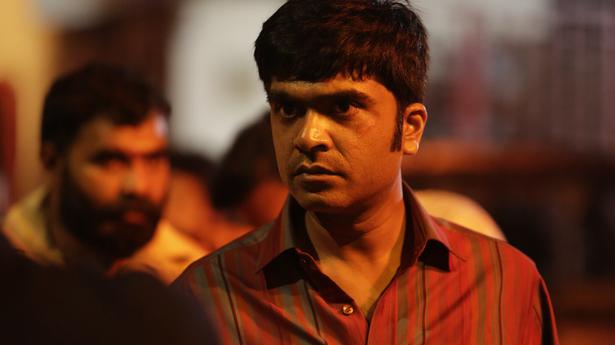
‘Vendhu Thanindhathu Kaadu’ movie review: Simbu and Gautham Menon are superb in this very ordinary gangster drama
The Hindu
Simbu is as invisible as Gautham Menon in ‘Vendhu Thanindhathu Kaadu’ and this is a welcome departure for them. Yet, something feels incomplete
The dying embers of a forest fire end up elsewhere as a flame-throwing machine.
At least this seems to be the lyrical idea that must have ignited a spark in Gautham Menon to adapt Jeyamohan’s short story, now as Vendhu Thanindhathu Kaadu ( VTK). At least that is how VTK opens, with Muthu (Silambarasan) being the ember in a dying fire who gets thrown out of it, as if to imply that he is a survivor. Or rather, he is a ball of fire himself. The latter sounds more believable.
Let’s get this out of the way: Vendhu Thanindhathu Kaadu isn’t your regular gangster film. In fact, it doesn’t even claim to belong to the gangster genre. Instead, we get a nice procedural drama that is both a blessing and a curse. More about that later. And Gautham Menon anyway isn’t interested in telling the story of a gangster; he seems content with the journey itself. He seems interested in capturing the life of Muthu in real time. By doing so, Gautham creates a mood piece with space and leisure that makes it hard to tell whether I enjoyed it to its entirety or if something felt lost in translation. But what I can confidently say is that the world VTK tries to construct in the first half is exquisite — both in terms of writing and direction.
Gautham usually has this urgency to get into the protagonist’s head and ‘narrate’ his story, but that has been course-corrected. He has been using voice-over as a device to further the narrative. To fill up screenplay gaps. In VTK, the narrative itself is procedural in nature. Therefore, there is no urgency to rush over the story, no urgency for immediate pay-offs. In other words, it can be argued that Muthu’s story can be told only this way. When you adapt a literary piece of text for screen, there is a tendency to trim reams of pages that might take up the bulk of the screentime. Some filmmakers might show this gradual progression of life in montages or transition effects; Gautham himself has done it.
Imagine this: for Muthu to leave his village in Naduvakurichi, Tirunelveli, to work as a migrant labourer in Chembur, Mumbai, pretty much takes about half an hour. And the next 40-odd minutes is dedicated to the everydayness of Muthu’s life; the people he meets, the stories he listens to. It could be said that some of these bits felt derivative and repetitive. Perhaps that was the point. To show the ordinariness of their lives, just like Vasantha Balan’s Angadi Theru.
In Mumbai, Muthu works at a parotta shop run by a Tamil. His co-workers are all from different villages from Tamil Nadu but with very similar stories. They are all invisible people that make a city look visible. But Muthu doesn’t know that the shop is an underbelly of the underworld. His superboss is Gaarji, a gangster from Tirunelveli, who has a beef with Kutty Bhai (Siddique), a Malayali gangster. Muthu and his friends almost live dual lives. They wait for the order to execute and each time they do it, death plays its course and a new occupant arrives at the scene.
We get this terrific line from Muthu’s friend Saravanan (Appukutty): “They are like big machines and we are just like screws on them, not knowing anything about the machine.” Come to think of it, the “machine analogy” gets fully-realised in the interval block when Muthu is forced to take a pistol to defend. As if to suggest that: “He is no longer a screw but a machine. Rather, a bullet.”


South African naturalist Steve Boyes speaks on ghost elephants, ancestral tracking, and Werner Herzog’s documentary exploring Angola’s elusive highland giants

Actor-director Amol Palekar will receive META's Lifetime Achievement award for 2026 on March 25 in New Delhi.

India's artists unite against rising censorship, advocating for creative freedom and support for marginalized voices in the arts.

Written and directed by Kunal, the film also stars Sparsh Shrivastava and Vanshika Dhir

This year, Bharatnatyam artistes will present the Tyagaraja Aradhane as a dance performance

This year, Bharatnatyam artistes will present the Tyagaraja Aradhane as a dance performance

The actor, along with director Sushant Shah, speak about their upcoming series ‘Chiraiya’, Divya’s process of working on the dialect, Sushant’s approach to telling a story about women, and more

An independent video, ‘Feel the Spark’ by Raleigh Rajan with vocals by Ciera Dumas that celebrates Tamil literary giants, garnered 1.4 million views in less than 36 hours.

In ‘Jack Ryan: Ghost War’, John Krasinski is back as the savvy CIA analyst, diving headfirst into a high-stakes mission that unravels a deadly conspiracy and pits him against a rogue black-ops unit

Shriram Bharatiya Kala Kendra’s Shankarlal festival showcased rare ragas, radiant artistry, and inclusive performances, from Pt Madhup Mudgal’s serene morning ragas to Ramana Balachandran’s Saraswati veena.

Explore "Threads that Bind: The Kantha Project," an exhibition in Delhi reimagining kantha as a medium of repair and renewal.

Sean Penn skips the Oscars to meet Ukraine's Zelenskyy, who praises him as a "true friend" amid the war.

The teaser of Tamil star Suriya’s much-awaited film with director Venky Atluri, titled Vishwanath and Sons, was unveiled by the makers on Monday