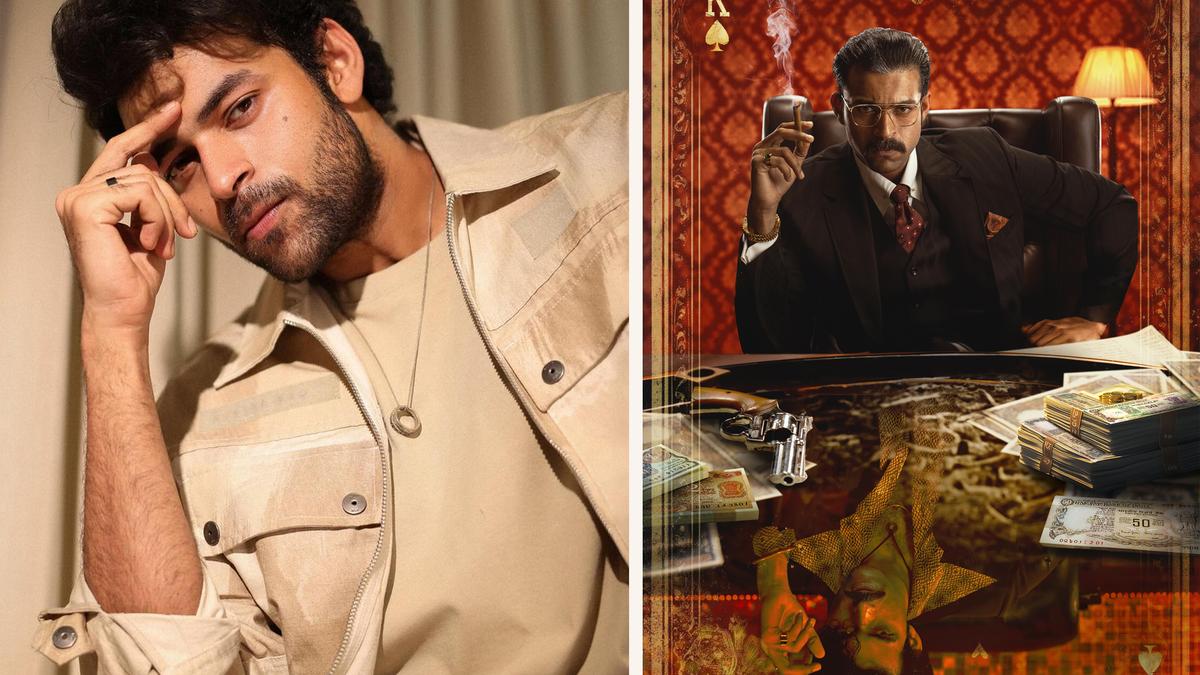
Varun Tej: ‘Matka’ entertains but does not glorify the gambler
The Hindu
Varun Tej discusses his upcoming Telugu film Matka, directed by Karuna Kumar and co-starring Meenakshi Chaudhary, inspired by the life of gambler Ratan Khatri, set for a multi-language release.
After playing an officer of the Indian Air Force in Operation Valentine, actor Varun Tej awaits the theatrical release of his new Telugu film Matka, in which he plays a character inspired by the gambler Ratan Khatri, referred to as ‘matka king’. “I was keen to be a part of a film that has the potential to appeal to a wide audience. I liked director Karuna Kumar’s raw and rugged narrative style in Palasa 1978 and was eager to work with him when he narrated a fictional story inspired by the life of Ratan Khatri,” Varun Tej explains with enthusiasm when we meet for this interview at Vyra Entertainments office in Hyderabad.
Varun emphasises that Matka, to be released in multiple languages on November 14, is essentially a Telugu film, staying true to its home language and cultural context. As the script evolved (Karuna Kumar wrote 13 drafts), Varun was taken in by portions that emerged as a spin-off of happenings in Khatri’s life. “It is interesting to know how Khatri expanded his network and gambling spread across India and affected the Indian economy. We have included a few events pertaining to the Emergency and the demonetisation of high denomination bank notes (1978). However, we were not keen on making a biopic.”
The character Vasu portrayed by Varun, is fictional though created along the lines of Khatri. Matka traces his journey from his 20s to his 50s, transforming from a youngster desperate to make ends meet to becoming a power-hungry gambler. “Khatri came to India during the Partition. The film is set in Visakhapatnam and Vasu arrives as a refugee from Burma. Later, he narrates the story of his early life to his daughter in a fairytale format, referring to his character in the third person. I liked how Karuna Kumar has written these segments,” says Varun, adding that Matka depicts nightclub glitz, crime and the underworld in the port city in the 1960s and 70s, a facet that has not often been explored.
In Varun’s decade-long career since Mukunda (2014), he has often chosen films from diverse genres and settings — a world war backdrop in Kanche, a gangster comedy in Gaddalakonda Ganesh, science fiction adventure in Antariksham 9000 KMPH and a boxer in the sports drama Ghani. He has also been a part of romances such as Tholi Prema and Fidaa and the comedies F2 and F3. “I strive to do something different in each film. Along the way, I have also realised the need to cater to a larger audience. Unlike my recent films, I am confident that Matka’s appeal will not be limited to a certain demographic; there are plenty of moments that will give the audiences a theatrical high.”
Varun terms Matka a ‘massy’ film but he is not taking the easy route of a formulaic mainstream entertainer, given the trajectory of his character from 1958 to 1982. “A regular commercial film is also tough to pull off,” he explains. “Such films can work only for star heroes whose persona translates to the characters they play and their huge fan bases celebrate them. Today, the audiences want something unique; we have to design a world that suits the story and the emotions need to be relatable.” He reveals that by the second draft of Matka, he had a fair idea of where it was headed. “I knew what the director intended to convey about economic inequality and other aspects, all in an entertaining format.”
Varun discusses how the film attempts to portray good versus evil, emphasizing he was drawn by the delineation of how an individual’s action is determined by hunger. “Someone who has food on his table and parents who care for him might judge another person’s act of stealing for hunger as a crime. We may not approve of the theft but we need to understand where that person comes from.”
Varun asserts that Matka does not celebrate Vasu as a superhero. “We show his glamorous side as he splurges, but we also show the repercussions of his actions. If the film were to end up glorifying him, I would not have been comfortable doing it.” He mentions how the character portrayed by Meenakshi Choudhary tries to show Vasu the mirror. “Her character, too, comes from a tough background but she is content with what they have, while he is not. This is where the character differentiation happens.”


The government plans to amend the FCRA, introducing new regulations for NGO asset management and accountability for key functionaries.

The draft policy for “Responsible Digital Use Among Students”, released on Monday by the Department of Health and Family Welfare, has recommended that parents set structured routines with clear screen-time rules and prioritise privacy, safety, and open conversation with children on digital well-being.

Police Observer Sushant Kumar Saxena conducts surprise inspection at Shencottai police station, reviewing warrants and security arrangements ahead of elections.

Andhra Pradesh government to launch key projects in April, focusing on industrial growth and infrastructure development, says Nara Lokesh.

Lok Sabha refers the Corporate Laws (Amendment) Bill to a JPC amid opposition concerns over CSR provisions dilution.

SHG members in Kanniyakumari use snakes and ladders to raise election awareness and boost voter turnout.

Government accelerates consultations for early implementation of the Women’s Reservation Act to ensure women’s representation in 2029 elections.

CM A. Revanth Reddy distributes ₹1 crore insurance cheques to families of deceased Electricity department employees, enhancing financial security for workers.

The Bengaluru Traffic Police (BTP) registered 634 cases of drunk driving during a week-long special enforcement drive conducted across the city between March 16 and March 22.

GHMC intensifies action against property tax defaulters, seizing properties and offering a One Time Settlement scheme for payments.

CCB arrests three drug peddlers in Mangaluru, seizing ₹2.5 lakh worth of MDMA and other valuables.

TVK's 28 candidates in Puducherry include former BJP MLAs, a sitting Independent, and a retired police IG.

BRS submits notice on private member bill to Speaker