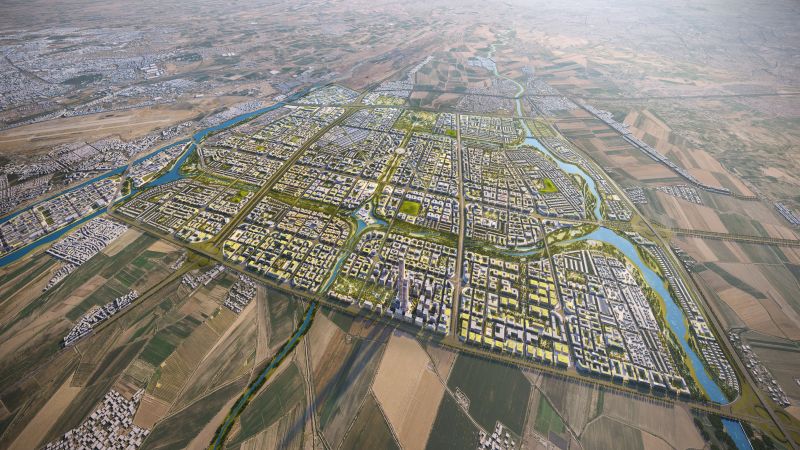
Uzbekistan targets growth with expansion to its capital
CNN
New Tashkent will include university campuses, and purpose-built tourism and innovation areas.
About five million people live and work in Uzbekistan’s capital, Tashkent, making it the largest city in the country, and one of the most populous cities in Central Asia. It’s about to get a lot bigger. A 20,000-hectare site (almost 50,000 acres) immediately east of its current boundaries is being developed to transform the city into a major metropolis. The capital expansion, dubbed New Tashkent, could play an important role in helping the country create new jobs, draw investment and boost its economy. “It will be a hub for a lot of new economic activities,” Christine P. Chan, Principal Urban Development Specialist at the Asian Development Bank (ADB), told CNN. In 2017, Uzbekistan’s new president Shavkat Mirziyoyev launched an ambitious economic and social reform program. The country hopes to halve its poverty rate by 2026 and become an upper-middle-income economy by 2030, increasing the per capita GPD from $2,200 to $4,000. As part of that plan, it’s set a target of a 60% rate of urbanization by 2030, up from just over 50%. Uzbekistan’s major industries include agriculture, mining, textiles, machinery and food processing. It’s the world’s sixth largest producer of cotton and the ninth largest producer of gold. But it faces challenges. The country “remains largely dependent on trade with regional neighbors,” according to the US state department, and unemployment is at around 6%.


Looking out his shop window, across the street, just to the right, Paloma Clothing co-owner Mike Roach sees one of Portland, Oregon’s, most expensive gas stations.

Oil and liquefied natural gas tankers moving through the Strait of Hormuz carry around 20% of the world’s supply. But for countries on the Persian Gulf, the waterway is more than just an energy route – it’s a lifeline for more than 100 million people.

A California jury has largely sided with Twitter shareholders who accused billionaire Elon Musk of defrauding them by intentionally driving down the social media company’s stock ahead of his $44 billion acquisition in 2022.

The war with Iran is disrupting global oil flows, damaging energy infrastructure and raising fears of prolonged conflict. But gold, usually considered a safe haven during periods of economic uncertainty, has slumped.

US stocks and bonds fell, oil prices rose and gold had its worst week in four decades as the Iran war continues to ripple through financial markets.

The White House on Friday released its long-awaited national artificial intelligence legislative framework, a move to prevent states from enacting their own laws and enforce the Trump administration’s light-touch approach to AI regulation.

“Today is a difficult day,” CBS executives wrote to staff, explaining the cuts as a tough but necessary reallocation of newsroom resources.

President Donald Trump has repeatedly promised that Americans will get larger tax refunds this year thanks to his “big, beautiful bill.”

President Donald Trump has repeatedly promised that Americans will get larger tax refunds this year thanks to his “big, beautiful bill.”

Oil prices edged lower on Friday after a tumultuous day that saw the international benchmark surge above $119 a barrel as the Middle East conflict deepened energy supply fears.

The war in Iran has delivered what economists call a “black swan” event — an unforeseen shock so destructive, no one is immune to it.

The war in Iran is driving up the cost of buying a home in America.

Eight state attorneys general have filed an antitrust lawsuit to block Nexstar’s pending acquisition of Tegna, which would strengthen the right-leaning Nexstar and shrink the number of station owners in the US.