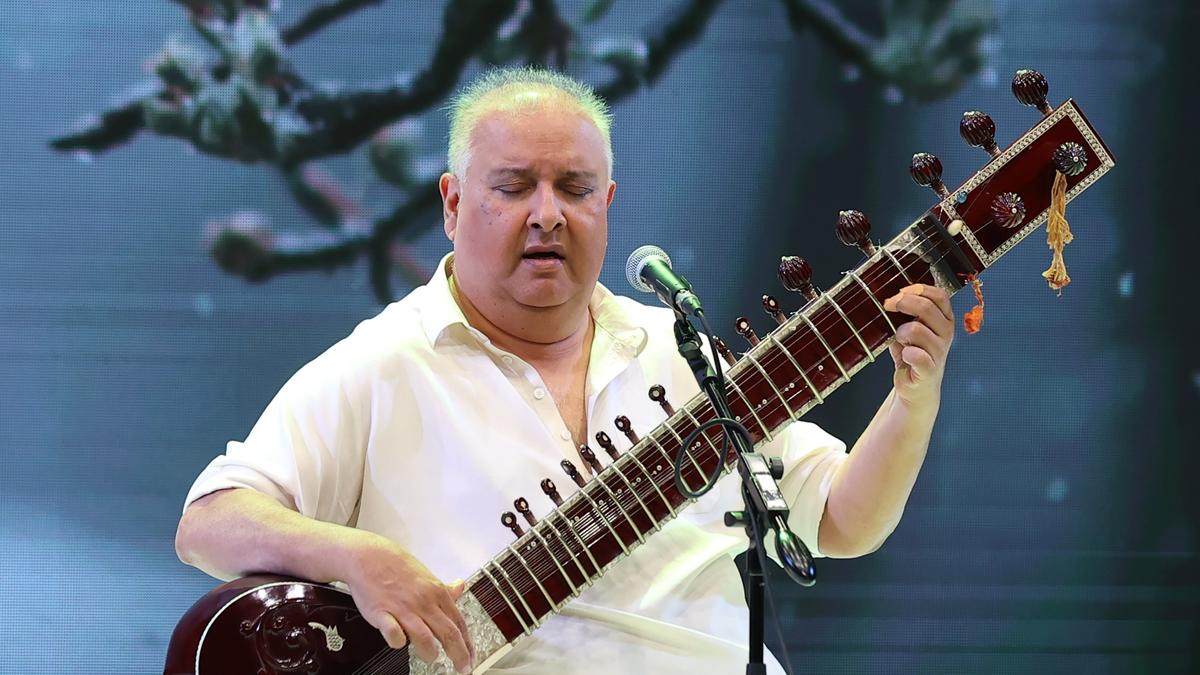
Ustad Shujaat Khan and Pt. Venkatesh Kumar to perform at Teen Prahar in Bengaluru
The Hindu
Teen Prahar’s 18th edition at Chowdiah Memorial Hall, Bengaluru, will showcase Indian classical music across time zones
Banyan Tree’s classical music festival, Teen Prahar, is set to return to Bengaluru for its 18th edition on February 27 at Chowdiah Memorial Hall. Celebrated for its distinctive approach to raga presentation, the festival guides listeners through three distinct time zones of the day, which is reflected in its name — Teen Prahar (where ‘prahar’ refers to a subdivision of the day in Sanskrit, and ‘teen’ means three).
Since its inception in 2006, Teen Prahar has carved a niche for itself by bringing together musicians at different stages of their careers — budding talents, rising stars, and legendary masters — on the same stage. It is a format that not only nurtures young artists but also gives audiences the chance to experience classical music “in its purest and most dynamic form,” according to the organisers. Over the years, it has grown into one of India’s most anticipated classical music festivals, with editions in Delhi, Mumbai, Hyderabad, Bengaluru, and Kolkata.
In the upcoming edition, the evening opens with a performance by the Shishya’s Collective Ensemble, featuring young talents Shruti Vishwakarma (vocal), Swar Sharma (vocal), Sandeep Mishra (sarangi), Hrishikesh Majumdar (flute), Rohit Deo (tabla), and Tejas Katoti (harmonium). For these musicians, performing at Teen Prahar is both an honour and a milestone in their journey.
“It is a huge honour and privilege to be sharing the same stage with stalwarts like Ustad Shujaat Khan ji and Pandit Venkatesh Kumar ji,” says flautist Hrishikesh, “Performing at such a big stage is a truly special moment. It adds so much to my experience and career.”
Following the young ensemble, audiences will be treated to a mesmerising sitar recital by Ustad Shujaat Khan, one of the greatest exponents of the instrument. When asked about how he selects ragas for an event like Teen Prahar, he explains that the process is deeply rooted in convention.
“Raga selection happens on the basis of tradition — what has already been prescribed by the ancient traditions of our music. Each part of the day has specific ragas dedicated to it, meant to evoke and mirror the moods and feelings one experiences during those times,” he says. “Beyond that, it also depends on my mood and temperament at the moment.”
While studio recordings have their place, for Ustad Shujaat Khan, nothing compares to the energy of a live performance.


Indian vessels can freely sail through the Strait of Hormuz without needing permission, confirms a senior government official.

The Hindu Morning Digest gives a select list of stories to start the day. Read the top news today on March 25, 2026

An IndiGo flight at Vijayawada airport was grounded due to a tyre burst, but all 79 occupants are safe.

Tamil Nadu Assembly election 2026: TMC(M) gets five seats in NDA, to contest on BJP's 'Lotus' symbol
TMC(M) secures five NDA seats, to contest Assembly elections using BJP's 'Lotus' symbol in Tamil Nadu.

The Karnataka government will discuss with officials the possibility of creating a portal for unemployed youth to share their details and access job opportunities in micro, small and medium enterprises (MSMEs), Minister for Small Industries and Public Enterprises Sharanabasappa Darshanapur said in the Legislative Council on Tuesday.

AIADMK's 2026 manifesto promises free rations, women's benefits, education reforms, and economic growth initiatives for Tamil Nadu.

U.S.-Israel war on Iran LIVE: Follow The Hindu for updates on the West Asia conflict on March 24, 2026

Join the 'Click & Commit' campaign on World TB Day, uniting Chennai's community to pledge against tuberculosis.

Brahmin candidates join Naam Tamilar Katchi, marking a significant shift in Tamil Nadu's political landscape and inclusivity.

Over 750 wheelchairs are prepared in Thoothukudi for accessible voting, ensuring convenience for differently abled and elderly voters.

Madras HC dismisses S.P. Velumani's petition challenging I-T assessment of ₹7 crore as unexplained election expenses from 2016.

The Lok Sabha passes a contentious Transgender Bill, sparking praise from the government and criticism from opposition parties.

Kamal Haasan announces support for DMK in 2026 elections, emphasizing the need for 'Dravidian Model 2.0' for Tamil Nadu's welfare.