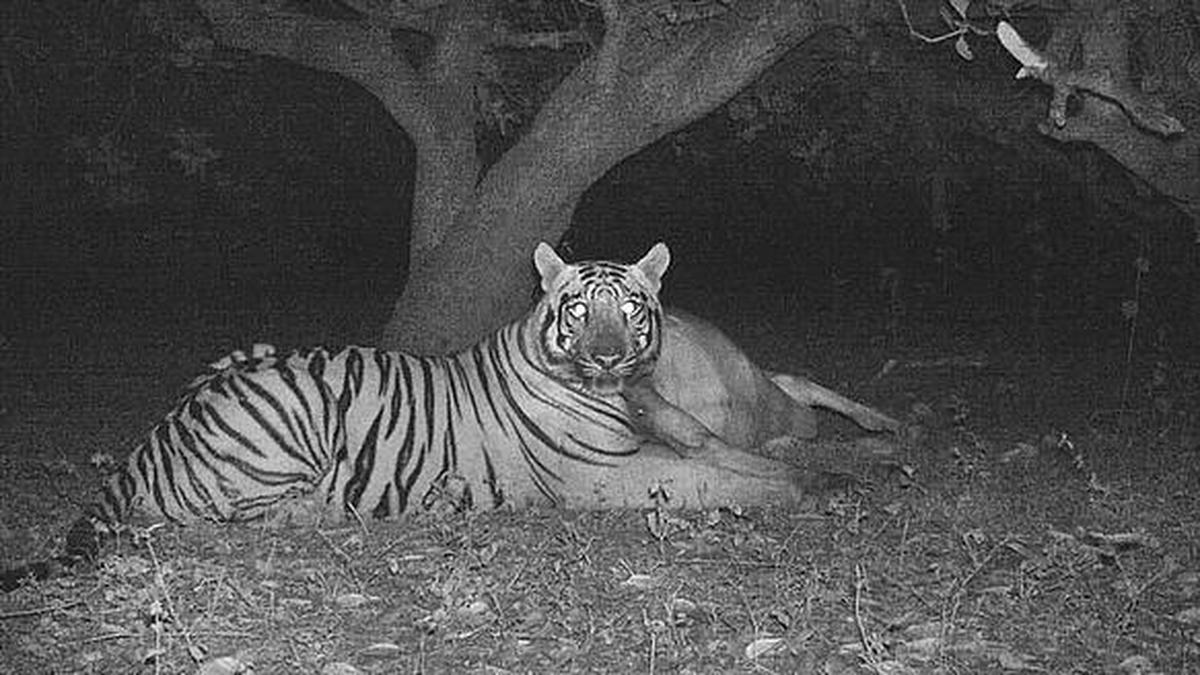
Use of tranquilisers to catch tiger cannot be decided solely by public pressure: Forest officials
The Hindu
Forest officials emphasize that tranquilizing tigers should not be driven by public pressure, as survival rates are uncertain.
Fear travelled faster than facts in villages bordering the Reserve Forest after reports of a tiger’s movement surfaced, prompting forest officials to clarify that the animal poses no threat as long as it remains within its natural habitat.
The wildlife experts caution that survival of the tiger after tranquilising it are 50:50. The tiger might behave aggressively or become depressed. There are instances where such tigers died in captivity. “Actions such as use of tranquilisers to catch the tiger cannot be taken simply because of public pressure or perception,” they say.
When contacted, Project Tiger Field Director B. Vijay Kumar said, “Tigers are natural inhabitants of forest ecosystems and their movement should not be treated as an emergency situation.”
The official explained that under Sections 11 and 12 of the Wildlife Protection Act, intervention such as tranquilisation, capture, or relocation can be undertaken only when there is a proven threat to human life or property. “If the animal strays into a village or populated area and poses a real danger to people, the law empowers us to act, but only after obtaining the necessary permissions from competent authorities,” he said.
He explained that the chances of recovery will be almost negligible. “See, wild animals cannot be tranquillised. Tranquiliser is nothing but anesthesia, which will be given based on the body weight, and also based on the animal’s health condition. “Tigers weight, we cannot assess. By trial and error, we make the dose. So, the recovery chances are fifty-fifty,” he said.
Mr. Vijay Kumar further added that tranquilised animals should either be released in a reserve forest or shifted to a zoo. “We don't know the territory of the caged tiger. If it is released in territory of another tiger, it leads to tiger-tiger conflict,” he explained.


Discover how to turn creative passion into a sustainable business by mastering finance, IP, and strategic growth.

Arjun Krish and Ria Dinesh win Best Telefilm at Kerala State Television Awards for their impactful short film, F for Freedom.

redBus data reveals a significant 76% rise in solo women travelers from Karnataka since 2019, highlighting increasing independence in travel.

Air India and AI Express will operate 44 flights to West Asia amid Dubai airport restrictions on foreign carriers.

Maharashtra Assembly passes the Freedom of Religion Bill, imposing strict penalties for unlawful conversions, ensuring protection for vulnerable individuals.

Trump claims he can do “anything” with Cuba amid U.S.-Cuba talks, escalating tensions over political intervention and economic crises.

Amrutanjan owes ₹9.74 crore in rental arrears for Mylapore Kapaleeswarar Temple land, despite lacking a landlord-tenant relationship.

BJP intensifies campaign in Palakkad for the 2026 Assembly elections, targeting UDF amid scandal surrounding MLA Mamkootathil.

Jeevan Reddy leads a rally for maize farmers in Jagtial amid speculation of leaving Congress for BRS.

BJP and AINRC likely to maintain 2021 seat-sharing formula for Puducherry's 2026 Assembly elections, confirms party president.

BJP reveals 144 candidates for Bengal Assembly polls, featuring Suvendu Adhikari contesting against Mamata Banerjee in Bhabanipur.

Anna University partners with Ramco Systems to create an advanced ERP lab for enhanced industrial engineering education.

NDA announces candidates for 12 Kozhikode seats in Kerala Assembly polls 2026 as UDF and LDF ramp up campaigning.