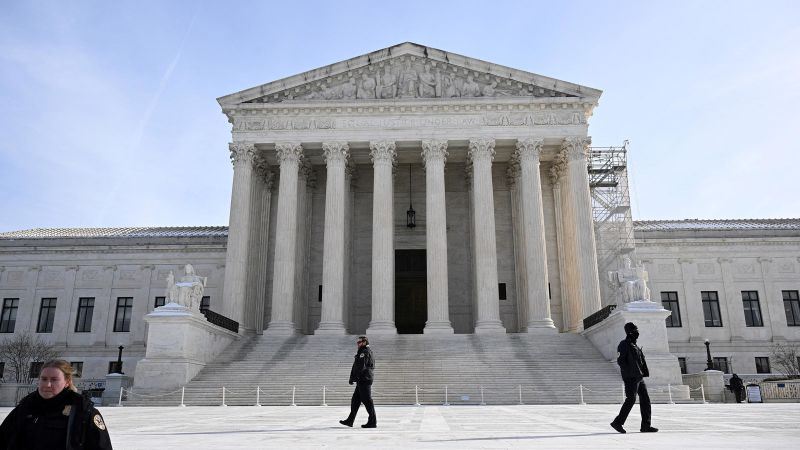
US Supreme Court blocks Holocaust victims from suing Hungary in American courts
CNN
A group of Holocaust victims may not sue Hungary in American courts to recover property stolen during World War II because their funds were comingled with other funds, the Supreme Court ruled Friday in a long-running case about how much reach US courts should have to settle disputes abroad.
A group of Holocaust victims may not sue Hungary in American courts to recover property stolen during World War II because their funds were comingled with other funds, the Supreme Court ruled Friday in a long-running case about how much reach US courts should have to settle disputes abroad. Justice Sonia Sotomayor wrote the opinion for a unanimous court. Sotomayor, quoting from a brief filed by the government, noted that “the moral imperative has been and continues to be to provide some measure of justice to the victims of the Holocaust, and to do so in their remaining lifetimes.” But, she added, respecting the limits on people suing foreign governments in US courts “aids in the United States’ efforts to persuade foreign nations to establish appropriate redress and compensation mechanisms for human-rights violations.” The court stressed that the victims might be able to bring their claims some other way, just not based strictly on the theory they relied on in this case. More than a dozen Holocaust victims and their families have been fighting the Republic of Hungary and its national railway for nearly 15 years over whether they may continue their lawsuit in federal court. Such lawsuits aimed at foreign governments are generally prohibited, but the victims wanted the Supreme Court to apply an exception to the rule in their case.


The storied White House East Room has welcomed politicians, foreign dignitaries, war heroes, celebrities and elite athletes, but on Wednesday, it was the setting for an extremely robotic speech introducing first lady Melania Trump.

Amid the constant barrage of President Donald Trump’s often-unpopular actions, it can be easy to lose sight of what probably matters most politically: the sputtering economy.

An Air Canada regional jet landing at one of the country’s busiest and most prominent airports slammed into a firetruck at more than 100 miles per hour on Sunday, leaving federal investigators and frightened passengers questioning what could have gone wrong.

The former assistant attorney general for civil rights under President Joe Biden, Kristen Clarke, is joining the National Association for the Advancement of Color People (NAACP) as general counsel, according to the organization.

Approximately 1,000 US soldiers with the Army’s 82nd Airborne Division are expecting to deploy in coming days to the Middle East, according to two sources familiar with the matter, adding to the growing military firepower in the region as the Trump administration says it is in talks with Iran to end the conflict.

CNN’s 5 Things AM brings you the news you need to know every morning.

When the historic East Wing of the White House was suddenly demolished to make way for President Donald Trump’s new ballroom construction last year, another piece of history was taken down with it.

The high-profile deployment of Immigration and Customs Enforcement agents to airports has renewed support on the right and fear on the left about the possibility of ICE going to the polls in November.

The House Oversight Committee released videos Tuesday of closed-door depositions with two men in Jeffrey Epstein’s inner circle as part of its probe into the late convicted sex offender.

The House Intelligence Committee voted Tuesday to give federal prosecutors classified records related to John Brennan, according to a committee spokesperson, signaling the Justice Department’s investigation into the former CIA director may be heading towards possible charges.

North Carolina State Senate leader Phil Berger on Tuesday conceded his primary race to Rockingham County Sheriff Sam Page, a political earthquake that took down arguably the most powerful politician in a pivotal swing state.

It’s looking like the Department of Homeland Security shutdown could soon be over. The two sides seem to have made serious progress, and President Donald Trump hasn’t rejected anything, even if he’s a little sour. But it’s likely the resolution will disappoint many Democrats.

California Gov. Gavin Newsom said that he regretted using the word “apartheid” to describe the Israeli government’s treatment of Palestinians, though he warned “that’s a word you may hear others use” if Prime Minister Benjamin Netanyahu pushes for territorial gains.