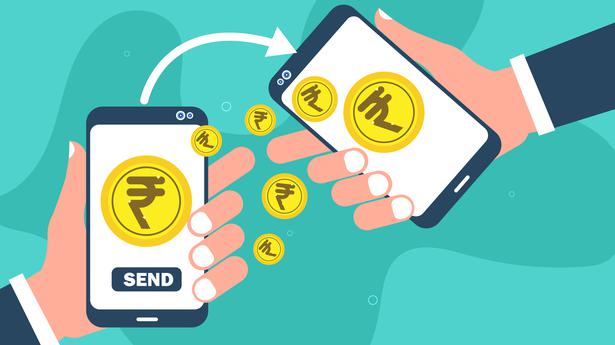
UPI: the dawn of digital fintech nirvana
The Hindu
This virtual payment interface is an Indian technological success story, one which enables us to move around with an empty pocket barring a smartphone
If you own a smartphone, you have most probably done UPI-based payments using BHIM or some other mobile application. The Unified Payments Interface or the UPI, processed ₹10,41,520 crore worth of transactions just in May of this year in India. More than 40% of all retail digital payments (non-cash and non-paper payments) in India happen through UPI now.
The UPI was launched in 2016 and is operated by the National Payments Corporation of India (NPCI). The NPCI was formed in 2009 as an initiative of the Reserve Bank of India (RBI) and the Indian Banks’ Association (IBA) with the goal to create a robust payment and settlement infrastructure. UPI operates on top of the Immediate Payment Service (IMPS) which was created by the NPCI for immediate fund transfers.
UPI based payments function broadly through three steps. First, one’s bank account is mapped to a Virtual Payment Address (VPA). A VPA eliminates the risk of mentioning account details in every transaction. It can be created in a couple of minutes using a UPI app. The only prerequisite is that your bank account be linked to a mobile number. Secondly, a Payment Service Provider (typically a bank) takes care of the to-and-fro transactions to this VPA (and hence to the underlying bank account) and finally, the UPI software orchestrates the fund movement from a customer’s VPA to a target VPA and completes the transaction.
This transaction is different from paying with a debit card or credit card as it does not involve a Merchant Discount Rate (MDR). The MDR is a fee that the recipient bank collects from the merchant. For UPI transactions, there is no MDR (like in the case of the Indian government’s Rupay card which also does not have an MDR) and hence there is no price to be paid by the merchant.
The popularity of UPI is evident — from tiny roadside shops to large brands, many merchants accept UPI-based payments. The primary reason for this penetration is that UPI accepts transactions as small as one rupee and for merchants, the absence of MDR that they have to pay to their banks is a significant incentive to accept UPI payments. Also, just your smartphone being the only device needed to complete a transaction makes the process as simple as it can get, instead of using devices like the Point-of-Sale card-swiping machines. If there is no extra price to be paid by customer or merchant, how does NPCI manage the cost of running the infrastructure for UPI? Is it sustainable in the long run to continue without MDR to fund the infrastructure? The answer can be that cost savings from the reduction in hassles and overheads for banks (by supporting UPI) will be used to bear the cost of operating UPI in the long run.
The ecosystem in which UPI thrives is not to be missed: the presence of high-speed internet in many parts of the country, technologies that power a smartphone, cloud computing and modern software engineering technologies that fulfil a transaction in a few seconds. The security of a UPI transaction is tied to the user’s authentication with the mobile phone — there is a mobile personal identification number (MPIN) for the UPI application and there is one more layer of security when the bank’s online transaction PIN is to be keyed in as part of every UPI transaction. If you block a mobile number due to theft, for example, then UPI transactions on that mobile number will also be halted.
The NPCI has come up with multiple new innovations over the past few years: recurring payments for monthly bills, international payments, linking UPI to credit cards, 123PAY that allows people without smartphones but with only ordinary mobile phones to use UPI using missed calls, allowing one-time payment by letting a merchant generate a QR (Quick Response) code that is valid for just that specific transaction and many more features. The dynamic QR code is a great boost to security and trust because there is no risk of someone having tampered with a static QR code (a static QR code is what is widely prevalent now and we see it on the wall in many shops). The merchant generates a QR code specific to that transaction amount and the customer pays through UPI by scanning the QR code.


L&T confirms 95% of its West Asia project sites are safe, while addressing logistics challenges amid ongoing regional conflicts.

Mines Ministry to auction 19 critical mineral blocks on March 23, expanding strategic resources for clean energy and technology sectors.

Mines Ministry to auction 19 critical mineral blocks on March 23, expanding strategic resources for clean energy and technology sectors.

Five top firms lose ₹1 lakh crore in market value, with HDFC Bank experiencing the largest decline of ₹56,124.48 crore.

HDFC Bank terminates three senior officials over client onboarding issues at its DIFC branch amid ethical concerns following chairman's resignation.

Air India CEO warns of potential flight cuts and reduced travel demand due to rising fuel costs amid ongoing Gulf conflict.

Options are widely used by retail traders to speculate on the value of the stock for immediate gains and such behaviour in large scale can distort the market

India achieves 1 billion tonne coal production for the second consecutive year, ensuring stable energy supply and economic growth.

Generic drugmakers in India launch affordable Semaglutide versions, targeting a $1 billion diabetes and weight loss market.

Indian and Asian refiners eye Iranian oil purchases as U.S. waives sanctions amid energy crisis linked to the Iran-Israel war.

Iran war impacts pesticide prices, warning of a 20-25% rise and increased risk of counterfeit products during the kharif season.

India's forex reserves fell by $7 billion to $709.76 billion, according to RBI data for the week ending March 13.

Natco Pharma will launch its Semaglutide injection (multi dose vials) in the domestic market on Saturday.