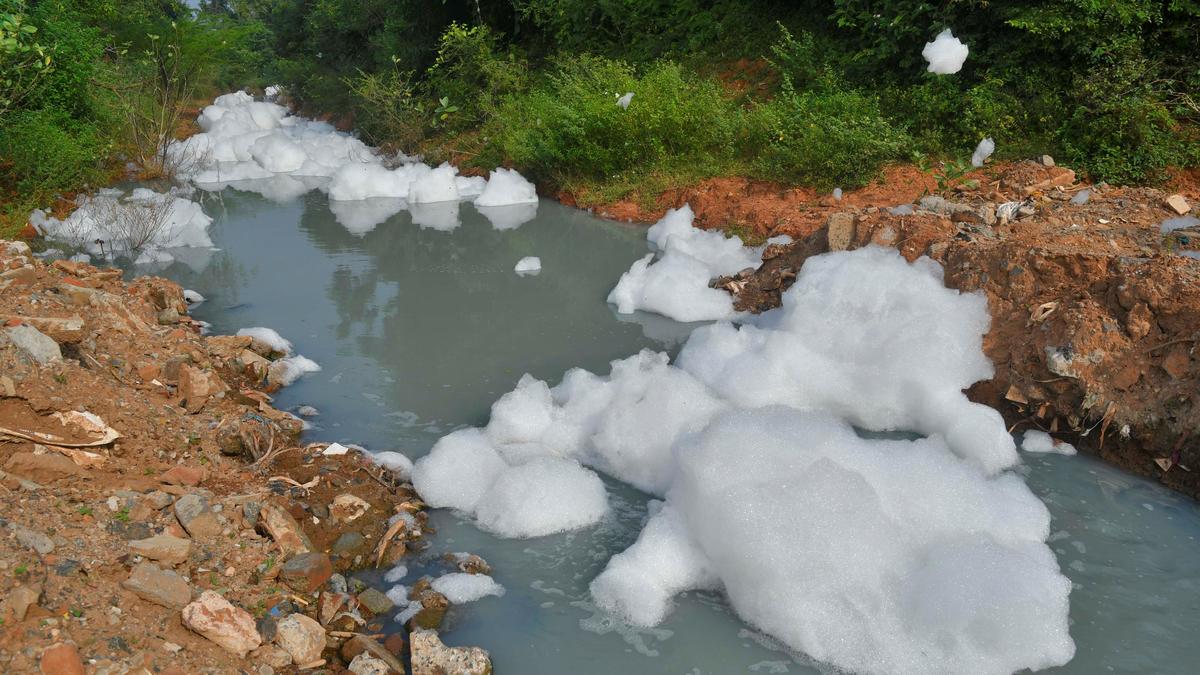
Untreated wastewater discharged from Karuvadikuppam STP into canal meant for carrying rainwater in violation of norms
The Hindu
The discharge of untreated grey water is one of the starkest cases of pollution and official apathy, rue environmentalists
The continuous discharge of untreated wastewater from the Karuvadikuppam Sewage Treatment Plant (STP) into a canal meant originally meant for carrying rainwater in Lawspet, in gross violation of rules, poses a serious risk of contamination of water sources downstream and significant threat to environment and health of residents, environmentalists say.
Untreated greywater frothing and foaming at several points of the rainwater canal near the Narikoravar colony and adjacent to the Puducherry Airport remain a common sight.
The unchecked pollution by the STP maintained by the Drainage Division of the Public Works Department (PWD) goes against the claims made by the department that there is no illegal discharge of sewage in the city.
The discharge of untreated grey water is one of the starkest cases of pollution and official apathy, rue environmentalists.
According to Probir Banerjee, co-founder of PondyCan, a civil society organisation and member of Alliance for Good Governance (AGG), “The canal was supposed to carry excess rainwater during the monsoon. But the canal has now become an easy location for the authorities of the STP to conveniently dispose of their untreated grey water. Thick foam is visible at many spots along the canal and the untreated water has been triggering a foul smell. This grey water meanders to the city to eventually flow out into the sea. The situation is similar all over the city and the authorities are using the ocean as a garbage dumpsite and ponds for sewage water to flow.”
Mr. Banerjee added, “The practice of discharging untreated grey water into the canal must be immediately stopped and authorities must ensure that this colossal amount of water being wasted is retreated and reused for various purposes. The grey water gushing out and forming into a white frothy stream discharged is highly toxic. The possibility of toxic chemicals, causing foam to catch fire like what happened in Bellandur lake in Bengaluru cannot be ruled out here.”
Tests conducted by the Environmental Monitoring Service, a testing and research laboratory for water, soil and food products in Auroville last year had revealed that the biochemical oxygen demand (BOD)—a marker for organic pollutants in the wastewater discharged into the canal was found to be a whopping 3,192 mg/litre as against the permissible standards of 30 mg/litre on inland surface waters and 100 mg/litre for marine coastal areas.


The Phalguni Nadi Ulisi Horata Samithi will hold a massive protest in front of the Karnataka State Pollution Control Board’s Regional Office, protesting unbridled pollution of Phalguni River by industrial and municipal waste in Mangaluru on Friday.

All India Radio retains its credibility and distinct identity even in the digital era, while steadily expanding its presence on social media, says D-G Rajeev Kumar Jain.

Over 500 kg of plastic covers collected from pilgrims at Maruthamalai temple, promoting sustainability with cloth bag distribution.

Andhra Pradesh is modernising 150 AYUSH centres to enhance traditional medicine access, with significant investments and new constructions underway.

Niranjanaradhya highlights Gandhi's vision of life skills-based education and critiques the neglect of government schools in India.

Leader of Opposition R. Ashok on Tuesday alleged in the Legislative Assembly that the ruling Congress government is planning to shut down Bengaluru’s only Government Flying Training School (GFTS) at Jakkur to develop an exclusive club for MPs, legislators, and senior bureaucrats.

The highlight of every edition of the Whitefield Art Collective is the Kala Car, an exhibit that showcases the creative and artistic prowess of art students. Over the years, this clever play on words has titled vehicles that have either been rescued from the scrap yard or sponsored or auctioned or all of the above.

Devotees flock to Sri Kanaka Durga Temple for serene Pushparchana celebrations during Vasantha Navaratri, adorned with fragrant floral decorations.

CAG audit reveals Arvind Kejriwal's bungalow renovation exceeded budget by 342%, costing ₹33.66 crore instead of ₹7.91 crore.

Unexpected hailstorm and evening showers in Hyderabad catch commuters off guard on March 24, 2026 evening, providing relief from the intense afternoon heat.

EVMs and VVPAT units dispatched to Erode's eight Assembly constituencies ahead of polling on April 23, 2026.

Indigo Airlines may halt Bengaluru–Shivamogga flights; MP Raghavendra seeks to persuade the airline to continue services.

181 offenders held in month-long crackdown on harassment