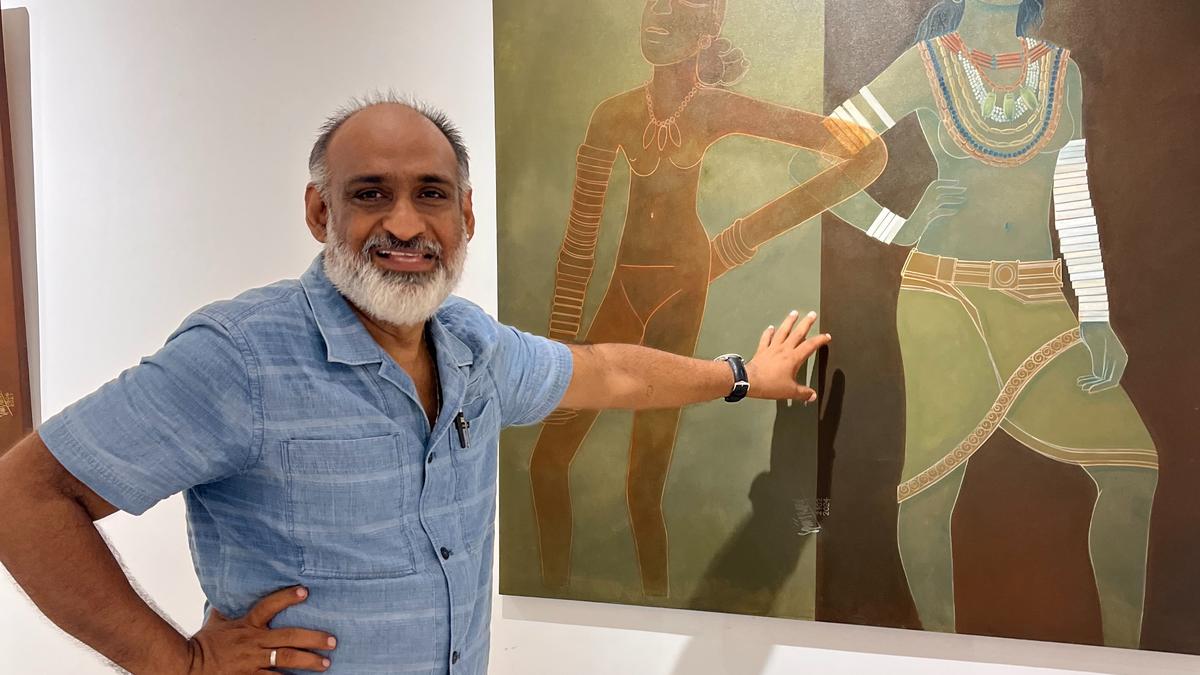
Undeciphered an art show in Hyderabad combines colours, patterns and symbols to tell the story of civilisation
The Hindu
Undeciphered by Srinivasa Babu Angara combines colours, patterns and symbols tell the story of civilisation
There are people who follow history. Then there are history enthusiasts. Srinivasa Babu Angara is slightly different from both. An artist, interior designer and sculptor, he studies history with a keen interest and goes on to paint scenes from history. His artworks include 3D recreations of maps of ancient cities and excavation sites. In his art show, Undeciphered, he shows his work, in which he drew inspiration from the studies of the Indus-Saraswathi civilisation. The majority of his artwork on display are acrylic on canvas. He also exhibits few steel in acetic acid sprayed over with metallic PU (colours). These sheets are a 3D representation of the street system from the Mohenjodaro civilisation.
His interest in history has led him to compare sign language, codes and the system of stamps. In doing so Srinivasa shows what the aesthetics of colours can do to something as simple as a painting of symbols and ancient number system.
Srinivasa’s narratives of history from books are a burst of colour. Changing the angle and the position you view the painting will reflect a different narrative.
One such art work is the red jasper torso from Harappa. A casual look at the art work will reveal a geometric pattern of red; move away, you will see a torso.
His Meluhha is a map representing the north western part of India. Srinivasa explains, “Meluhha is supposed to be the ancient name of the land in the north western region which falls between the Himalayas and the Arabian Sea. A great civilisation, which was primarily egalitarian flourished on the banks of rivers Indus and Saraswathi. It stretches over 2 million square kilometres, and 1181 sites have been discovered to date. Around 10 could be called cities, which are more than 100 hectares. The people of the Indus-Saraswathi civilisation used to trade with far-off lands like Mesopotamia and Egypt. Meluhha was the name with which the Mesopotamians referred to it in their records written in Cuneiform language.”
While viewing this artwork, viewers wonder why the Arabian Sea has an almost purple shade. Srinivasa explans, “The depth of the ocean makes it dark and mysterious. The heavy shade of blue, masked in an almost purple shade is what one sees as one sails away from the shore.”
Another striking feature of the artist’s work is the texture he creates with colours. The history lover in him uses symbols from the Indus script as design elements. In one of the paintings, the famous dancing girl figurine from Harappan civilisation is juxtaposed against a present-day tribal girl to “draw a comparison. We are not so different from our ancestors,” adds Srinivasa.


Bollywood actor Akshay Kumar paid tribute to the martial arts grandmaster and Hollywood’s action star, Chuck Norris, who passed away on Thursday, March 19, 2026.

Renowned Odissi dancer Madhumita Raut, aged 59, dies of cardiac arrest, leaving behind a legacy of artistic achievements.

Chuck Norris, iconic martial arts master and actor, dies at 86, leaving behind a legendary legacy and internet memes.

South African naturalist Steve Boyes speaks on ghost elephants, ancestral tracking, and Werner Herzog’s documentary exploring Angola’s elusive highland giants

Actor-director Amol Palekar will receive META's Lifetime Achievement award for 2026 on March 25 in New Delhi.

India's artists unite against rising censorship, advocating for creative freedom and support for marginalized voices in the arts.

Written and directed by Kunal, the film also stars Sparsh Shrivastava and Vanshika Dhir

This year, Bharatnatyam artistes will present the Tyagaraja Aradhane as a dance performance

This year, Bharatnatyam artistes will present the Tyagaraja Aradhane as a dance performance

The actor, along with director Sushant Shah, speak about their upcoming series ‘Chiraiya’, Divya’s process of working on the dialect, Sushant’s approach to telling a story about women, and more

An independent video, ‘Feel the Spark’ by Raleigh Rajan with vocals by Ciera Dumas that celebrates Tamil literary giants, garnered 1.4 million views in less than 36 hours.

In ‘Jack Ryan: Ghost War’, John Krasinski is back as the savvy CIA analyst, diving headfirst into a high-stakes mission that unravels a deadly conspiracy and pits him against a rogue black-ops unit

Shriram Bharatiya Kala Kendra’s Shankarlal festival showcased rare ragas, radiant artistry, and inclusive performances, from Pt Madhup Mudgal’s serene morning ragas to Ramana Balachandran’s Saraswati veena.