UAE, NASA missions find 'patchy' auroras in Mars atmosphere
The Hindu
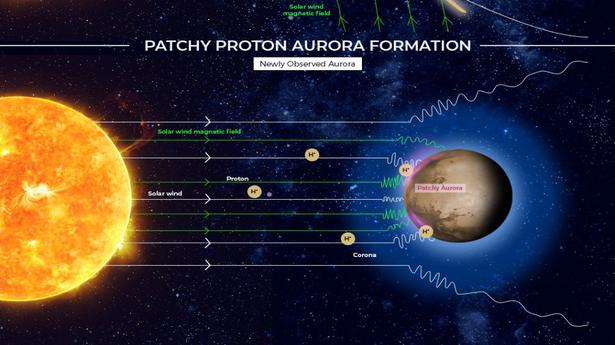
The new aurora found by the team is formed when the solar wind directly impacts Mars' upper atmosphere and emits ultraviolet light as it slows down.
The United Arab Emirate's Mars Mission (EMM) and NASA's MAVEN probe have found "patchy" proton auroras in Mars' skies, providing new insights into the red planet's atmosphere.
An aurora is a natural light display in a planet's sky, predominantly seen in high-latitude regions such as the northern lights, or the aurora borealis, seen from the Earth.
The new aurora found by the team is formed when the solar wind directly impacts Mars' upper atmosphere and emits ultraviolet light as it slows down.
It was discovered in snapshots of the dayside disk obtained by the Emirates Mars Ultraviolet Spectrometer (EMUS), which observes the planet's upper atmosphere.
When the aurora occurs, small regions of the planet become much brighter, signifying intense localised energy in the atmosphere.
"Our discovery of these patchy proton aurora adds a new kind of event to the long list of those currently studied by EMM and challenges our existing views of how the proton aurora on Mars’ dayside are formed," said Hessa Al Matroushi, EMM's Science Lead.
“The EMM Hope probe has so far uncovered many unexpected phenomena that extend our understanding of Mars’ atmospheric and magnetospheric dynamics.”


Saudi Arabia expels Iranian military staff amid escalating tensions and ongoing missile attacks during the U.S.-Israeli war on Iran.

Russia claims control of Potapivka village in Ukraine's Sumy region amid ongoing military efforts to establish a buffer zone.

Iranian missile strikes on Israeli towns cause widespread damage and injuries, marking a significant escalation in the ongoing conflict.

As Gor makes first trip as U.S. Special envoy to South Asia, Delhi watches strategic signals closely
Sergio Gor's inaugural trip as U.S. Special Envoy to South Asia signals strategic U.S. engagement amid regional tensions.

Slovenians vote in a tight election between liberal and populist candidates, impacting the country's future domestic and foreign policies.

Netanyahu asserts U.S.-Israel alliance fights Iranian threats, emphasizing global security after missile strikes on Israeli and European targets.

Israeli settlers attack Palestinian villages in the West Bank, causing injuries and destruction amid ongoing settlement expansion.

Britain asserts no evidence of Iran planning missile strikes on Europe, despite Israeli claims of missile capabilities.

UNESCO reports over half of countries have banned phones in schools due to concerns about attention, cyberbullying, and social media impact.

Analysis reveals a U.S.-operated Patriot missile likely caused a pre-dawn explosion in Bahrain, injuring numerous civilians.

Sri Lanka raises fuel prices by 25% amid ongoing West Asia conflict, impacting petrol and diesel costs significantly.

Iran strikes near Israeli nuclear research center as Trump threatens attacks on Iranian power plants
Iran's missile strikes near Israel's nuclear site escalate tensions as Trump threatens retaliation against Iranian power plants.

Saudi Arabia intercepts one of three ballistic missiles targeting Riyadh amid ongoing regional tensions and threats from Iran.