U.S. authorities issuing more foreign interference warnings as election nears
Global News
Lawmakers from both parties have voiced worries about the nation's preparedness for foreign disinformation during the presidential election and the impact it has on democracy.
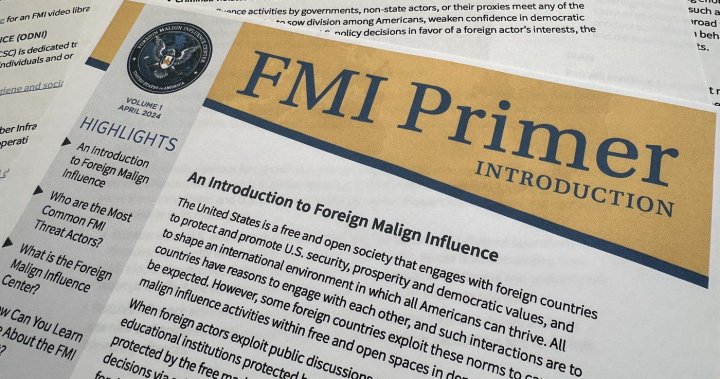
U.S. officials who track disinformation campaigns say they have issued more warnings to political candidates, government leaders and others targeted by foreign groups in recent months as America’s adversaries seek to influence the outcome of the 2024 election.
Without giving specifics, an official from the Office of the Director of National Intelligence said Wednesday that the number is higher, at least in part, because “presidential elections draw more attention from our adversaries.”
The increase in warnings, which began last fall, could also reflect a growing threat or the government’s improved detection capabilities or both, said the official, who was one of several to brief reporters on condition of anonymity under ground rules set by the office of the director.
Lawmakers from both parties have voiced worries about the nation’s preparedness for foreign disinformation during the presidential election and the corrosive impact it has on voter confidence and trust in democratic institutions. They also have questioned whether the federal government is up to the task of warning voters when nations like Russia and China use disinformation to try to shape American politics.
Influence operations can include disinformation and propaganda designed to mislead voters about specific candidates, issues or races. It can also include social media posts or other digital content that seeks to suppress the vote through intimidation or by giving voters false information about election procedures.
Officials say the list of nations launching such campaigns includes familiar foes like Russia, China and Iran as well as a growing number of second-tier players like Cuba. They also noted indications that some nations allied with the U.S. could mount their own campaigns aimed at influencing voters.
Russia was the top threat, one of the officials said, noting that its main objective was to degrade public support for Ukraine as well as decrease confidence in American democracy in general.
China is considered to be more cautious about its online disinformation campaigns and more concerned than Russia about potential blowback from the U.S., officials said. Iran is seen as a “chaos agent” that is more likely to experiment with online techniques to stoke voter anger and even violence.


The Epstein files revealed consistent communication between the royal and Epstein, including after he was convicted of child sex trafficking offences in 2008.

Prime Minister Mark Carney endorsed a statement after it was released by allies Thursday, expressing willingness to contribute to efforts to reopen the Strait of Hormuz..

James 'Jimmy' Gracey was reported missing after he didn't return to the short-term rental where he was staying with friends during spring break.

The Mina Al-Ahmadi refinery in Kuwait, which can process some 730,000 barrels of oil per day, is one of the largest in the Middle East.

U.S. intelligence, military and law enforcement officials unanimously agreed that an intelligence assessment doubting a foreign role in the 'Havana syndrome' should be withdrawn.

The federal Conservatives accuse the government of being too secretive about the war and point out that Canada's allies are sharing such information openly at daily briefings.

Canada is amongst several nations who 'condemn in the strongest terms recent attacks by Iran on unarmed commercial vessels in the Gulf.'

Gas prices in Canada have been climbing sharply since the Iran war began, but how much higher they could go is unclear as consumers struggle with the higher cost of living.

The Oscar-winning actor has denied all allegations against him and maintains that the incidents raised in the lawsuits either did not happen or were consensual.

European leaders have deflected entreaties from U.S. President Donald Trump to send military assets to secure the Strait of Hormuz.

All six crew members of a KC-135 Air Force refueling aircraft were killed last week in a plane crash over friendly territory in western Iraq, supporting operations against Iran.

U.S. Director of National Intelligence Tulsi Gabbard testified that the regime remains intact and Tehran and its proxies remain capable of attacking U.S. and allies' interests.

James 'Jimmy' Gracey was reported missing after he didn't return to the short-term rental where he was staying with friends during spring break.