Typhoon Rai death toll tops 200 as Philippines grapple with dozens still missing
Global News
At its strongest, the typhoon packed sustained winds of 195 kilometers per hour and gusts of up to 270 kph before it blew out Friday into the South China Sea.
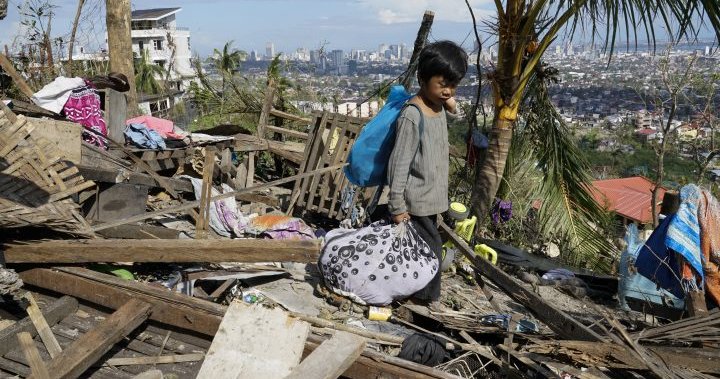
The death toll rose to more than 200 following the strongest typhoon to batter the Philippines this year, with 52 people still missing and several central towns and provinces grappling with downed communications and power outages and pleading for food and water, officials said Monday.
At its strongest, the typhoon packed sustained winds of 195 kilometers (121 miles) per hour and gusts of up to 270 kph (168 mph) before it blew out Friday into the South China Sea.
At least 208 people were killed, 52 remained missing and 239 were injured, according to the national police. The toll was expected to increase because several towns and villages remained out of reach due to downed communications, power outages and clogged roads, although massive clean-up and repair efforts were underway with the improved weather.
Many of those who died were hit by falling trees or walls, drowned in flash floods or were buried alive in landslides. A 57-year-old man was found dead hanging from a tree branch in Negros Occidental province and a woman was blown away by the wind and died in the same hard-hit region, police said.
Governor Arlene Bag-ao of Dinagat Islands, which was among the southeastern provinces first hit by the typhoon, said Rai’s ferocity in her island province of more than 130,000 was worse than that of Typhoon Haiyan, one of the most powerful and deadliest typhoons on record and which devastated the central Philippines in November 2013 but did not inflict any casualties in Dinagat.
“If it was like being in a washing machine before, this time there was like a huge monster that smashed itself everywhere, grabbed anything like trees and tin roofs and then hurled them everywhere,” Bag-ao told The Associated Press by telephone. “The wind was swirling north to south to east and west repeatedly for six hours. Some tin roof sheets were blown away then were tossed back.”
At least 14 villagers died and more than 100 others were injured by flying tin roofs, debris and glass shards and were treated in makeshift surgery rooms in damaged hospitals in Dinagat, Bag-ao said. Many more would have died if thousands of residents had not been evacuated from high-risk villages before the typhoon arrived, she said.
Like several other typhoon-hit provinces, Dinagat remained without electricity and communications and many residents in the province, where the roofs of most houses and buildings were ripped off, needed construction materials, food and water. Bag-ao and other provincial officials traveled to nearby regions that had cellphone signals to seek aid and coordinate recovery efforts with the national government.


Israeli Prime Minister Benjamin Netanyahu claimed Israel and the U.S. were well on their way to achieving the war’s goals and implored the international community for more support.

Israeli Prime Minister Benjamin Netanyahu claimed Israel and the U.S. were well on their way to achieving the war’s goals and implored the international community for more support.

Canadians are preparing to sail to Gaza with an aid flotilla, despite expectations of interception and detention by Israeli forces

Trump also said ICE could carry out arrests at airports, including targeting undocumented immigrants, and made specific references to migrants from Somalia.

Trump says U.S. is nearing its Middle East objectives as allies condemn Iran’s actions in the Strait of Hormuz and warn of global energy impacts.

NATO’s top commander, Gen. Alexus Grynkewich, confirmed earlier Friday that the alliance has pulled several hundred personnel out of Iraq and relocated them to Europe.

The Epstein files revealed consistent communication between the royal and Epstein, including after he was convicted of child sex trafficking offences in 2008.

Prime Minister Mark Carney endorsed a statement after it was released by allies Thursday, expressing willingness to contribute to efforts to reopen the Strait of Hormuz..

James 'Jimmy' Gracey was reported missing after he didn't return to the short-term rental where he was staying with friends during spring break.

The Mina Al-Ahmadi refinery in Kuwait, which can process some 730,000 barrels of oil per day, is one of the largest in the Middle East.

U.S. intelligence, military and law enforcement officials unanimously agreed that an intelligence assessment doubting a foreign role in the 'Havana syndrome' should be withdrawn.

The federal Conservatives accuse the government of being too secretive about the war and point out that Canada's allies are sharing such information openly at daily briefings.

Canada is amongst several nations who 'condemn in the strongest terms recent attacks by Iran on unarmed commercial vessels in the Gulf.'