Two Hindustani artistes show why improvisation is the key to good music
The Hindu
Musical tribute to Acharya Bimalendu Mukherjee
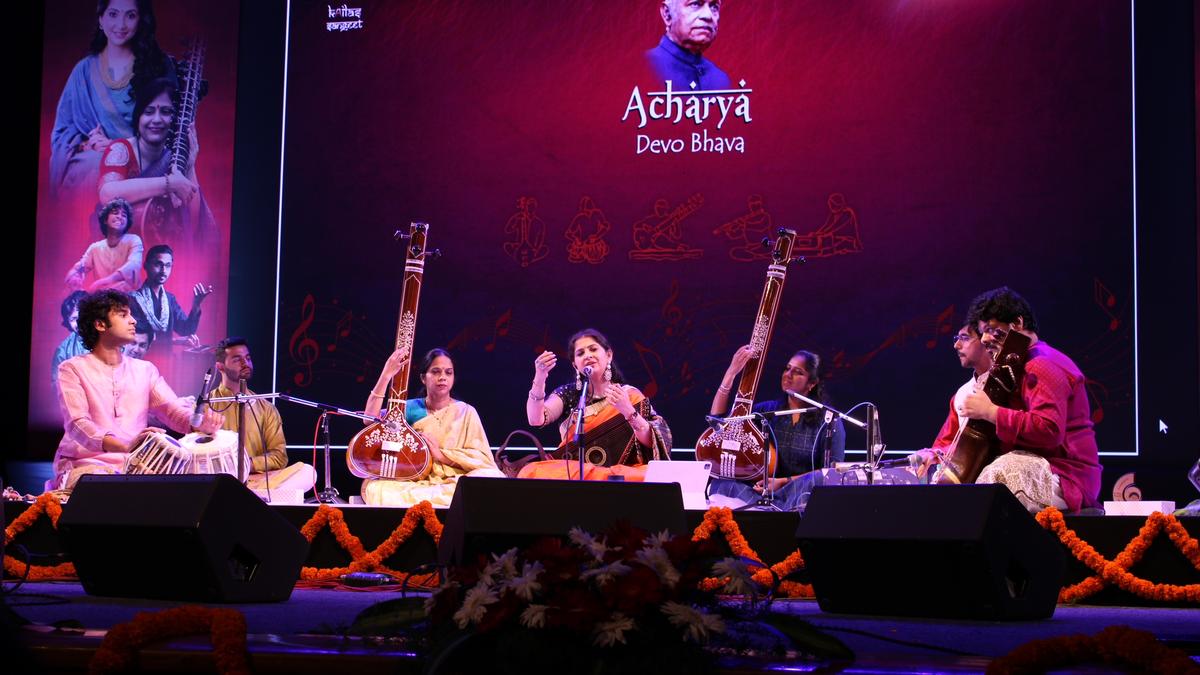
’Acharya devo bhava’, a musical soiree to celebrate the birth centenary of Acharya Bimalendu Mukherjee, was organised recently by Kailas Sangeet Trust at Chowdaiah Memorial Hall in Bengaluru. Two well-known Hindustani musicians, Anupama Bhagwat and Kaushiki Chakraborty, paid tributes to the Acharya.
Anupama, one of the foremost disciples of Acharya Bimalendu Mukherjee and an exponent of Imdadkhani/Etawah gharana, chose the evening melody raag Shyam Kalyan for her solo sitar recital. She built up the raag through an expansive and meditative alaap. She embellished her raag vistaar with meends, emphasising the Kalyan and Kamod ang, with delicate stretching of the gandhar note that distinguishes it from raag Shuddh-Sarang in her prelude of ‘anibaddh’ alap section before the gat.
Anupama’s improvisational abilities were discernible in her development of this raag through alap and rhythmic patterns of the jod and swift jhalas. In the gat section, Anupama took up a vilambit (slow tempo) composition in Teen taal for a meticulous exploration. She was ably supported on the tabla by Meghashyam Keshav. The deep inward quality of her music, devoid of any gimmickry, was a refreshing experience.
After the vilambit Teen taal composition, Anupama demonstrated her swift taans in the Drut Teen taal, building up a reverberating climax.
Popular Hindustani vocalist Kaushiki Chakraborty commenced her late evening recital with the night melody Rageshree. In her Vilambit khayal composition ‘Sakal sukh devo kartar’, Kaushiki launched into a soulful alap, which was enhanced by the nuanced sangat provided by Murad Ali Khan on the sarangi and Tanmay Deochake on the samvadini.
Kaushiki‘s voice negotiated the three octaves with ease. Her felicity in the development of this sringar pradhan raag, bearing close affinity to raags such as Bageshree and Malgunji. was noteworthy. Equipped with a huge repertoire of bandishes , Kaushiki displayed her prowess by presenting a bouquet of three drut bandishes in Rageshree: ‘Kar phool sohe virajan par, chanda sohe amal gagan par’ (Teen taal), ‘Jao jao giridhari’ (Roopak taal) and “Sundar naveli nar’ (Ekwai taal) with sargams characterised by vibrant speedy taankari. The vilambit exposition contrasted beautifully with the drut renditions.
The young tabla artiste Ishaan Ghosh impressed the audience with his ebullient performance. Teen or Rupak or Ekwai taal, Ishaan was in his element while executing the tihais. He created attractive rhythmic patterns with his explorations and variations of the taals.


Sean Penn skips the Oscars to meet Ukraine's Zelenskyy, who praises him as a "true friend" amid the war.

The teaser of Tamil star Suriya’s much-awaited film with director Venky Atluri, titled Vishwanath and Sons, was unveiled by the makers on Monday

A 'Golden' moment for a K-pop track at the Oscars.

Parvathi Nayar’s new exhibition, The Primordial, in Mumbai, traces oceans, pepper and climate change
Opened on March 12, the exhibition marks the artist’s first solo show in Mumbai in nearly two decades. Known for her intricate graphite drawings and multidisciplinary practice spanning installation, photography, video, and climate change, her artistic journey has long engaged with the themes of ecology, climate change and the natural world. In this ongoing exhibition, these strands converge through a series of works centred on water, salt, and pepper — materials that carry natural and historic weight across centuries.

Explore the highlights and key winners of the 98th Academy Awards, featuring memorable moments and historic achievements from Oscars 2026.

Spring season celebrated at Ramakrishna Mission Institute, Kolkata, with ‘Evening of Basant’

The Spirit of the Land, a solo show by artist Shivakumar Sunagar, is a vista of Nature-inspired emotions

Tal Fry is all set for an exciting new performance season

Netflix is making a bold move by snagging InterPositive, the AI filmmaking company founded by Ben Affleck, in a deal that could hit $600 million

Watch the eerie trailer for 'Hokum,' where Adam Scott faces a witch haunting in a mysterious Irish inn.

Oscars 2026 security heightened amid FBI warnings of a potential Iranian drone threat ahead of the Hollywood ceremony.

Directed by Rahul Pandey, the series also stars Naila Grewal, Nidhi Bisht, Anant Joshi, Anjum Batra and Kusha Kapila

A tribute to the versatile actor and comedian V.K. Ramasamy in his birth centenary year.