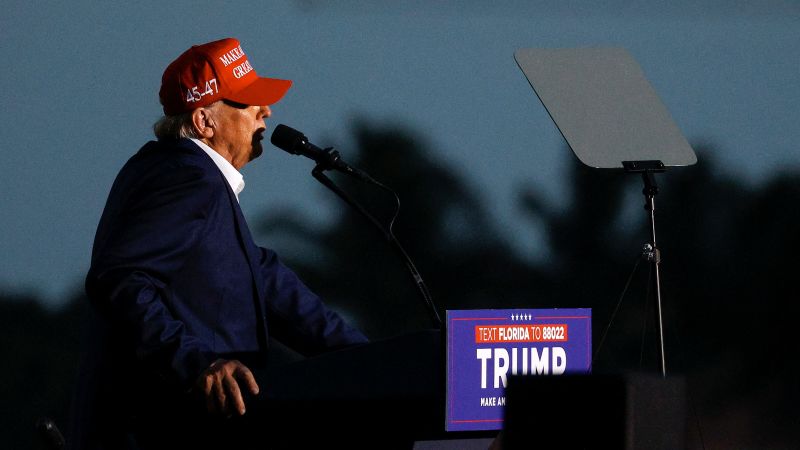
Trump transformed the federal judiciary. He could push the courts further right in a second term
CNN
Supporters and opponents of former President Donald Trump agree that the cornerstone achievement of his first term will continue shaping the American legal and political landscape for decades.
Supporters and opponents of former President Donald Trump agree that the cornerstone achievement of his first term will continue shaping the American legal and political landscape for decades. “I totally transformed the federal judiciary,” Trump boasted at a summit hosted by the right-wing Moms for Liberty group last summer. “Many presidents never get the opportunity to appoint a Supreme Court justice. I had three, and they’re gold.” That claim, the numbers show, is not hyperbole. As president, Trump named 234 judicial nominees to seats on the most critical benches across the country, including 54 who reshaped the ideological makeup of federal appeals courts and three who drove a generational shift in the highest court in the land. But as Trump drives toward a potential second term, one thing is clear: He’s just getting started. It’s a reality that thrills supporters – and strikes fear among even a few right-leaning legal scholars. “I fear that in a second term, you might see a reelected President Trump imposing more of a political test on prospective judges and looking for people who will be more loyal to him personally or to the Republican Party in general,” Gregg Nunziata, the executive director of the conservative Society for the Rule of Law and a former counsel to the Senate Judiciary Committee, told CNN. It’s a fear President Joe Biden said was a top concern heading into November.


President Donald Trump has said ICE agents will head to US airports tomorrow amid a partial government shutdown. Follow for live updates

Cuba is working to restore the electricity supply after another island-wide blackout left more than 10 million people without power.

President Donald Trump said Sunday border czar Tom Homan will be in charge of deploying Immigration and Customs Enforcement agents to airports on Monday, with Homan telling CNN the agents will help with security at entrances and exits to ease the Transportation Security Administration’s workload.

Donald Trump wants us to believe that a deal with Cuba is close at hand. After this past week, I am not so sure.

President Donald Trump has said ICE agents will head to US airports tomorrow amid a partial government shutdown. Follow for live updates

President Donald Trump said Sunday border czar Tom Homan will be in charge of deploying Immigration and Customs Enforcement agents to airports on Monday, with Homan telling CNN the agents will assist with security at entrances and exits to ease TSA workload amid a partial government shutdown.

Janet Mills and her allies are counting on a gender gap to narrow Platner’s wide lead ahead of the June 9 primary to decide who will face incumbent Republican Sen. Susan Collins. They are betting that the unfiltered style that has brought Platner widespread attention as someone who could help Democrats reach young men will backfire with women.

Why do people “pledge allegiance” to a “state” that is no longer a state? And what spurs someone to not just attack innocent people, but to then make a statement of loyalty while doing so?

A Supreme Court case examining state deadlines for election ballots sent in the mail is just the tip of the spear in President Donald Trump’s war on mail-in voting.

As a shrinking number of Transportation Security Administration agents work to keep hourslong security lines moving despite not being paid, President Donald Trump stepped into the fray Saturday, announcing he will send Immigration and Customs Enforcement officers to airports by Monday if Congress doesn’t agree to a plan to end the partial government shutdown.

Donald Trump wants us to believe that a deal with Cuba is close at hand. After this past week, I am not so sure.

The search for missing 84-year-old Nancy Guthrie, mother of “Today” show host Savannah Guthrie, has stretched into another anguished week, with mounting pressure on investigators and a family grappling with uncertainty.

Cuba’s Ministry of Energy announced Saturday evening that entire island has suffered another electrical blackout, leaving more than 10 million people without power.