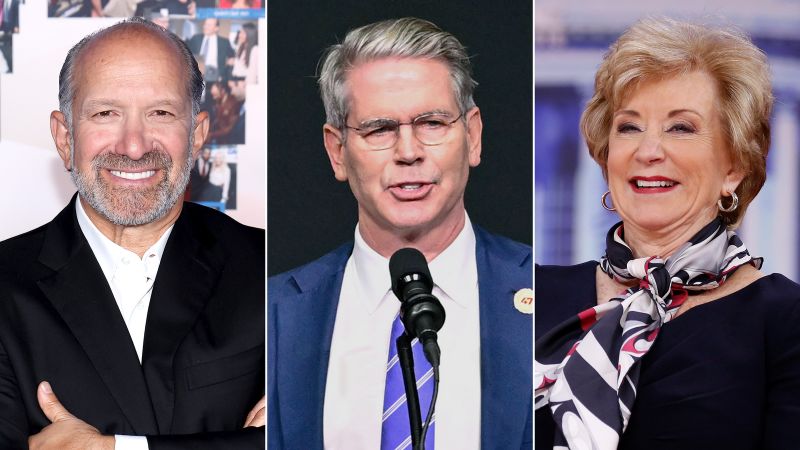
Trump’s wealthy Cabinet picks will have to divest. But the rules make that a potentially lucrative prospect
CNN
Moving from a Wall Street corner office to a DC corner office comes at a cost: For a top financier who’s been asked to run the Treasury Department, say, you could be looking at a pay cut of tens of millions of dollars a year. On top of that, you’d have to offload any stock holdings that create a potential conflict of interest with the new gig.
Moving from a Wall Street corner office to a DC corner office comes at a cost: For a top financier who’s been asked to run the Treasury Department, say, you could be looking at a pay cut of tens of millions of dollars a year. On top of that, you’d have to offload any stock holdings that create a potential conflict of interest with the new gig. But cry not for the titans of industry who deign to take on government work. The way the rules are set up — largely unchanged from their Nixon-era origins — ensure that the many one-percenters who are vying to join the next administration are going to be just fine if confirmed, and possibly even richer than when they came in. See here: President-elect Donald Trump is assembling what is likely to be the wealthiest Cabinet in US history, with at least two known billionaires — financier Howard Lutnick as Commerce secretary and former pro-wrestling executive Linda McMahon as Education secretary — and many others who are multimillionaires with complex financial holdings. Federal ethics laws require those senior government jobs in the Cabinet and beyond to divest their individual stock holdings, lest anyone be tempted to abuse their position of power to juice their personal investments. “The rule of thumb is, recuse or divest,” said Jordan Libowitz, vice president for communications at Citizens for Responsibility and Ethics in Washington, or CREW. “The more complex your assets are, the harder it can be to divest from them. But just because you’re outrageously rich with complicated assets doesn’t mean you get a special set of rules.” The complication arises in part because the Nixon-era conflict of interest laws were created decades before the rise of private equity and other alternative investments that now make up sizable chunks of some portfolios.


Gerald Rodriguez, the general manager of an NPR affiliate in rural Colorado, expected federal funding for public media to shrink. He didn’t expect it to disappear almost overnight.

The much-touted new tax breaks for tips, overtime, seniors and car loan interest have a lot of income tax filers expecting a big bump in their refunds this year – or a big cut in their tax bill.

Looking out his shop window, across the street, just to the right, Paloma Clothing co-owner Mike Roach sees one of Portland, Oregon’s, most expensive gas stations.

Oil and liquefied natural gas tankers moving through the Strait of Hormuz carry around 20% of the world’s supply. But for countries on the Persian Gulf, the waterway is more than just an energy route – it’s a lifeline for more than 100 million people.

A California jury has largely sided with Twitter shareholders who accused billionaire Elon Musk of defrauding them by intentionally driving down the social media company’s stock ahead of his $44 billion acquisition in 2022.

The war with Iran is disrupting global oil flows, damaging energy infrastructure and raising fears of prolonged conflict. But gold, usually considered a safe haven during periods of economic uncertainty, has slumped.

US stocks and bonds fell, oil prices rose and gold had its worst week in four decades as the Iran war continues to ripple through financial markets.

The White House on Friday released its long-awaited national artificial intelligence legislative framework, a move to prevent states from enacting their own laws and enforce the Trump administration’s light-touch approach to AI regulation.

“Today is a difficult day,” CBS executives wrote to staff, explaining the cuts as a tough but necessary reallocation of newsroom resources.

President Donald Trump has repeatedly promised that Americans will get larger tax refunds this year thanks to his “big, beautiful bill.”

President Donald Trump has repeatedly promised that Americans will get larger tax refunds this year thanks to his “big, beautiful bill.”

Oil prices edged lower on Friday after a tumultuous day that saw the international benchmark surge above $119 a barrel as the Middle East conflict deepened energy supply fears.

The war in Iran has delivered what economists call a “black swan” event — an unforeseen shock so destructive, no one is immune to it.