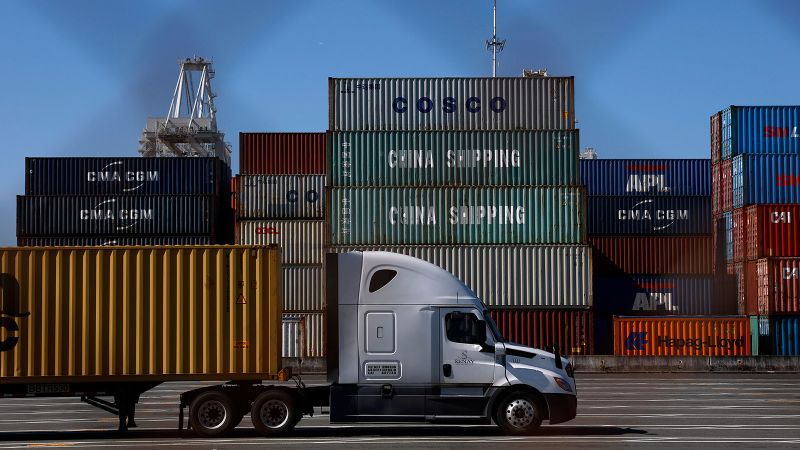
Trump’s tariffs are under threat, but ports aren’t seeing a big rebound yet. That’s bad news for prices
CNN
US ports have been seeing pandemic-level declines in imports, so good news on tariffs was just what port officials were hoping for.
US ports have been seeing pandemic-level declines in imports, so good news on tariffs was just what port officials were hoping for. For awhile on Wednesday, it looked like retailers and ports got exactly that, with a court blocking many of President Donald Trump’s tariffs. But a federal appeals court on Thursday quickly paused that ruling. That kind of whiplash underscores why, even when there’s news of tariffs easing, goods don’t start flowing into US ports right away. And that could mean fewer goods on store shelves in the coming months, cutting into available choices and raising prices for everyday Americans. “I think there was an expectation that all of a sudden everything would start coming in again. I don’t think you’ve seen that huge rush to bring everything in again because I think folks are still being cautious on how this is going to proceed,” said Jonathan Gold, vice president of supply chain and customs policy at the National Retail Federation. Even after Trump lowered tariffs on China from 145% to 30% earlier this month, America’s largest ports have yet to see a rebound. The Port of Los Angeles reported a 30% import decline during the final week of May compared to last year. The Northwest Seaport Alliance, which represents the ports of Seattle and Tacoma, says imports also dropped by 30% from the last week in April to the first week in May, and volume is significantly lower compared to last year. Then Wednesday evening’s decision by a US court in Manhattan injected new chaos into the trade picture. The ruling blocked a swath of Trump’s tariffs, including a 10% tariff on most imports and the higher duties on China, Mexico and Canada. The White House filed an appeal, and by Thursday afternoon a federal appeals court restored the tariffs until both sides provide written arguments by early next month.


Gerald Rodriguez, the general manager of an NPR affiliate in rural Colorado, expected federal funding for public media to shrink. He didn’t expect it to disappear almost overnight.

The much-touted new tax breaks for tips, overtime, seniors and car loan interest have a lot of income tax filers expecting a big bump in their refunds this year – or a big cut in their tax bill.

Looking out his shop window, across the street, just to the right, Paloma Clothing co-owner Mike Roach sees one of Portland, Oregon’s, most expensive gas stations.

Oil and liquefied natural gas tankers moving through the Strait of Hormuz carry around 20% of the world’s supply. But for countries on the Persian Gulf, the waterway is more than just an energy route – it’s a lifeline for more than 100 million people.

A California jury has largely sided with Twitter shareholders who accused billionaire Elon Musk of defrauding them by intentionally driving down the social media company’s stock ahead of his $44 billion acquisition in 2022.

The war with Iran is disrupting global oil flows, damaging energy infrastructure and raising fears of prolonged conflict. But gold, usually considered a safe haven during periods of economic uncertainty, has slumped.

US stocks and bonds fell, oil prices rose and gold had its worst week in four decades as the Iran war continues to ripple through financial markets.

The White House on Friday released its long-awaited national artificial intelligence legislative framework, a move to prevent states from enacting their own laws and enforce the Trump administration’s light-touch approach to AI regulation.

“Today is a difficult day,” CBS executives wrote to staff, explaining the cuts as a tough but necessary reallocation of newsroom resources.

President Donald Trump has repeatedly promised that Americans will get larger tax refunds this year thanks to his “big, beautiful bill.”

President Donald Trump has repeatedly promised that Americans will get larger tax refunds this year thanks to his “big, beautiful bill.”

Oil prices edged lower on Friday after a tumultuous day that saw the international benchmark surge above $119 a barrel as the Middle East conflict deepened energy supply fears.

The war in Iran has delivered what economists call a “black swan” event — an unforeseen shock so destructive, no one is immune to it.